Capriccio with Roman Ruins, Sculptures and a Port
1650
Oil on canvas.
115.6 x 88.7 cm
Museo Nacional Thyssen-Bornemisza, Madrid
Inv. no.
62
(1984.2
)
Room 20
Level 2
Permanent Collection
Bartholomeus Breenbergh was a member of the first generation of artists to be known as “Italianate”. He may have arrived in Rome towards the end of 1619 where according to his own account he spent seven years with the Flemish painter Paul Brill. Breenbergh’s early works reveal the influence of that artist as well as striking parallels with the style of Cornelis van Poelenburgh. Numerous drawings of ruins, buildings and views of the Roman campagna survive from this period. Breenbergh signed many of these detailed and finely executed drawings, considering them to be finished works in their own right although he also used them as starting points for later paintings.
The artist is documented in Amsterdam in 1633 and it is thought that he left Italy around 1629. The 1630s was the most productive decade of his career, while his output notably diminished from the 1640s. The present panel, dated 1650, is from a period when few works by Breenbergh are known and is thus an important example of his style at this date.
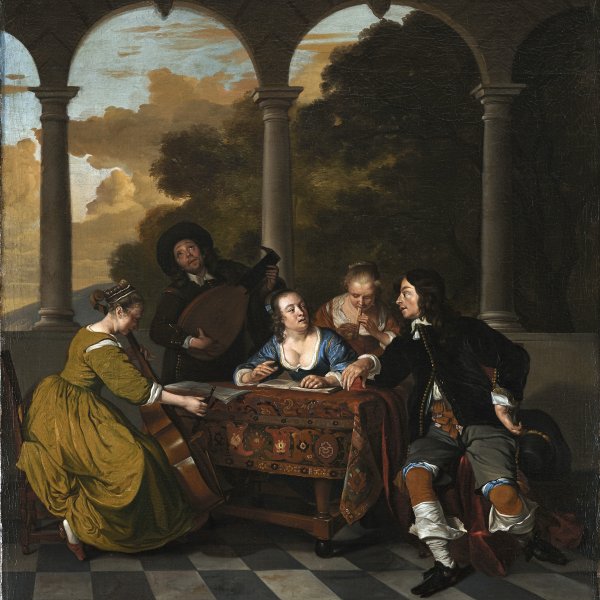
In this imaginary view painted in Holland on the basis of drawings made in Italy, Breenbergh locates a solid group of ruins on the left and a port on the right. A fragment from the entablature of the temple of Isis and Serapis is used, together with the San Paolo gateway, to create a diagonal line that recedes at a pronounced angle into the pictorial space. The foreground also includes classical references scattered on the ground such as the drum of a column, fragments of a frieze and the realistic relief of the ox with the sacrificial sash on its back. Breenbergh also included a Renaissance sculpture in the form of Michelangelo’s Moses. The composition combines real with invented elements, together offering a fantastical view of Rome. Breenbergh also introduced figures in the form of a seated artist sketching in front of the famous Moses, and a reclining figure asleep underneath it whose vivid crimson cloak is the only bright note in the painting’s tonality. These figures have been read in a moral key with the artist representing diligence and the sleeping figure, indolence.
The composition of the present canvas has been related to a drawing by the artist in the Rijksmuseum, Amsterdam, of the Porta di San Paolo in Rome. Reference has also been made to two further drawings by Breenbergh in which he used the same fragment of the entablature of the temple of Isis and Serapis seen from the same angle. These are: Christ with the Centurion in the Kunsthalle, Karlsruhe, of 1637, and Landscape with Cimon and Iphigenia of 1636 in the Musée Boucher, Perthes, Abbeville.
Mar Borobia
The artist is documented in Amsterdam in 1633 and it is thought that he left Italy around 1629. The 1630s was the most productive decade of his career, while his output notably diminished from the 1640s. The present panel, dated 1650, is from a period when few works by Breenbergh are known and is thus an important example of his style at this date.
In this imaginary view painted in Holland on the basis of drawings made in Italy, Breenbergh locates a solid group of ruins on the left and a port on the right. A fragment from the entablature of the temple of Isis and Serapis is used, together with the San Paolo gateway, to create a diagonal line that recedes at a pronounced angle into the pictorial space. The foreground also includes classical references scattered on the ground such as the drum of a column, fragments of a frieze and the realistic relief of the ox with the sacrificial sash on its back. Breenbergh also included a Renaissance sculpture in the form of Michelangelo’s Moses. The composition combines real with invented elements, together offering a fantastical view of Rome. Breenbergh also introduced figures in the form of a seated artist sketching in front of the famous Moses, and a reclining figure asleep underneath it whose vivid crimson cloak is the only bright note in the painting’s tonality. These figures have been read in a moral key with the artist representing diligence and the sleeping figure, indolence.
The composition of the present canvas has been related to a drawing by the artist in the Rijksmuseum, Amsterdam, of the Porta di San Paolo in Rome. Reference has also been made to two further drawings by Breenbergh in which he used the same fragment of the entablature of the temple of Isis and Serapis seen from the same angle. These are: Christ with the Centurion in the Kunsthalle, Karlsruhe, of 1637, and Landscape with Cimon and Iphigenia of 1636 in the Musée Boucher, Perthes, Abbeville.
Mar Borobia