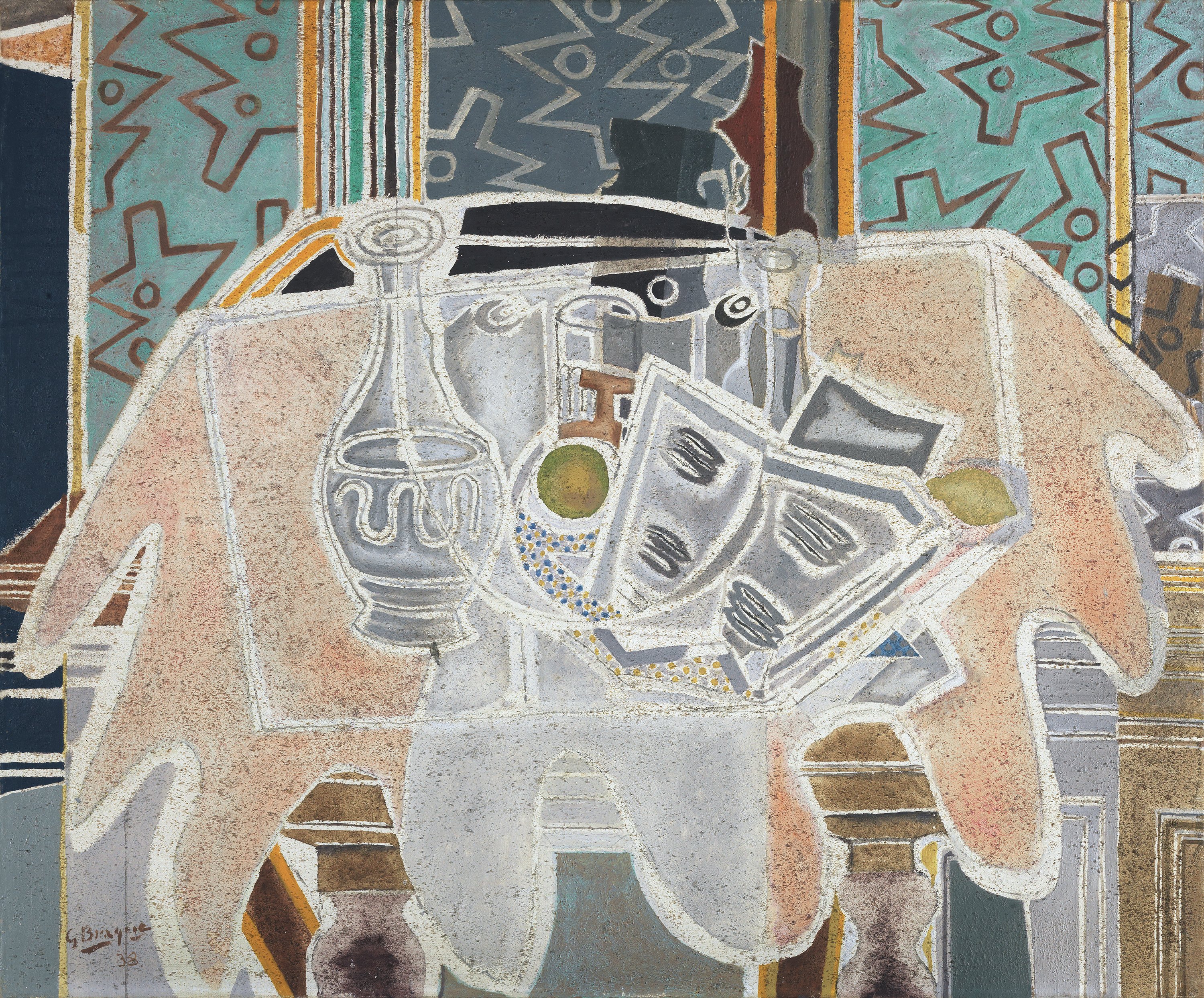
The Pink Tablecloth
1938
Oil and sand on canvas.
87.5 x 106 cm
Museo Nacional Thyssen-Bornemisza, Madrid
Inv. no.
480
(1979.61
)
Room 41
Level 1
Permanent Collection
Braque’s artistic career was interrupted when he was called up to serve in the First World War, and this experience distanced him from Picasso and dampened his avant-garde spirit. The prevailing traditionalism of the interwar period, coupled with the serenity maturity brought him, awakened a classical spirit in Braque, who, without abandoning the language of Cubism, to which he would always remain loyal, produced a set of still lifes characterised by undulating rhythms and contrasting textures. This classicism was heralded by a text he wrote in 1917: “Nobility is born from a restrained emotion. Emotion should not be translated into an agitated tremor: nor can it be added to or imitated. It is the seed, the work is the flower. I love the rule which corrects the emotion.”
The Pink Tablecloth in the Museo Thyssen-Bornemisza belongs to a series of still lifes painted in the 1930s and shown at Paul Rosenberg’s Paris gallery in November 1938, in which Braque achieves a monumentality characteristic of traditional painting. The objects that make up the scene — which are less fragmented than in his early Cubist works and some of them even depicted in an almost naturalistic way — are arranged on a table covered with an undulating pink tablecloth. Its position in parallel to the picture plane accentuates the two-dimensionality of the composition. The background arranged into vertical strips, the geometrical pattern of the wallpaper and the rectangular mouldings of the wooden wainscot create a play of angular forms that contrast with the soft, sinuous lines of the tablecloth. Although Braque had been painting still-life scenes since recovering from the wounds received in the First World War, in these still lifes dating from the end of the 1930s he began to introduce references to the room in which the composition was located. He thus developed a new interest in depicting interiors, which was announced in the Ateliers of the 1940s.
Braque’s obsession with the tactile and sensuous aspects of painting and the relationship between colour and matter, which he considered indissoluble, makes colour inseparable from its texture. He himself spoke of “the hankering I have always had to touch things and not merely to see them.” This prompted him to prepare his own canvases and make his own colours by mixing various materials with oil to achieve a sheen, or a dry or rough effect, as required. On occasions he imitates the properties of materials in trompe l’oeil fashion, returning to the techniques of the trade of painter-decorator he learned from his father during his youth.
In The Pink Tablecloth Braque scatters sand over a white ground layer and applies the colours over this rough surface. The artist thus achieves a faithful imitation of the textures of the various objects — the background wallpaper, the wood of the wainscot and the tablecloth — and a lifelike rendering of the properties of things, conveying a sensation of closeness to reality that provides a counterweight to the more intellectualised interpretation of the Cubist synthesising of forms.
Christopher Green compares the present painting with Still Life with Fruits and Stringed Instrument, in which the same type of zigzag background pattern is repeated. By introducing this decorative motif, Braque not only makes a reference to the wallpaper which had played such a prominent role in the Cubist invention of papier collé, but furthermore creates an ironic play on the perhaps excessive influence of Cubism in decoration following the international exhibition of the decorative arts in 1925. The reproduction of this flat, jagged design is an ironic allusion to the paradox of how fashion had come to glorify motifs inspired by the artistic avant-garde revolution led by Braque himself.
The painting, which belonged to the family of Paul Rosenberg (1881‒1959) for decades, preserves its original stretcher bearing the label of Lucien Lefevre-Foinet (no. 5627), a foremost supplier of art materials, whose shop was located near the boulevard de Montparnasse in Paris.
Paloma Alarcó
The Pink Tablecloth in the Museo Thyssen-Bornemisza belongs to a series of still lifes painted in the 1930s and shown at Paul Rosenberg’s Paris gallery in November 1938, in which Braque achieves a monumentality characteristic of traditional painting. The objects that make up the scene — which are less fragmented than in his early Cubist works and some of them even depicted in an almost naturalistic way — are arranged on a table covered with an undulating pink tablecloth. Its position in parallel to the picture plane accentuates the two-dimensionality of the composition. The background arranged into vertical strips, the geometrical pattern of the wallpaper and the rectangular mouldings of the wooden wainscot create a play of angular forms that contrast with the soft, sinuous lines of the tablecloth. Although Braque had been painting still-life scenes since recovering from the wounds received in the First World War, in these still lifes dating from the end of the 1930s he began to introduce references to the room in which the composition was located. He thus developed a new interest in depicting interiors, which was announced in the Ateliers of the 1940s.
Braque’s obsession with the tactile and sensuous aspects of painting and the relationship between colour and matter, which he considered indissoluble, makes colour inseparable from its texture. He himself spoke of “the hankering I have always had to touch things and not merely to see them.” This prompted him to prepare his own canvases and make his own colours by mixing various materials with oil to achieve a sheen, or a dry or rough effect, as required. On occasions he imitates the properties of materials in trompe l’oeil fashion, returning to the techniques of the trade of painter-decorator he learned from his father during his youth.
In The Pink Tablecloth Braque scatters sand over a white ground layer and applies the colours over this rough surface. The artist thus achieves a faithful imitation of the textures of the various objects — the background wallpaper, the wood of the wainscot and the tablecloth — and a lifelike rendering of the properties of things, conveying a sensation of closeness to reality that provides a counterweight to the more intellectualised interpretation of the Cubist synthesising of forms.
Christopher Green compares the present painting with Still Life with Fruits and Stringed Instrument, in which the same type of zigzag background pattern is repeated. By introducing this decorative motif, Braque not only makes a reference to the wallpaper which had played such a prominent role in the Cubist invention of papier collé, but furthermore creates an ironic play on the perhaps excessive influence of Cubism in decoration following the international exhibition of the decorative arts in 1925. The reproduction of this flat, jagged design is an ironic allusion to the paradox of how fashion had come to glorify motifs inspired by the artistic avant-garde revolution led by Braque himself.
The painting, which belonged to the family of Paul Rosenberg (1881‒1959) for decades, preserves its original stretcher bearing the label of Lucien Lefevre-Foinet (no. 5627), a foremost supplier of art materials, whose shop was located near the boulevard de Montparnasse in Paris.
Paloma Alarcó