Guercino and his Biblical Heroines
Giovanni Francesco Barbieri (Cento, 1591–Bologna, 1666), better known as ‘Il Guercino’, was one of the most prominent Baroque painters in northern Italy. This room brings together a select group of works focused on the representation of women in his pictures on religious themes.
Anonymous women such as the Samaritan and the adulteress, together with others with names – Salome, Susannah, Delilah and Hagar – are the subjects of paintings depicting highly popular themes in Italian Baroque art which Guercino explored throughout his career. This exhibition provides an opportunity to study them in relation to the evolution of the artist’s style of painting. The earliest works, such as the canvas of Susannah and the Elders, belong to a type inspired by the contemplation of nature. These compositions are energetic with intense chiaroscuro, thickly applied colours and figures with huge plasticity, whose spontaneous gestures engage the spectator.
Following a trip to Rome in 1621, his painting evolved towards a classicising style which later became consolidated as a result of his permanent move to Bologna in 1642 and the influence of the work of Guido Reni. Abraham Casting out Hagar and Ishmael attests to this more idealised language, less free in its approach to biblical passages. His compositions became more balanced, his colours more luminous, and the characters expressed themselves through codified gestures in what has been called the ‘poetics of the emotions,’ a characteristic of Bolognese Seicento painting.
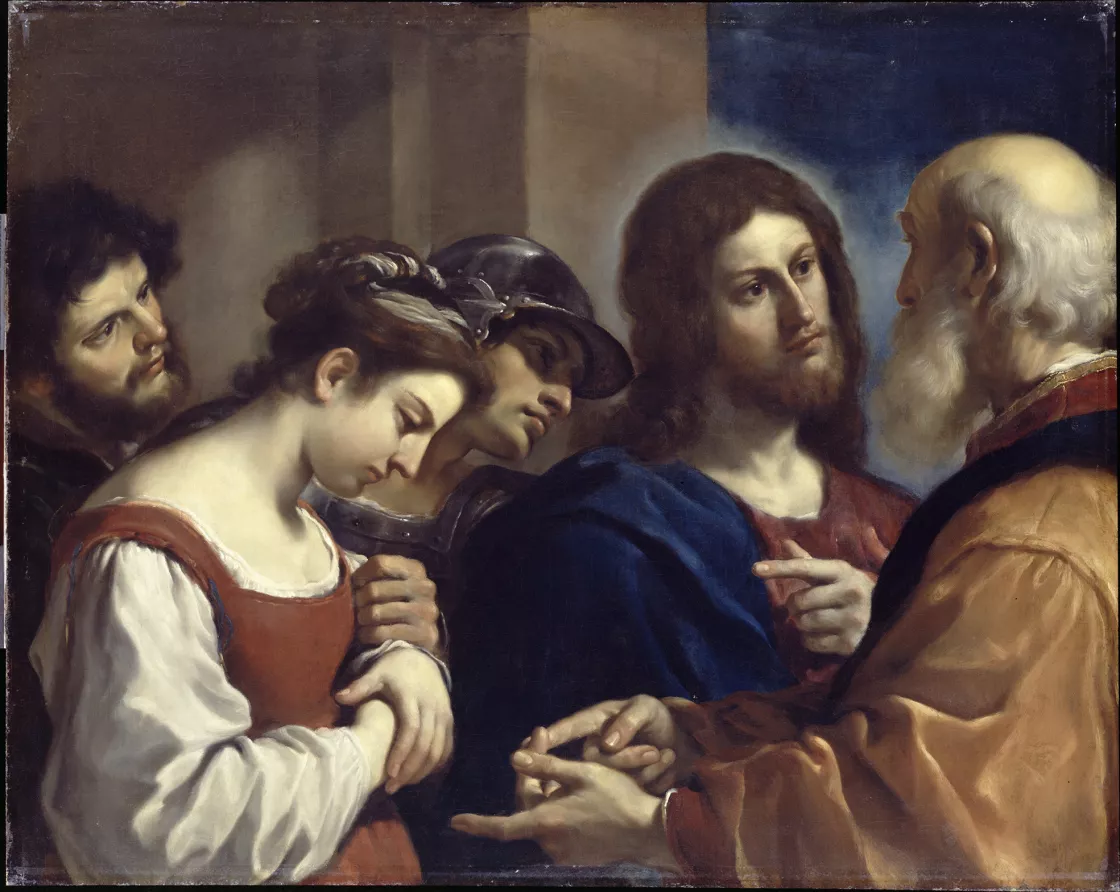
Guercino (Giovanni Francesco Barbieri)
The Woman taken in Adultery
c. 1621
Oil on canvas. 98.2 x 122.7 cm
London, Dulwich Picture Gallery
© Dulwich Picture Gallery, London
This early work, painted before or possibly immediately after a trip to Rome, contains all the characteristic elements of Guercino’s early style, such as his storytelling skills and ability to bring us closer to the characters through his handling of space and gestures. Crammed into a claustrophobic composition, the half-length figures almost completely fill the picture space. With his clever treatment of light and shadow, Guercino conveys the tense dialogue in which Jesus responds to the Pharisee’s gesticulations with a single gesture of his finger. The fragility of the woman beside them with her head bowed and engrossed in her thoughts, contrasting with the force with which the soldier grabs her by the arm, arouses the viewer’s compassion. The scene tells of the miracle of forgiveness referred to in the Gospel of John (John 8:1–11): ‘Whichever of you is free from sin shall cast the first stone at her.’
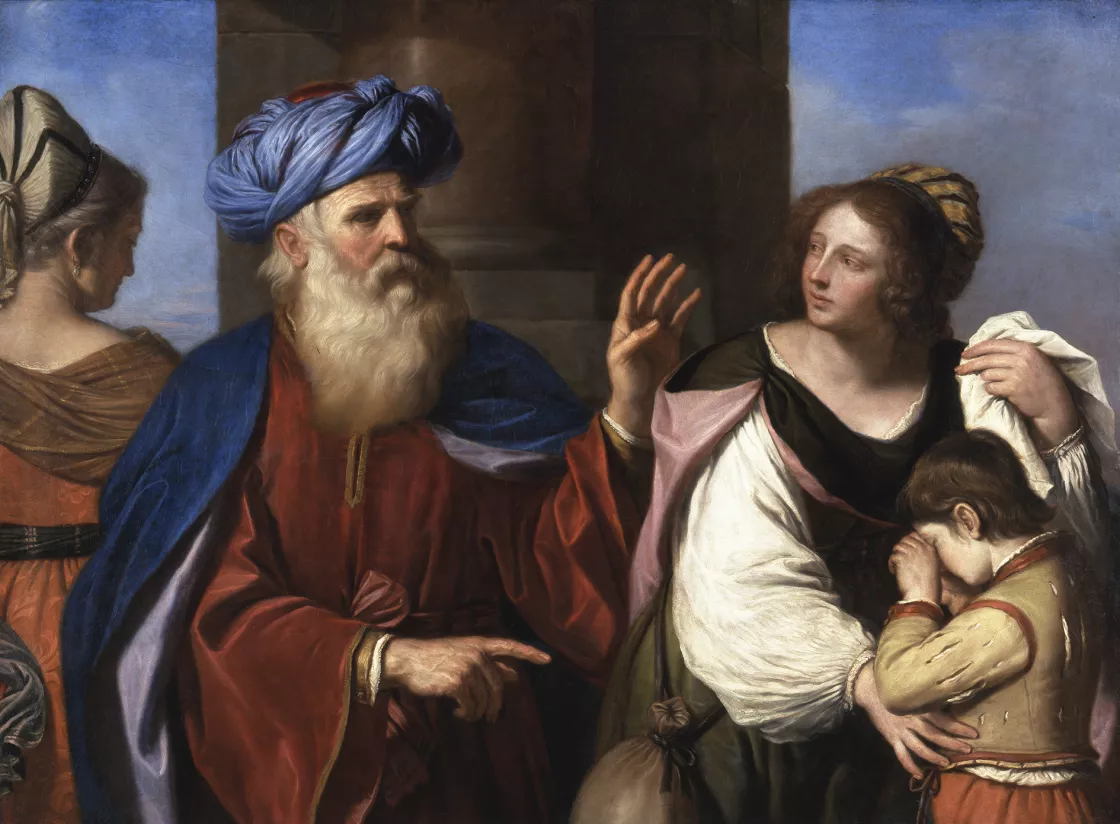
Guercino (Giovanni Francesco Barbieri)
Abraham Casting out Hagar and Ishmael
1657
Oil on canvas. 115 x 152 cm
Milano, Pinacoteca di Brera
© Pinacoteca di Brera, Milano - MiC
This canvas was commissioned by the community of Cento as a gift for Lorenzo Imperiali, cardinal legate of Ferrara.
The scene shown here depicts the moment when Abraham, patriarch of Israel, urged on by his wife Sarah, expels Hagar and their son Ishmael from his home (Genesis 16:21). This masterpiece is Guercino’s only surviving painting on this biblical theme. It is a magnificent example of the highly theatrical pictures typical of the artist’s mature period, characterised by a complex study of the gestures with which the figures act out a melodrama. Abraham’s hands indicate distancing, while Hagar, with tears in her eyes, protects the child with her arms. The representation of emotions is the central theme of this canvas. Guercino adopts a stage-like, horizontal compositional arrangement with half-length figures and a palette of very vibrant colours, notably the costly lapis lazuli blue pigment, which was very common in his work during this period. His attention to detail in the rendering of the exquisite fabrics recalls theatrical costumes.
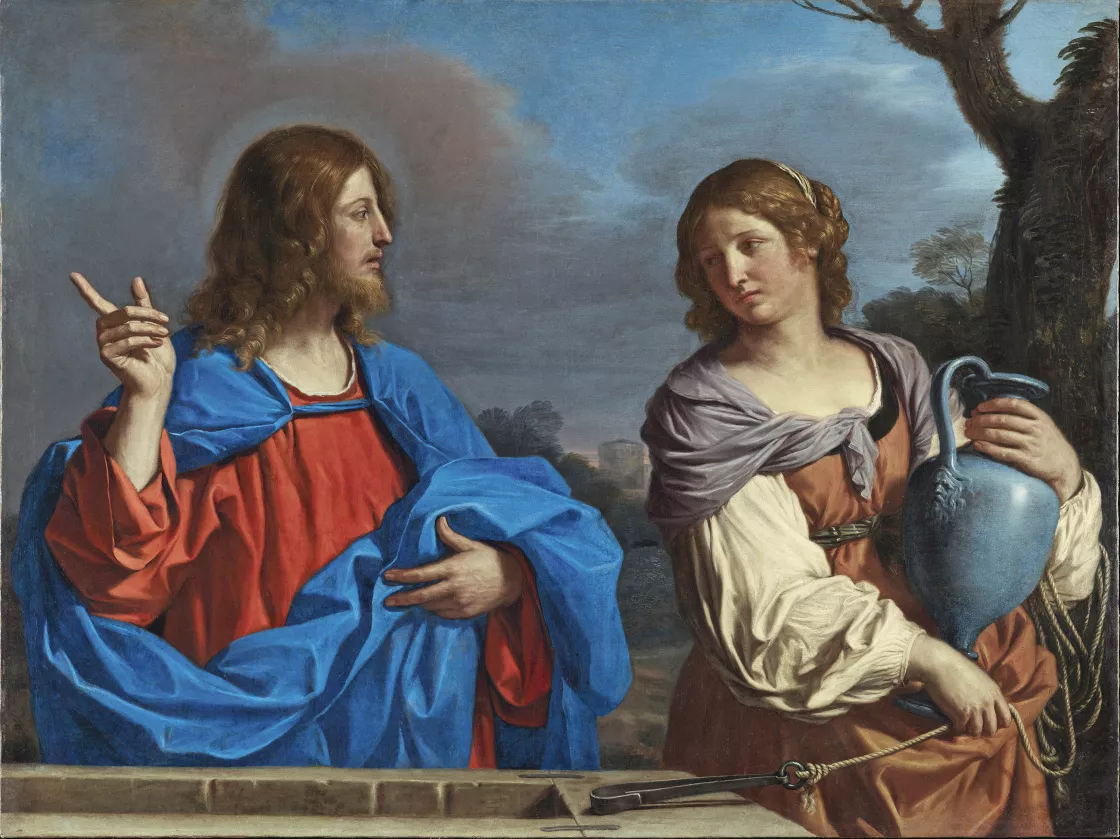
Guercino (Giovanni Francesco Barbieri)
Christ and the Woman of Samaria at the Well
c. 1640-1641
Oil on canvas. 116 x 156 cm
Madrid, Museo Nacional Thyssen-Bornemisza
According to the surviving accounting records of Guercino's workshop, this would have been the first painting on this subject. There are two other existing versions, one in the National Gallery of Canada in Ottawa and another in the collection of the Banco San Geminiano e San Prospero in Modena.
This work, painted for Giuseppe Baroni of Lucca, a well-known collector of the period, illustrates the New Testament passage in which Jesus stops to rest at a well on his way to Galilee and asks a woman from Samaria for a drink, striking up a conversation with her about the purifying power of the water of eternal life (John 4:1–26). During the artist’s mature period, the naturalistic style of previous decades gave way to a classicising language and brighter colours. Guercino’s depiction of the scene is faithful to the biblical texts, without the narrative liberties he took in earlier works. In this canvas he opts for a very balanced composition with a realistic portrayal of the fabrics, the objects and the background landscape against which the characters express themselves through codified gazes and gestures that are in no way directed at the viewer.
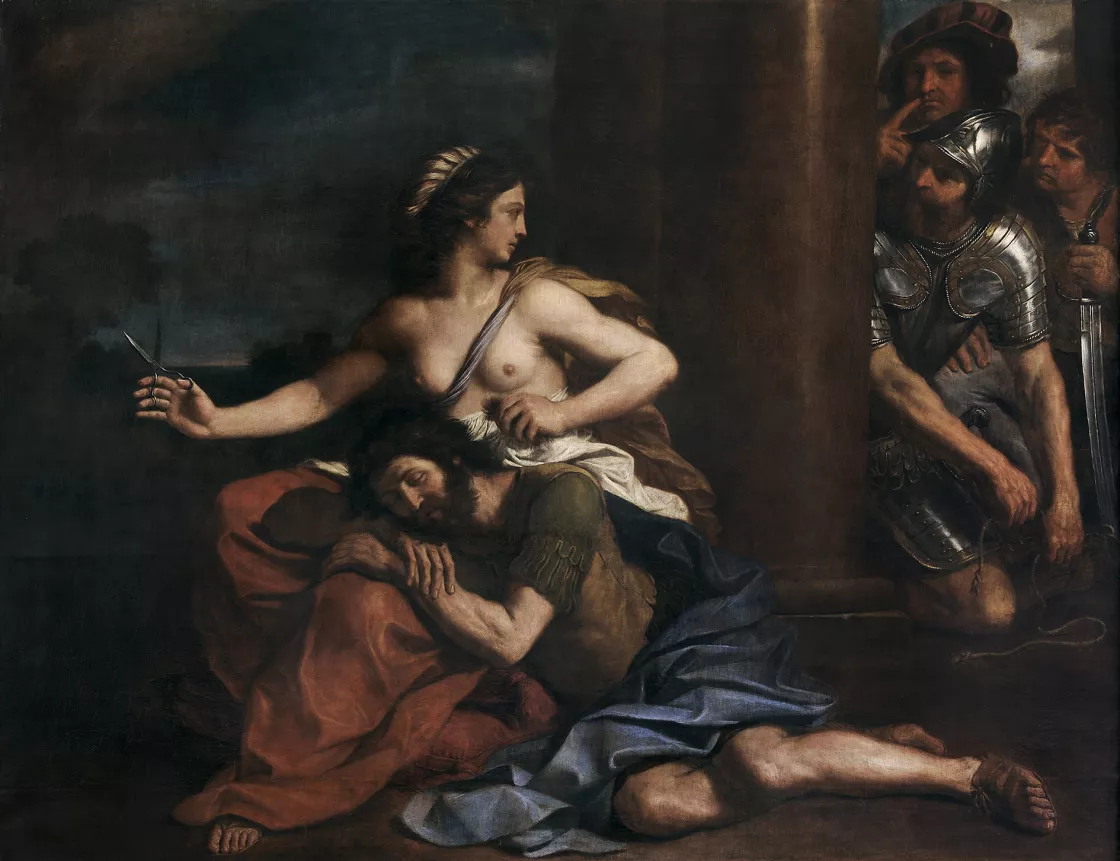
Guercino (Giovanni Francesco Barbieri)
Samson and Delilah
1654
Oil on canvas. 176 x 223 cm
Strasbourg, Musée des Beaux-Arts
© Musées de la ville de Strasbourg, M. Bertola
This painting was commissioned by Charles II Gonzaga-Nevers, Duke of Mantua, along with the canvas of Lot and his Daughters now in the Louvre in Paris.
It dates from Guercino’s mature period and depicts the moment when Delilah, knowing that Samson's strength lies in his hair, prepares to cut off his locks. The passage from the Old Testament (Book of Judges 16:4–21) is the inspiration for this scene, in which the artist takes certain liberties, such as having Delilah herself, rather than a soldier, perform the action. Contrary to the interpretations of Delilah as a new Eve who leads humankind to perdition, Guercino paints her as a semi-naked warrior with a classical profile fulfilling her mission to save her people. The composition, arranged as a stage set, shows the characters playing their roles in a linear sequence in which Delilah’s action is followed by the capture of Samson by the Philistines hidden behind the column.
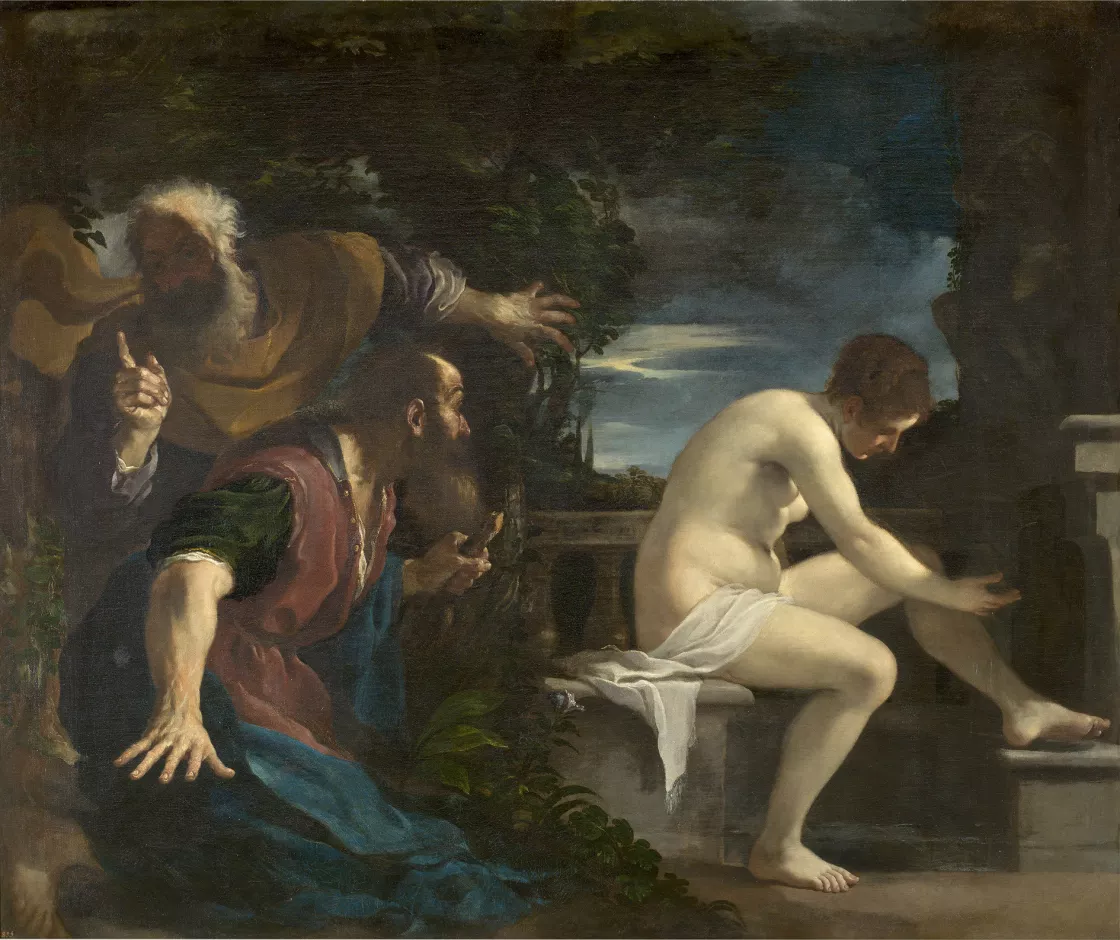
Guercino (Giovanni Francesco Barbieri)
Susannah and the Elders
1617
Oil on canvas. 176 x 208 cm
Madrid, Museo Nacional del Prado
© Archivo Fotográfico. Museo del Prado. Madrid
Between 1617 and 1618 Guercino produced three works for Cardinal Alessandro Ludovisi, archbishop of Bologna and the future Pope Gregory XV: The Return of the Prodigal Son (Galleria Sabauda, Turin), Lot and His Daughters (monastery of El Escorial) and this Susannah and the Elders.
The canvas is a sublime example of the naturalism of his early period and illustrates a moment of great tension recounted in the Old Testament (Book of Daniel, 13). The elderly judges leer at Susanna, who is taking refuge from the heat by bathing in a fountain at her home. Guercino has accentuated her figure by portraying her as a classical nude enveloped in a pearly light that contrasts with the darkness of an almost nocturnal sky and the dense vegetation in earthy, leaden tones. The skilful arrangement of the composition turns us into voyeurs of this scene of harassment, expressed through the interplay of the judges’ gestures. They draw the viewer into the scene and direct our gaze towards the figure of Susannah, whose innocence is symbolised by the lilies and the white cloth covering part of her body.
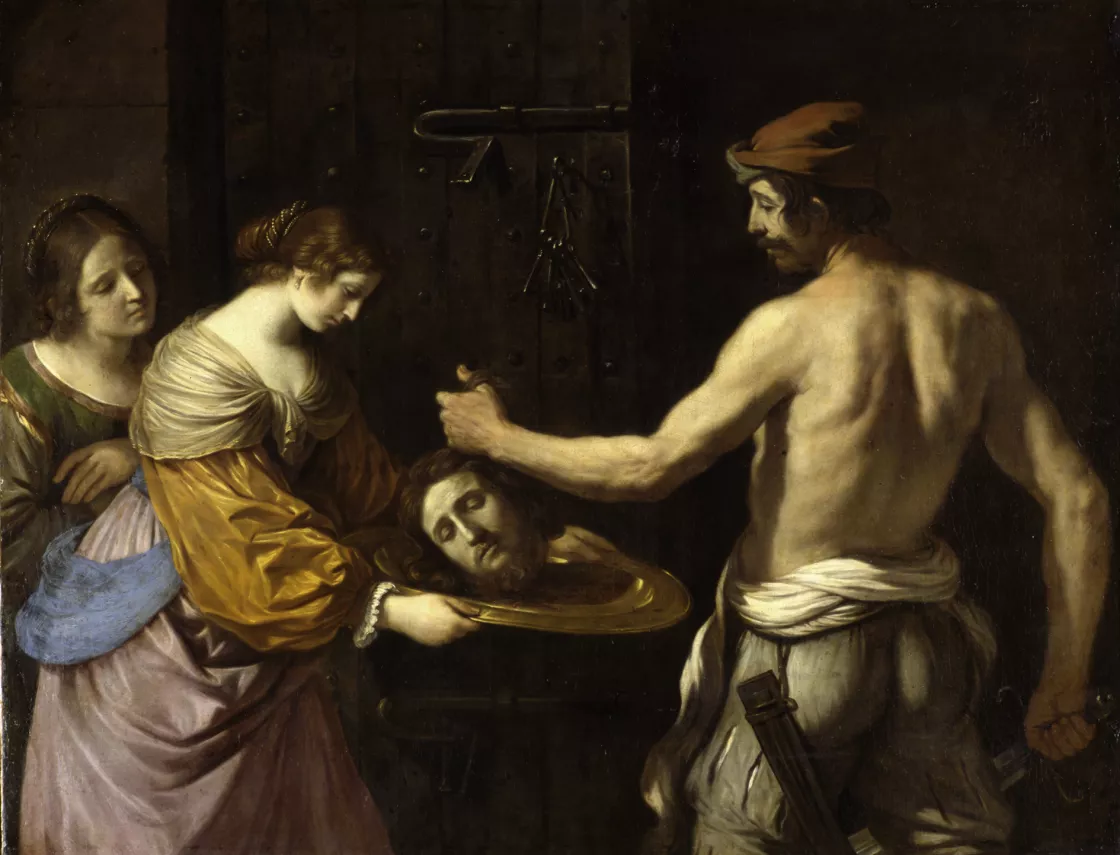
Guercino (Giovanni Francesco Barbieri)
Salome Receiving the Head of St. John the Baptist
1637
Oil on canvas. 139 x 175 cm
Musée du Louvre, en dépôt au musée des Beaux-Arts de Rennes depuis 1955
© Musée du Louvre, en dépot au musée des Beaux-Arts de Rennes depuis 1955
Art dealer Lodovico Mastri, a friend of Guercino’s, must have been the original patron of this work, which was later given to Francis I, Duke of Modena, who had expressed to Barbieri his wish to acquire it.
The scene, inspired by a passage from the New Testament (Matthew 14:3–11 or Mark 6:17–29), illustrates the moment when the executioner places Saint John the Baptist’s head on the platter held by Salome before handing it to her mother Herodias. The artist takes a novel approach to the subject, depicting Salome alongside a female figure who is not mentioned in the biblical account. Compared to his early works, Guercino has given more space to this composition, in which the figures are shrouded in a less intense chiaroscuro and the palette is lighter. A tense calm envelops a repentant Salome far removed from the personification of sin attributed to her in other paintings on the same subject.
The Royal Collection at Windsor Castle contains some preparatory drawings of the female figures related to this canvas.