Thyssen-Bornemisza Museo Nacional Search Ir al contenido principal

Navegación superior (EN)

About Us Support Friends Shop Tickets
Español
Visit Collection Exhibitions Activities Education Search
  • Visit
  • Collection
  • Exhibitions
  • Activities
  • Education

Thyssen - Navegación superior (EN)

About Us Support Friends Shop Tickets
Español
©
Salvador Dalí, Fundación Gala-Salvador Dalí / VEGAP, Madrid
Salvador Dalí

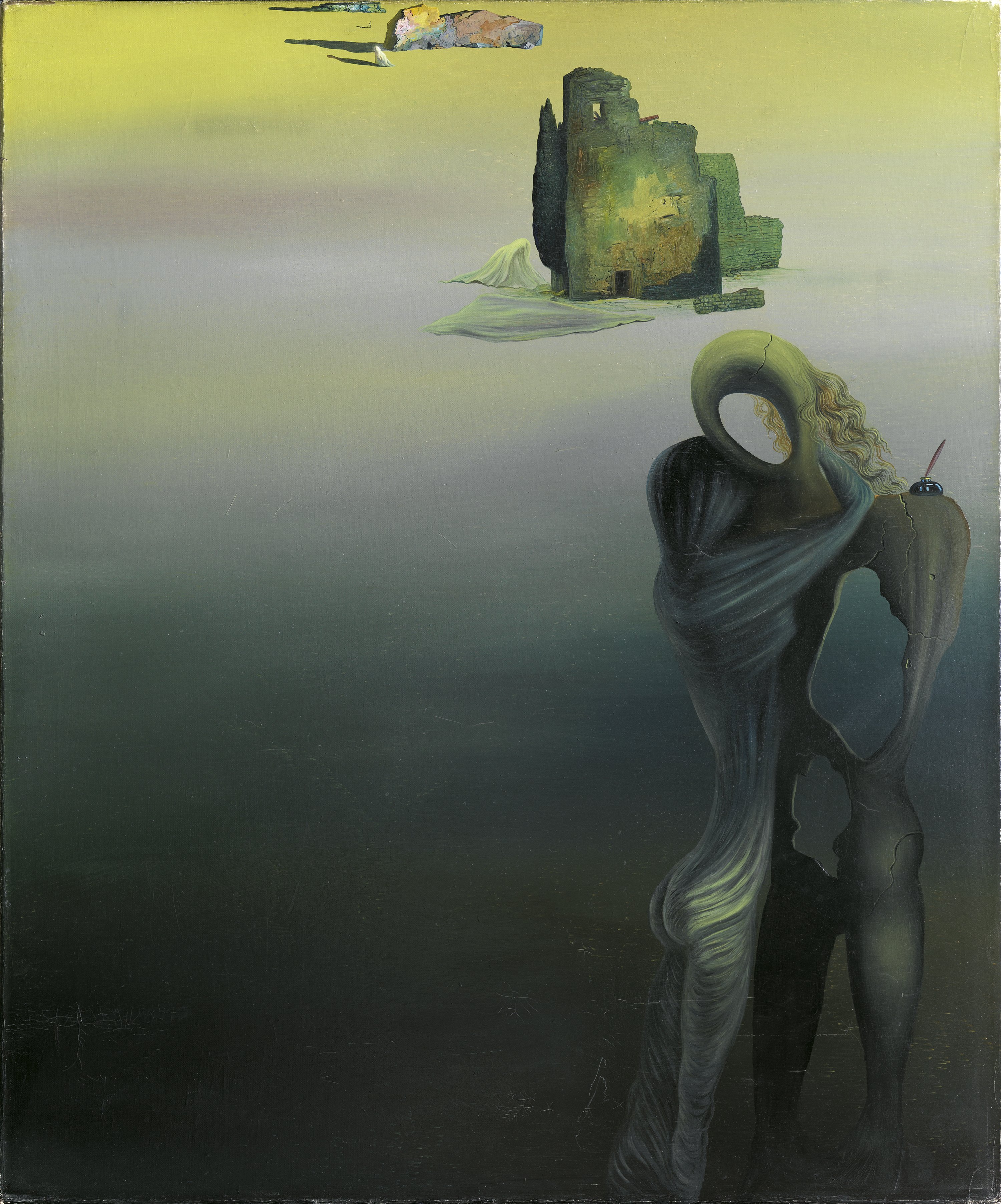
Gradiva rediscovers the Anthropomorphic Ruins (Retrospective Fantasy)

1932
Oil on canvas.
65 x 54 cm
Museo Nacional Thyssen-Bornemisza, Madrid
Inv. no.
511
(
1975.39
)
Temporary Exhibition Rooms
  • Level 2 Permanent Collection
  • Level 1 Permanent Collection
  • Level 0 Carmen Thyssen Collection and Temporary exhibition rooms
  • Level -1 Temporary exhibition rooms, Conference room and EducaThyssen Studio
Level 2
Permanent Collection
1 2 3 4 5 6 7 8 9 10 11 12 14 13 15 16 17 18 22 19 20 21 23 24 25 26 27 28 29 Recommended start of the visitClassical rooms
1 14th Century. Early Italian Painting 2 15th Century. German and Spanish Painting 3 15th Century. Early Netherlandish Painting 4 15th Century. Italian Painting 5 15th and 16th Centuries. Renaissance Portraiture 6 16th Century. Villahermosa Gallery 7 16th Century. Italian Painting 8 15th and 16th Centuries. German Painting 9 15th and 16th Centuries. German Painting 10 16th Century. Netherlandish Painting 11 Tiziano, Tintoretto, Bassano and  El Greco 12 17th Century. Caravaggio and Baroque Painting 13 17th Century. Italian, French and Spanish Painting 14 17th Century. Italian, French and Spanish Painting 15 17th Century. Italian, French and Spanish Painting 16 18th Century. Italian Painting 17 18th Century. Italian Painting 18 18th Century. Italian Painting 19 Classical rooms 20 Classical rooms 21 Classical rooms 22 18th Century. Italian Painting 23 17th Century. Dutch Painting. Landscape 24 18th Century. French and English Painting 25 17th Century. Dutch Painting. Scenes of Daily Life and Interiors 26 17th Century. Dutch Painting. Landscape 27 17th Century. Dutch Painting. Portrait 28 17th Century. Dutch Painting. Landscape 29 19th Century. European Painting. Goya and Romanticism  
Level 1
Permanent Collection
30 31 32 33 34 35 36 37 38 39 40 41 42 43 44 45 46 47 48 49 50 51 52 Postpop rooms Rodin room
30 18th and 19th Centuries. Transatlantic Relations 31 19th Century. American Landscape and Environmental Awareness 32 19th Century. American Landscape and Urban Life 33 19th Century. The Impressionist Period 34 20th Century. Expressionist Landscapes 35 20th Century. Expressionist Portraits 36 20th Century. The Language of the Body 37 20th Century. Urban unrest 38 20th Century. Flowers 39 20th Century. Pioneers of abstraction 40 20th Century. Popular flavor 41 20th Century. The Cubist Tradition I 42 20th Century. The Cubist Tradition II 43 20th Century. Abstract Utopias 44 20th Century. Dada and Surrealism 45 20th Century. Interwar Realisms 46 20th Century. American Abstraction I 48 20th Century. Post-ward American Art 49 20th Century. Post-ward European Figurative Art 50 20th Century. Informalisms 51 20th Century. Homo Ludens 52 20th Century. Pop Art • Rodin room • Rooms Post-Pop
Level 0
Carmen Thyssen Collection and Temporary exhibition rooms
A B C D E F G H I J Hall Temporary exhibition rooms Access to Permanent Collection Entrance Access to Carmen Thyssen Collection Paseo del Prado Garden
A 17th and 18th Centuries. Old Masters B 19th Century. North American Landscape C 19th Century. French Naturalist Landscape D 19th Century. Impressionism E 19th Century. Monet and North American Impressionism F 19th Century. Gauguin and Postimpressionism G 19th and 20th Centuries. Neo Impressionism and its Wake H 20th Century. Early Avant-gardes I 20th Century. Between the Wars Painting. Cubism, Abstraction and Surrealism J 20th Century. North American Painting and Others • HALL • Jardín • Temporary exhibition rooms
Level -1
Temporary exhibition rooms, Conference room and EducaThyssen Studio
Temporary exhibition rooms Conference room EducaThyssen Studio
• Rooms Moneo
When Salvador Dalí settled in Paris in 1929, he came into contact with the Surrealist group led by André Breton. That summer he invited to Cadaqués the Surrealists René Magritte, Camille Goemans, Luis Buñuel and Paul Éluard and his wife Gala, with whom Dalí immediately fell in love and who became his muse for the rest of his life. Dalí’s main contribution to Surrealism was his “paranoiac-critical method, ” developed from 1930, according to which, on the basis of Freudian theories on dream interpretation, every image could be read doubly: “The way in which it has been possible to obtain a double image is clearly paranoiac, ” the artist explains. “By a double image is meant such a representation of an object that is also, without the slightest physical or anatomical change, the representation of another entirely different object, the second representation being equally devoid of any deformity or abnormality betraying arrangement.”

Gradiva Rediscovers the Anthropomorphic Ruins (Retrospective Fantasy) is generally dated to 1931, although, as Christopher Green has pointed out, since it was not included in the major exhibition of the artist’s work at the Pierre Collé gallery in Paris the following year, it should be ascribed to 1932, after the show. Gradiva had entered Dalí’s personal mythology in 1931, the year the French translation came out of Sigmund Freud’s Delusion and Dreams in Jensen’s Gradiva, written in 1907. Freud’s essay was an interpretation of the novella by Wilhelm Jensen and was published together with a French translation of the latter. Gradiva provided Freud with an archaeological metaphor for the analysis of repressed desire and immediately aroused the interest of the Surrealists, who regarded the novella as an expression of the power of dreams and desire over reality.

The main character in Jensen’s tale is a young archaeologist, Norbert Hanold, who is obsessed by the figure of a tunic-clad woman, Gradiva, he had seen in a classical relief. The young woman appears to him in dreams when Vesuvius is about to erupt in Pompeii, and when he visits the ruins of the ancient Italian town the same phantasmagorical figure appears to him on three occasions. At first he believes her to be the incarnation of Gradiva, but he later realizes that she is his childhood love Zoe Bertgang, who immediately becomes his “Gradiva rediviva.”

The Surrealists made Gradiva their heroine and in Dalí’s case it was Gala who had the same curative effect and thus became his Gala-Gradiva. The work in the Thyssen-Bornemisza collection features two figures locked in an embrace among the ruins of the ghostly, deserted landscape; one appears to have been converted into a rock. William Jeffett interprets them as two representations of Gradiva, one the real Gradiva, the other that which is buried in the memories of the young Hanold — or, in other words, two representations of Gala-Gradiva buried in the memories of the young Dalí-Hanold.

Paloma Alarcó
20th Centurys. XX - Pintura europea. SurrealismoPaintingOilcanvas
Listen
Download image Print page

Más obras de arte de la Colección

Salvador Dalí
Salvador Dalí
Pierrot with a Guitar
ca. 1923
Salvador Dalí
Salvador Dalí
One Second Before the Awakening from a Dream Provoked by the Flight of a Bee Around a Pomegranate
1947
Pablo Picasso
Pablo Picasso
Bullfight
1934
Paul Delvaux
Paul Delvaux
Woman in the Mirror
1936
  • Private and/or didactic use
  • Commercial use
Private and/or didactic use
Gradiva rediscovers the Anthropomorphic Ruins (Retrospective Fantasy). Gradiva descubre las ruinas antropomorfas (Fantasía retrospectiva), 1932
Gradiva rediscovers the Anthropomorphic Ruins (Retrospective Fantasy)
Salvador Dalí

©

Salvador Dalí, Fundación Gala-Salvador Dalí / VEGAP, Madrid

Terms of Use

The exploitation rights of the images correspond to the Fundacion Coleccion Thyssen-Bornemisza, F.S.P. The Fundación authorizes the downloading of high-resolution images from its website for private use, use for educational and research purposes and non-commercial uses.

However, photographed works are protected by copyright. Therefore, regardless of the terms of use of the images set out below by the Foundation, it will be necessary to obtain a license from VEGAP (www.vegap.es), or from the corresponding collective management organization in the country where the work is going to be used or, where appropriate, from the holder of their rights in order to reproduce or exploit the work.

Use for educational and research purposes is understood as the non-commercial or advertising use of images in presentations, conferences, school or university work, in classes at regulated education institutions, as well as in academic publications, with a circulation of less than 1,000 copies, provided that it is non-profit.

Non-commercial use is understood as the use of the images in a context where no profit, monetary or commercial, is generated, directly or indirectly.

Any use other than those indicated above will require the prior written authorization of the Fundación.

Any request for educational and research use or for non-commercial use (including academic publications), should be directed by email to the Museum Photo Library through the email address archivo.fotografico@museothyssen.org. This department manages the worldwide distribution of the images of the works of the Museo Nacional Thyssen-Bornemisza and the management of their reproduction rights for those uses.

The user agrees to use the image of the website solely and exclusively for the purposes described above and in accordance with the following terms of use, which, however, do not apply to the reproduction of the works included in the photographs, as they are protected by Copyright.

Terms of use

  • If the image is used for reproduction, the work must be reproduced in its entirety. The image may not be manipulated, deformed, modified or altered in any way. In particular, no superposition (of images or texts) on the reproduction is allowed.
  • The reproduction of a detail or part of the work may only be made with the prior written authorization of the Fundación In this case, the credit line must include the following mention: “detail”.
  • Any total or partial reproduction of the images of the Fundación that has been previously authorized must be accompanied by the copyright text indicated by the owners or their copyright holders as well as the following mention: Provenance: Museo Nacional Thyssen-Bornemisza, Madrid”.
  • The user will send free of charge to the Museum Photo Library one (1) free copy of the edition, publication or reproduction to the following address: Archivo Fotografico, Museo Nacional Thyssen-Bornemisza, Paseo del Prado, 8 28014 Madrid, Spain.
Download image
Commercial use
Gradiva rediscovers the Anthropomorphic Ruins (Retrospective Fantasy). Gradiva descubre las ruinas antropomorfas (Fantasía retrospectiva), 1932
Gradiva rediscovers the Anthropomorphic Ruins (Retrospective Fantasy)
Salvador Dalí

©

Salvador Dalí, Fundación Gala-Salvador Dalí / VEGAP, Madrid

Terms of Use

The Photo Library of the Museo Nacional Thyssen-Bornemisza offers sale and rental service of photographic material of all the works on its Permanent Collection.

To request images or permits for commercial use in academic or research publications, that is, catalogues of other institutions, monographs and other specialized publications, you should contact the Museum's Photo Library by email at the e-mail @email.

To request images or permits for other commercial or advertising uses (general publications, merchandising, exhibitions, audio-visual works, web pages, etc.), you should contact the Museum's Commercial Archive by email at the e-mail @email.

The Photo Library and the Museum's Commercial Archive manage the worldwide distribution of images of the Museo Thyssen-Bornemisza works, as well as their reproduction rights. The applicable rates are calculated based on the nature and proposed use of the images, as well as the availability of the requested image.

Requests for scans or new photographs will be reviewed on a case-by-case basis. Once approved, an additional fee will apply. Re-photographing a work will require a minimum of six weeks to complete.

However, photographed works are protected by copyright. Therefore, regardless of the terms of use of the photographs set out below by the Foundation, it will be necessary to obtain a license from  VEGAP (Visual Entidad de Gestión de Artistas Plásticos www.vegap.es) or from the corresponding collective management organizations in the country where the work is going to be used or, where appropriate, from the holder of their rights in order to reproduce or exploit the work.

Download image
Thyssen-Bornemisza Museo Nacional

Navegación secundaria (EN)

  • #Thyssenmultimedia
  • Press
  • Corporate events
  • Tourism
  • Join our team
  • Newsletter
Instagram
Facebook
X
Youtube
TikTok
iVoox
LinkedIn

The Museo Nacional Thyssen-Bornemisza would like to thanks for the collaboration of:

Fundación Mutua Madrileña Master Card Comunidad de Madrid
©2026 Thyssen-Bornemisza National Museum

Menú al pie (EN)

  • Legal terms
  • Public tenders
  • Transparency site
  • Whistleblower channel
  • Use of images
  • Accessibility and quality
  • Environment, Sustainability & 2030 Agenda
  • Contact
Ministry of Culture España es cultura | Spain is culture. The website promoting Spanish culture Paisaje de la Luz | Paseo del Prado y Buen Retiro. Paisaje de las Artes y las Ciencias
Certificación de Conformidad con el Esquema Nacional de Seguridad. Categoría Media. RD 311/2022