Ewa Juszkiewicz and the Crisis of Faciality
By Guillermo Solana
For the past fifteen years, Ewa Juszkiewicz (Gdańsk, Poland, 1984) has reworked historical portraits of women, drawing primarily from European painting traditions of the eighteenth and nineteenth centuries. Since the beginning of this body of work, she has explored the limits of portraiture through processes of deformation, displacement, and transformation. Long before the anti-faciality masks that would become characteristic of her practice, Juszkiewicz experimented with ways of disrupting the conventions of the traditional portrait and testing its boundaries.
In 2010, Juszkiewicz painted a series of masked characters: a woman in a striped sweater with a ruffled collar and bowtie, wearing a sinister rabbit mask; another woman, dressed in a shirt reminiscent of seventeenth-century Dutch portraits with a lion mask; a girl in a red velvet dress and white apron, her face covered like a Mexican wrestler. In all these cases, the markedly feminine clothing contrasted with the sense of unease suggested by the mask.
Pro-Faciality Masks
These early masks replaced a natural face with an artificial one, but they were not intended to challenge the dominant position of the face in our visual environment. They were examples of what I call the pro-faciality mask. Deleuze and Guattari, in their classic book A Thousand Plateaus: Capitalism and Schizophrenia (1980), characterized “the abstract machine of faciality” as a total cultural and communicative grammar:
We have made some progress toward answering the question of what triggers the abstract machine of faciality, for it is not in operation all the time or in just any social formation. Certain social formations need face, and also landscape. There is a whole history behind it. At very different dates, there occurred a generalized collapse of all of the heterogeneous, polyvocal, primitive semiotics in favor of a semiotic of significance and subjectification.1
In tribal societies, according to Deleuze and Guattari, the mask ensured the integration of the head into the body as a whole; under the new regime, the mask brings about the symbolic separation of the face from the rest of the body. Thus begins the era of faciality with its successive avatars: the emperor’s head, Christ the Pantocrator, the Renaissance portrait, the movie star close-up, the TV talking head.
For all its breaks from tradition, avant-garde art rarely questioned this schema. From the post-Impressionist pioneers, such as Cézanne and Van Gogh to the Fauves, the German Expressionists, and the Cubists, advanced artists adopted the human countenance as the central object of their experimentations and subjected it to innumerable transformations, but always retaining the dominance of faciality. Even the featureless mannequins of Giorgio de Chirico and the figures of Malevich offer us their blank heads onto which we project a face. The twentieth century artist who most radically changed the representation of the human face, Pablo Picasso, was, at the same time, the one artist who most decisively confirmed the hegemony of faciality.
1Gilles Deleuze and Félix Guattari, A Thousand Plateaus: Capitalism and Schizophrenia, trans. Brian Massumi (Minneapolis and London, University of Minnesota Press, 1987), 180.
Anti-faciality or Camouflage Masks
The series of female characters painted by Ewa Juszkiewicz in 2010 includes a young woman dressed in a white pleated skirt and blue blouse with white polka dots. We cannot see her face, hidden by her own hair gathered in two pigtails. Is she facing us, with her head bent down or are we looking at her head from behind?
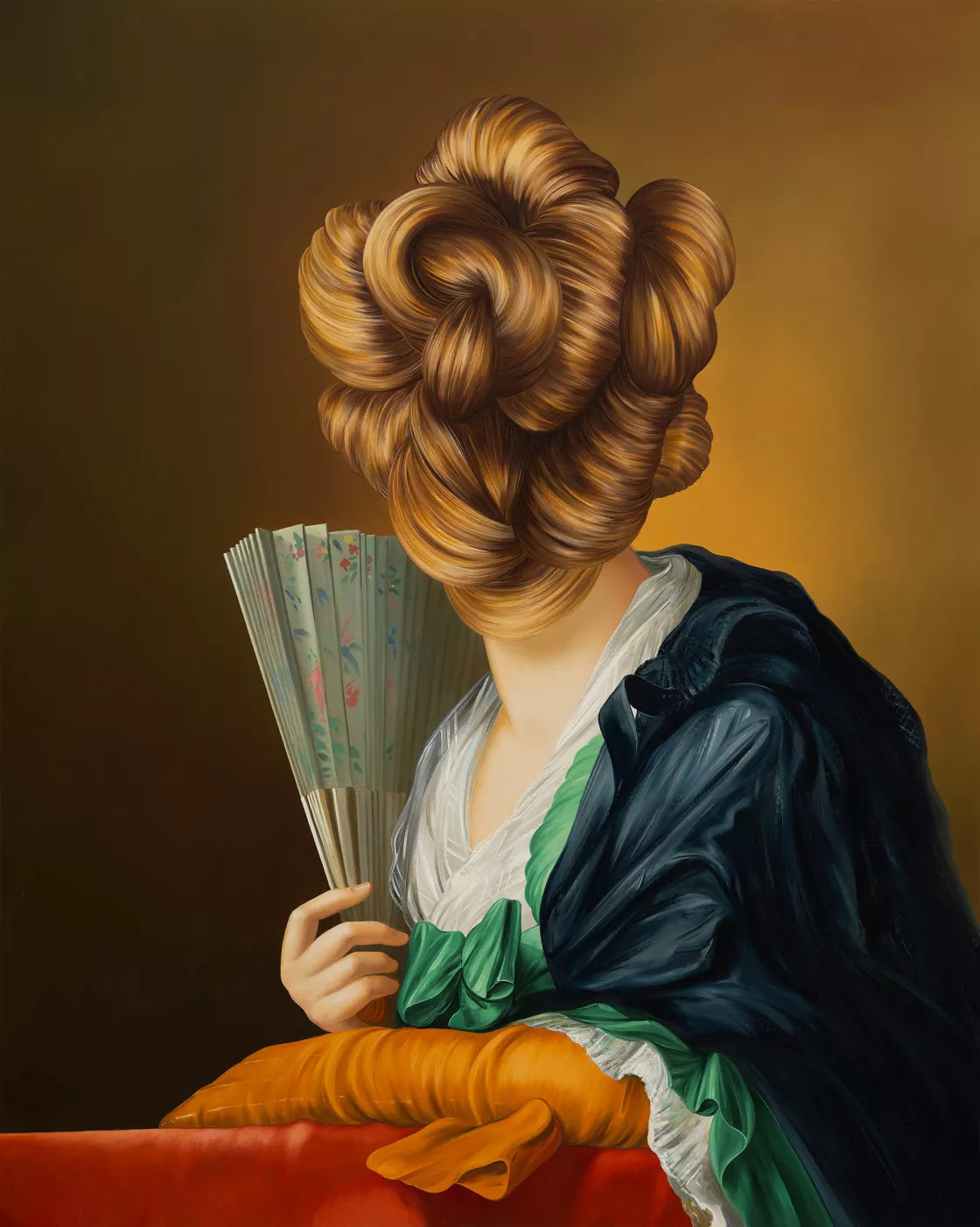
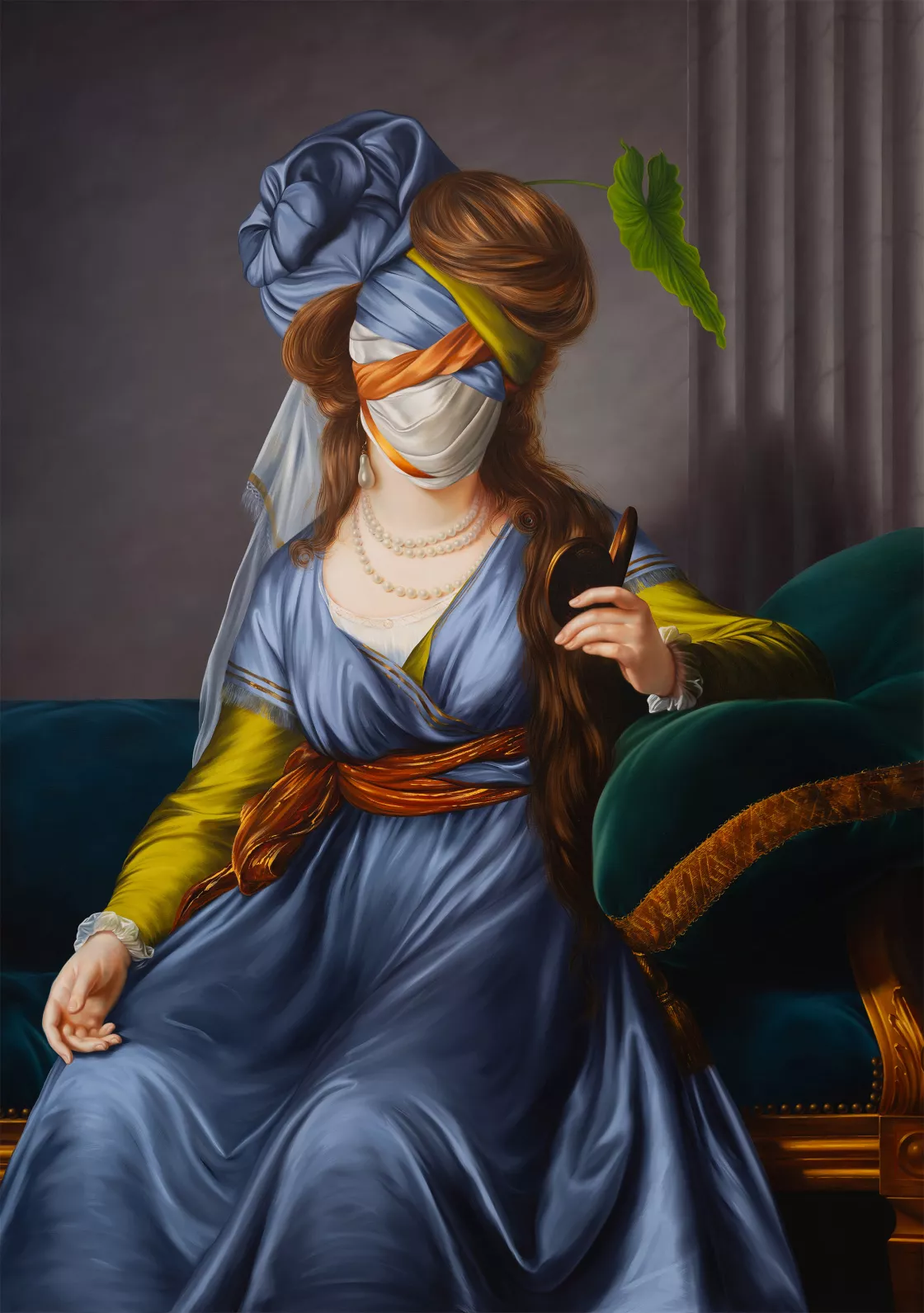
The hair is an improvised mask, but a mask that does not offer us, over the face it hides, the image of another face or facial scheme. In 2012, Juszkiewicz painted a version of Élisabeth Vigée Le Brun’s Self Portrait in a Straw Hat (1782) in which, instead of a face, we see carefully combed hair divided by a vertical parting. This is already a consummate example of Juszkiewicz’s characteristic invention, the anti-faciality mask. The pro-faciality mask hid one face and proposed another, symbolic or fantastic, animal or supernatural. The anti-faciality mask hides the first face and prevents the appearance of a second one, blocking the reproduction of faciality. I also call it a ‘camouflage mask’ because it can mimic anything, except a face.
For some time, Juszkiewicz occasionally relapsed into the pro-faciality mask, for instance when she resorted to Native American Northwest Coast masks to transform Albrecht Dürer’s Portrait of His Mother (2012) or Vigée Le Brun’s Self Portrait at the Easel (2013). In Sisters (2014), one of her most compelling and unsettling compositions, the heads of the three women in a portrait by Anton Graff are replaced by three giant beetles, suggesting masks from some tribal culture.
Historical Portraits
Juszkiewicz’s series of versions of historical portraits participates in a strategy of appropriation that was established by Pop Art and became widespread in the 1980s. Juszkiewicz cites Cindy Sherman’s and her History Portraits series as a precedent for her own work. But she does not conceive appropriation as a satirical parody of the source painting. Her work is based on a genuine admiration for the painters she chooses, and an eagerness to rescue the painting of the past and bring it back to life:
For me, this activity is a symbolic attempt of forging a relationship with a painter from the past. In this way, I try to establish a dialogue with him and try to share the common experience which is characteristic of creative work. It is a little bit like a séance — a painterly attempt to look for connections, to recall the presence of the painter from the past and to say just that little bit more — maybe what has been hidden under the painting for all those years?2
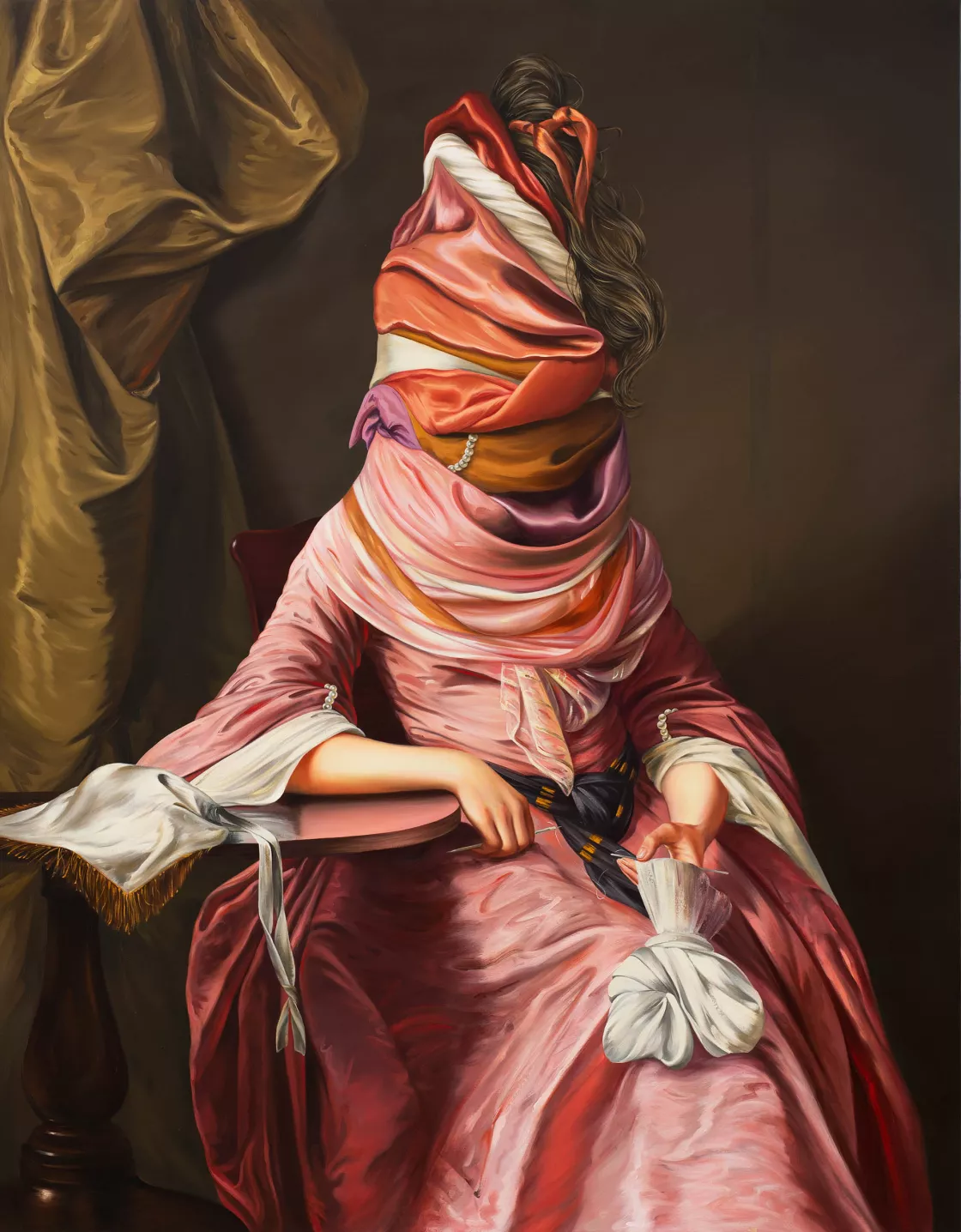
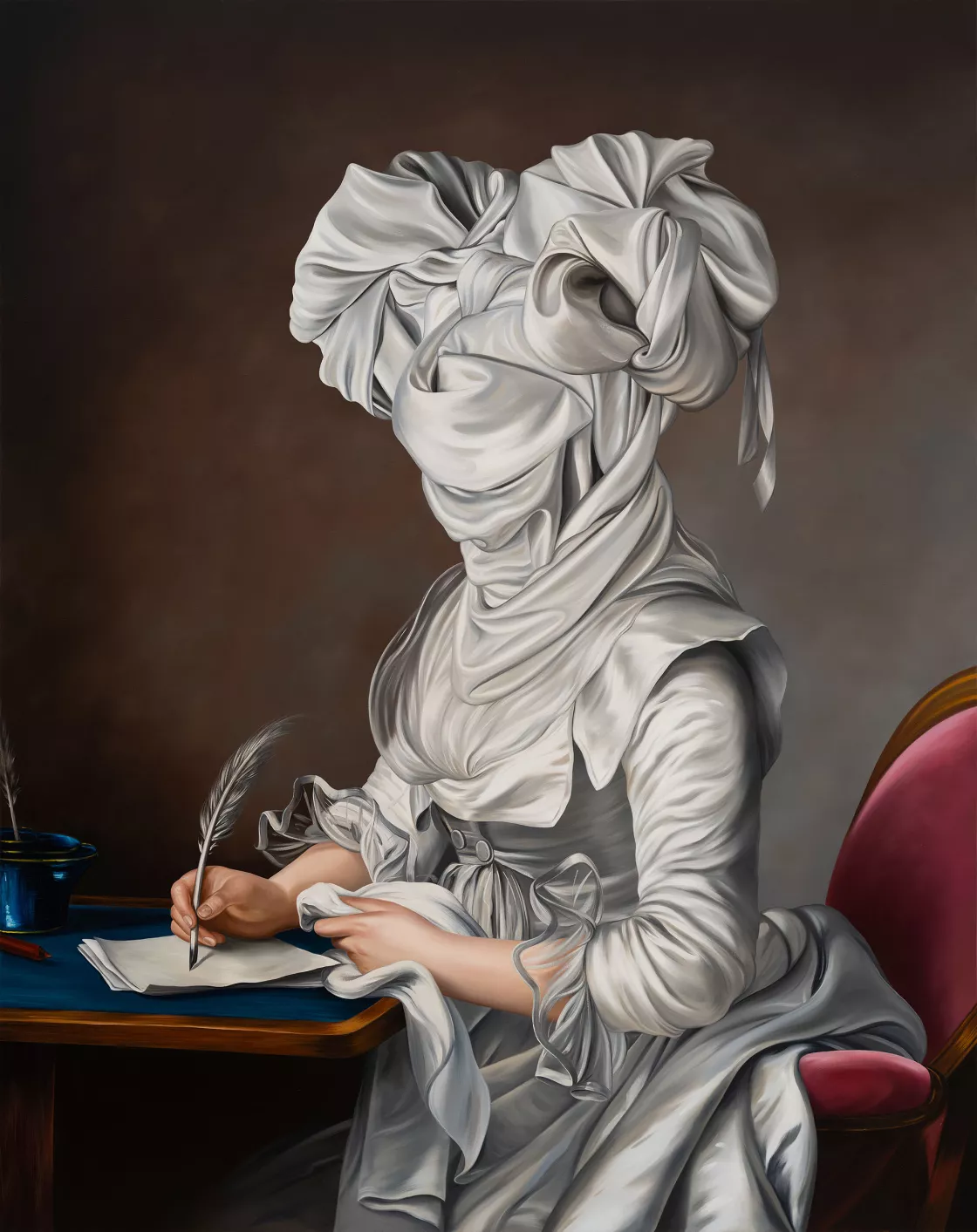
In her versions of historical portraits, Juszkiewicz cultivates a seemingly traditional pictorial craft, often echoing the techniques, surfaces and brushwork of historical painting. But her technical virtuosity would be useless if it were not at the service of a transgressive project. By covering the faces in historical portraits, Juszkiewicz challenges the very foundations of this genre: she undoes the portrait as such. Her paintings based on historical portraits are no longer portraits of anyone in particular, but representations of the condition of women under patriarchy. And, as she has pointed out, at the heart of the reworked portrait she drives the stake of another genre: still life, to which belong the fabrics, flowers, fruits, and other objects she uses as masks, subverting the traditional hierarchy of genres and the culture/nature dichotomy.Juszkiewicz’s painting style differs slightly from the inspiration she seeks in the originals: almost all her versions have a larger (sometimes much larger) format than the originals, and a palette that is more vivid, and saturated, with a more luminous effect. Her pictorial treatment is unmistakably contemporary.
2Ewa Juszkiewicz interviewed by Lucia Longhi, "Classical Female Portraiture and the Art of Constraint" BerlinArtLink, March 01, 2019.
Surrealist Precedents
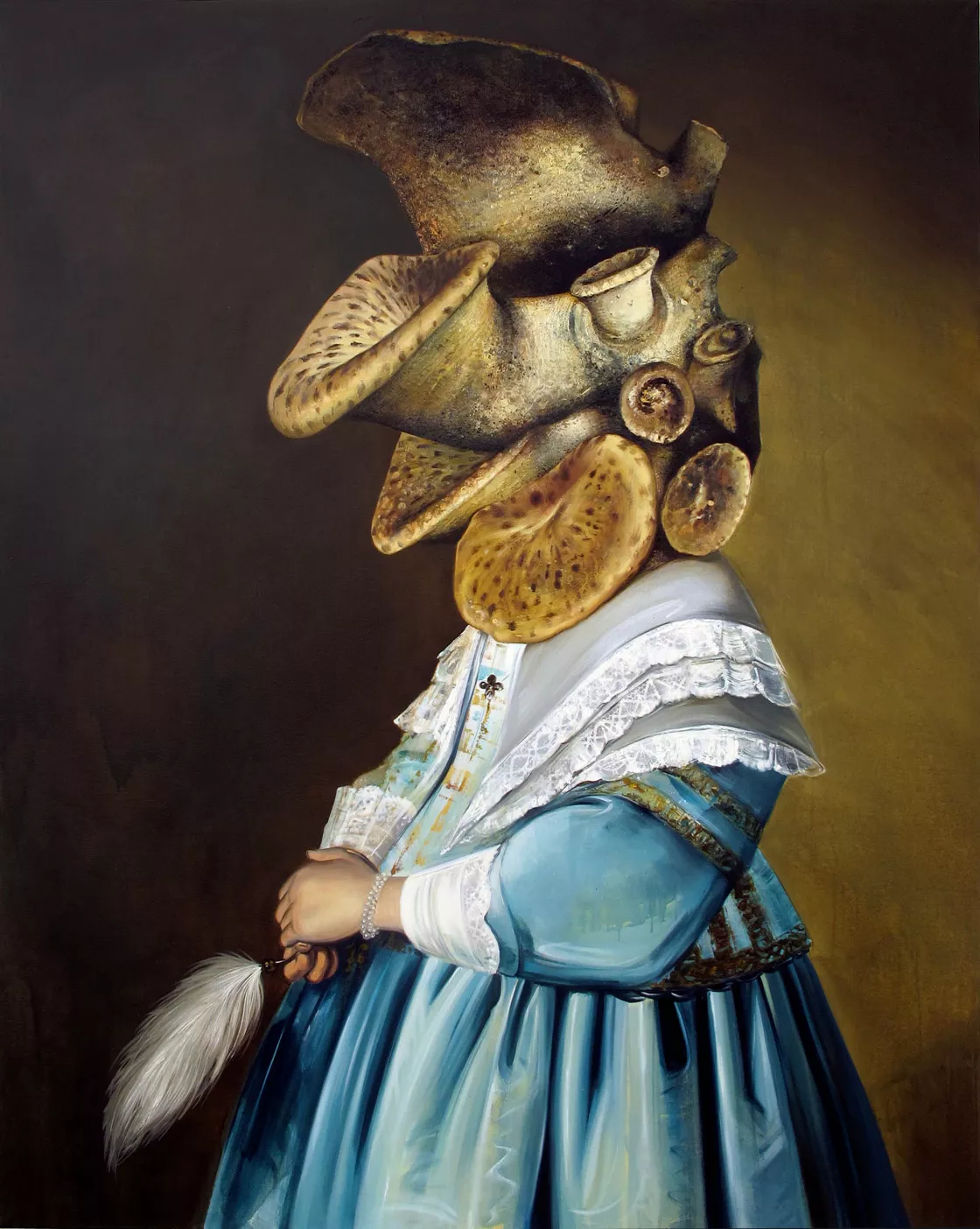
Juszkiewicz’s work certainly ties in with Surrealist precedents. For example, her 2017 collage cycle, which combines black-and-white reproductions of women’s portraits with cutouts from old natural history albums, is consciously in the wake of Max Ernst’s collage novels. But if Ernst’s hybrid characters, with their bird, lion, or insect heads, always remained in the realm of the pro-faciality mask, Juszkiewicz ventures to replace the human head with a mushroom, rose, orchid, butterfly wings, coral, or cloud. Juszkiewicz has painted an almost literal version of Magritte’s The Collective Invention (1935) that would fall into the catalog of pro-faciality masks because the fish has eyes and a mouth and even an expression of stupor. But most of her-work can be read in relation to a painting by Salvador Dalí, Woman with Head of Roses (1935), inspired by René Crevel’s verses: “A ball of flowers will serve for her head. Her brain is ruched, and, at the same time, a bouquet.”3
Unlike Giuseppe Arcimboldo, who adjusted his flowers or fruits to simulate a face, Dalí creates one of the first strictly anti-faciality masks, on the threshold of a new era of the visible: “When the face is effaced, when the faciality traits disappear,” Deleuze and Guattari claimed, “we can be sure that we have entered another regime, other zones infinitely muter and more imperceptible where subterranean becoming-animal occur, becoming-molecular, nocturnal deterritorializations overspilling the limits of the signifying system.”4
3"Une boule de fleurs va lui servir de tête. Son cerveau est à la fois la ruche et le bouquet." René Crevel, "La grande mannequin cherche et trouve sa peau," Minotaure no. 5 (1934).
4Deleuze and Guattari 1987, op. cit., 587.
A Feminist Détournement
One of the most comprehensive statements behind Ewa Juszkiewicz’s intentions can be found in a 2020 interview:
By deconstructing the portraits, I want to draw attention to the schematic and conservative way in which many of them are depicted. After all, most of the portraits we know of from art history embody the conventions that have been imposed on women. By reinterpreting their images, I want to revive history and overturn the aesthetic canons of a given period. This is my protest against the stereotypical perception of femininity. By substituting certain canons, I want to show the individual identity of women, their complexity and underline their uniqueness.5
One could argue that in the old portraits of women, the norms and ideals of decorum (and also of fashion) are reflected above all in their dress and accessories, in their bodies’ posture, and in the setting of the portrait, while the face would be a place safe from such conventions, and even the last redoubt of individual personality. By covering the face, Juszkiewicz would be removing this organ of subjective expression, taking to the extreme the depersonalization and reification of the model.
Such an interpretation idealizes and fetishizes the face in historical female portraits as the site of authenticity, when actually it is but another mask. Like the dress or posture, even more so, the female face is subjected to the canons of beauty and the codes of expression of the time. A slight inclination of the head can suggest shyness or, on the contrary, a restrained coquetry; a pout of the lips indicates the desire to please; a look can be candid, tender, or submissive, and all these features reflect the limited variety of accepted social roles of the woman as daughter, mother, fiancée or wife: always in relation to the male. When Juszkiewicz covers the face of the old portraits, she cancels those signs and roles and the female figures are liberated, emancipated from the patriarchal gaze.
5Ewa Juszkiewicz interviewed by Bill Powers, "Free Sensuality: Ewa Juszkiewicz," Muse, December 2020.
The Masquerade of Femininity
The essay “Womanliness as a masquerade” is a classic title by psychoanalyst Joan Rivière, published in 1929. Riviere studied the cases of women who hid their knowledge and abilities and adopted behaviors marked as feminine in order to prevent men from feeling threatened. The mask of femininity is a defensive performance:
Womanliness therefore could be assumed and worn as a mask, both to hide the possession of masculinity and to avert the reprisals expected if she was found to possess it — much as a thief will turn out his pockets and ask to be searched to prove that he has not the stolen goods. The reader may now ask how I define womanliness or where I draw the line between genuine womanliness and the ‘masquerade’. My suggestion is not, however, that there is any such difference; whether radical or superficial, they are the same thing.6
Such a conclusion anticipates by more than half a century of Judith Butler’s theory of gender as performance.
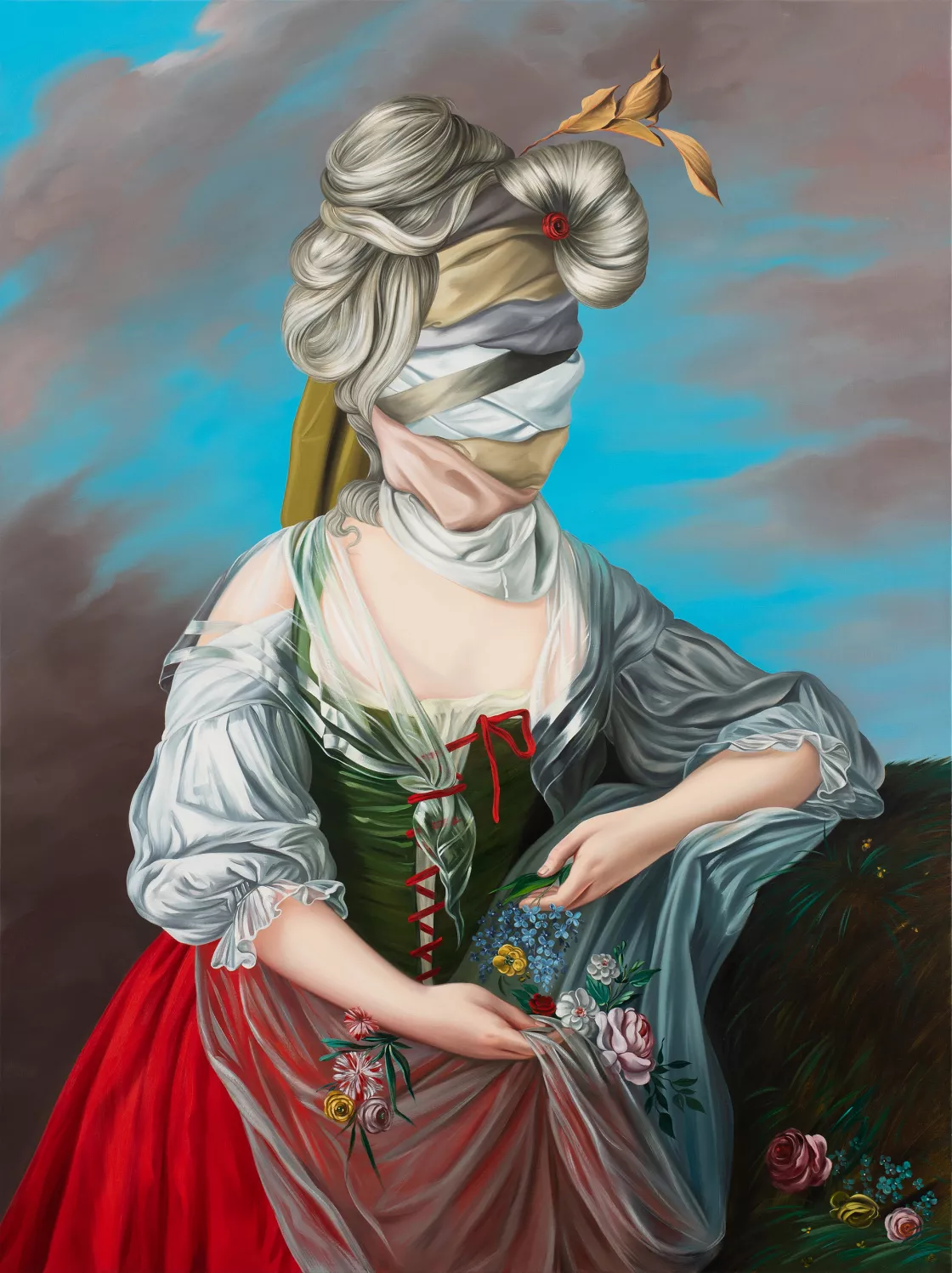
Costume in fashion has always been an important part of this ‘masquerade.’ The portraits Juszkiewicz chooses as her starting point are often filled with silks and velvets, sumptuous fabrics, with multiple folds and ribbons and bows. Fashion plays a role here, again, that is essentially ambiguous, at once repressive and expressive depersonalizing and objectifying women:
I often got the impression that they were trapped in corsets, crinolines, layers of petticoats constraining their movements, somehow imposing their presence on them in the world. Fashion in the past is visually attractive and fascinating to us today but, upon deeper reflection, we can conclude that its hidden function is a kind of oppression and constraint. There is not much room for individuality or otherness. What is significant is that this also applies to contemporary canons of beauty and ideals of the female body. I think it is a bit like making fun of history. We consider ourselves to be more modern than our ancestors, but we actually squeeze ourselves into our own, modern ‘corsets.’ My painting is the result of a little bit of contrariness; a desire to break free from the norms imposed on us by our fashion and culture.7
On the other hand, fashion can be transgressive and liberating. Among contemporary fashion creators, Juszkiewicz is interested in figures such as Rei Kawakubo, Martin Margiela, Alexander McQueen and Iris van Herpen; radical designers proposing alternative visions of the human body, far removed from the normative ones. One effect of “the abstract machine of faciality” was the strict separation of the face from the rest of the body. Juszkiewicz’s wrappings cancel this separation, covering not just the face but all of the head and sometimes part of the torso too, thus modifying the perception of the female body as a whole.8
6Joan Riviere, "Womanliness as a masquerade" in Shelley Saguaro, ed., Psychoanalysis and Woman: A Reader (New York: New York University Press, 2000), 73.
7Longhi 2019, op. cit.
8All of them have played with masks, from fencing masks to BDSM hoods, and sometimes even challenging the scheme of faciality.
Hair and Foliage
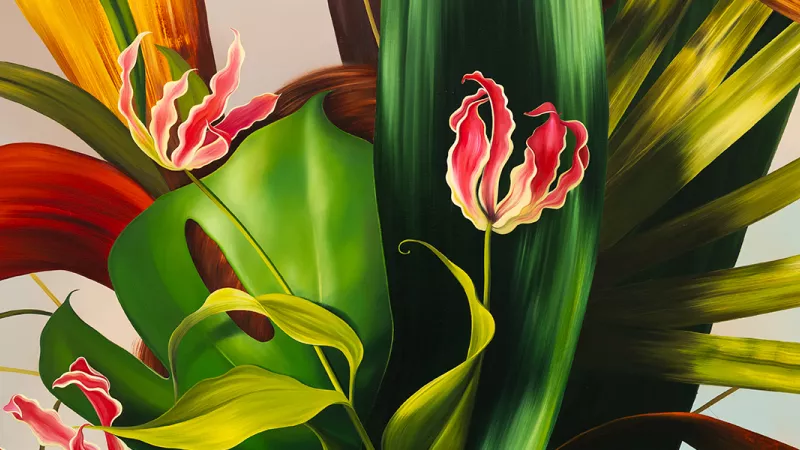
Each of the elements used by Juszkiewicz has a dual character: on the one hand, it can be seen as a stereotypical characterization of femininity within a patriarchal culture, on the other as a promise of emancipation. The materials, fabrics, hair, plants, can be considered as an embodiment of the ornamental role of women and their identification with a subdued nature. But one can also interpret them as the hidden expressions of women’s desire and sensuality buried beneath the corsets.
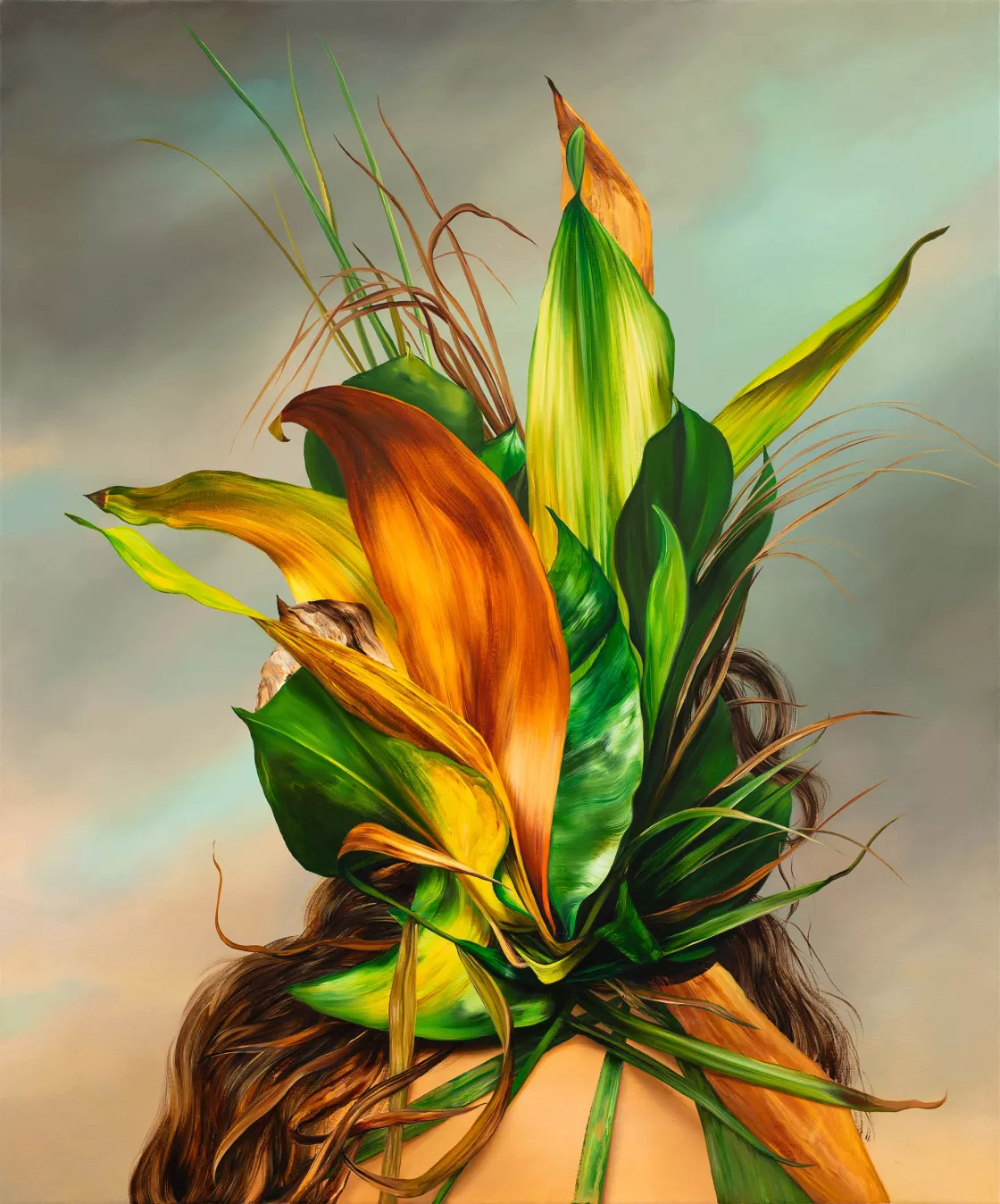
So it is with hair, one of the key features of female identity throughout centuries of patriarchal culture, and a symbolic element for both male sexual anxiety and the mythology of female sexual power. In Juszkiewicz’s work, hair is presented in two antithetical modes. From one perspective, there are heads of hair tightly combed, braided or curled, which are the antithesis of the openness of a face: something without eyes or mouth, incapable of speaking or looking back at us. Then there is tangled hair, interwoven with leaves and branches, enveloping the head as vegetation invades the ruins.
Lisa Small, senior curator of European Art at the Brooklyn Museum, begins her brilliant essay on Juszkiewicz’s work by evoking Daphne’s metamorphosis.9 The transformation of the nymph’s hair into leaves is rooted in the Greek word κόμη, which designates both hair and the foliage of trees. When Juszkiewicz intertwines hair and plant fibers a regression takes place, as if the hair is returning to its natural origin. And it is this regression that presents an ambiguous sense, seemingly endorsing the sexist cliché of women as pure nature and challenging the patriarchal regime with a desire capable of going wild.
By bringing together apparently incompatible worlds, I want to overthrow a well-known order and a free sensuality. My paintings are born from a deep desire to break existing patterns and to bring out emotions, feelings, and passions.10
9Lisa Small, "Ewa Juszkiewicz" Gagosian Quarterly, Winter 2020.
10 Powers 2020, op. cit.