
Mauritshuis ❤️ Thyssen-Bornemisza
Masterpieces from The Hague
The works from the Mauritshuis that form part of the exhibition in Madrid cover a period from around 1615 to 1705, and belong to artists such as Ambrosius Bosschaert I, Frans Hals, Hendrick Avercamp, Pieter Claesz, Rembrandt van Rijn, Gerard ter Borch, Jan Steen, Jacob Ruisdael, Pieter de Hooch and Nicolaes Maes, among others.
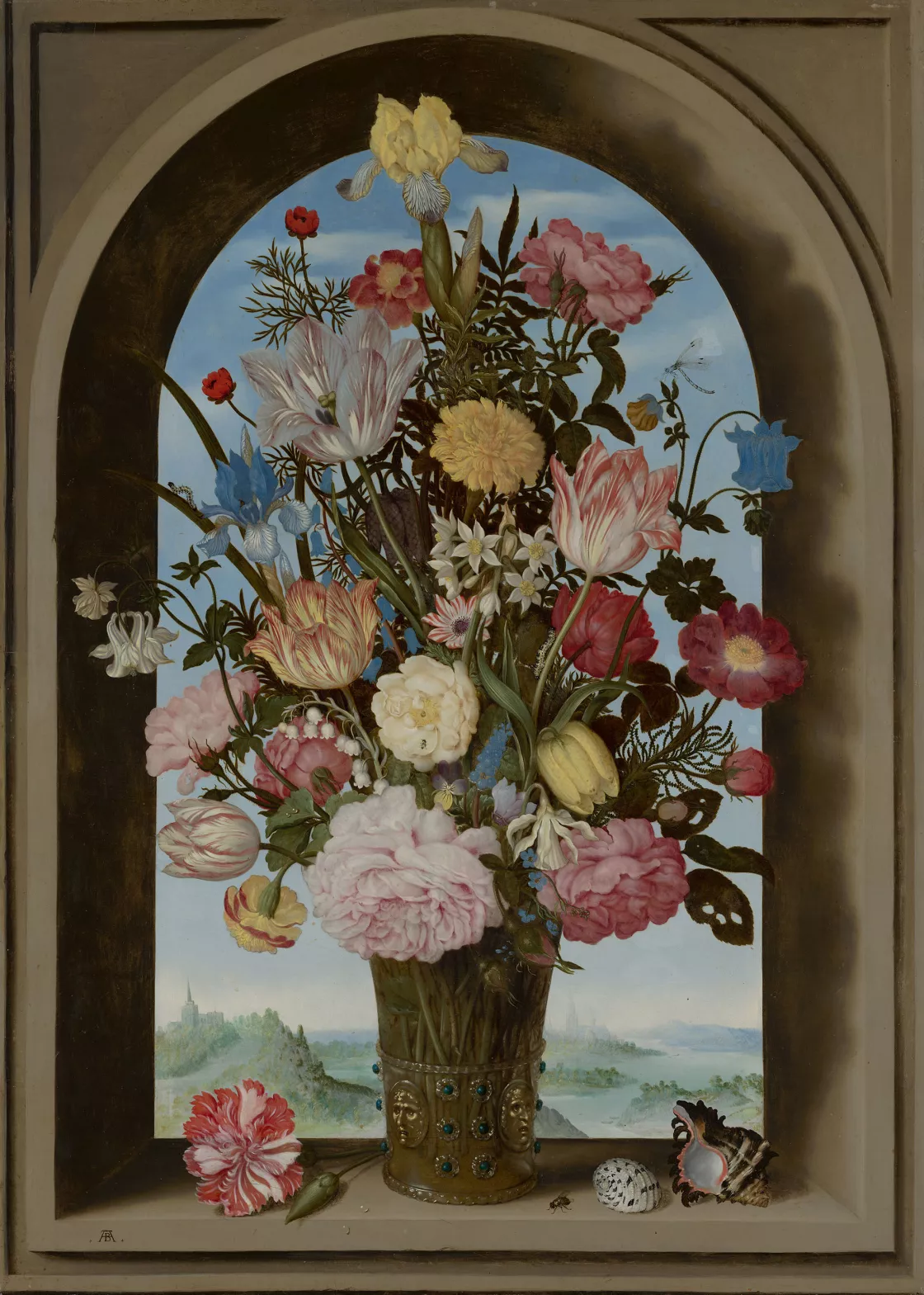
Ambrosius Bosschaert
Antwerp, 1573-The Hague, 1621
Vase of Flowers in a Window
Circa 1618
Oil on panel
The Hague, Mauritshuis, inv. 679
Ambrosius Bosschaert the Elder was one of the first Dutch artists to devote himself entirely to painting flower still lifes. His work is characterised by strict symmetrical flower arrangements and even lighting. This painting is generally considered to be one of Bosschaert’s most beautiful in the genre. In a window overlooking a panoramic landscape, he has placed a bouquet of some thirty different flowers, each captured in accurate detail. There are many more details in this picture, too, such as the beetle on the white rose, the nibbled leaves to the lower right, and the dewdrops on the windowsill. Bosschaert chose to depict the tulips in this flower painting in various stages of bloom: those at the bottom left are yet to open fully, at the top right they are in full bloom, in the middle they are past their prime, and at the top they are almost wilted. Nothing lasts forever, not even these flowers.
The artist worked after sketches, which he often used for multiple paintings. Because many of the flowers depicted here bloom at different times of the year, that was necessary. In his monogram, with the ‘B’ placed in the ‘A’, Bosschaert was following the signature of the German artist Albrecht Dürer (1471–1528), celebrated for his observation of nature.
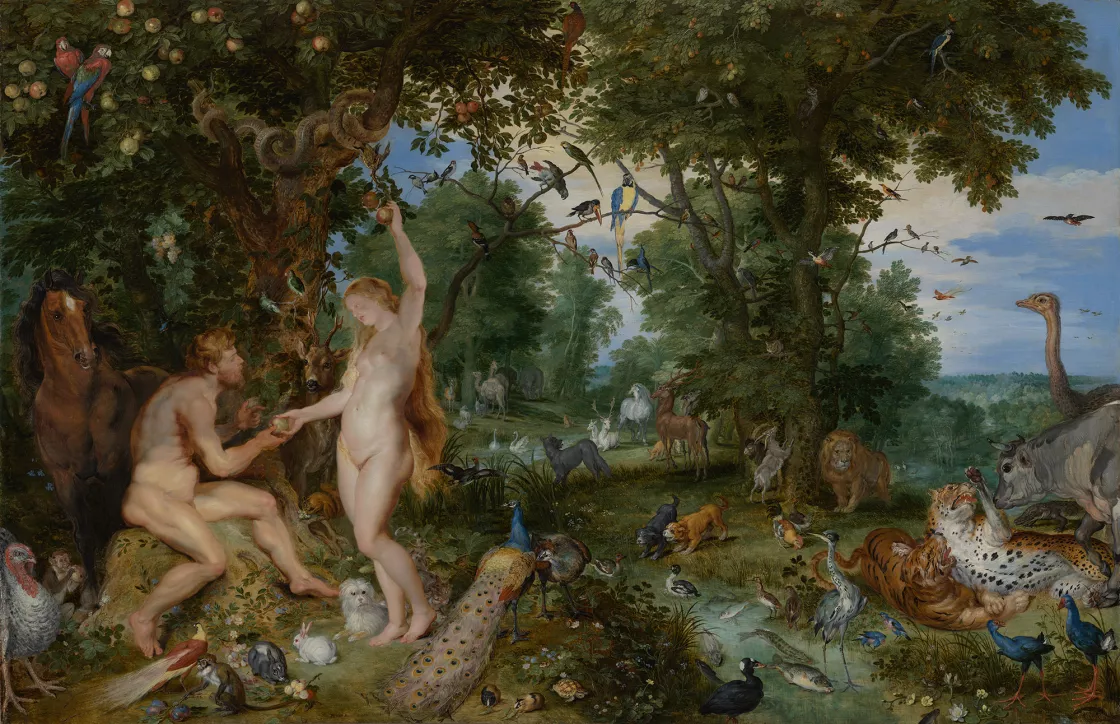
Jan Brueghel the Elder and Peter Paul Rubens
Brussels, 1568-Antwerp, 1625 and Siegen, 1577-Antwerp, 1640
The Garden of Eden with the Fall of Man
Circa 1615
Oil on panel
The Hague, Mauritshuis, inv. 253
This panel illustrates several verses from Genesis describing the abundance of Paradise and the episode of the temptation. The painting depicts a harmonious world where all species coexist peacefully, without predators, prey or violence. The composition brim with the exuberance of life in this setting, encouraging viewers to explore every inch of the painting to discover its many details. The work is the result of a collaboration between Antwerp's two finest painters at the time: Brueghel the Elder and Rubens. It perfectly combines their visual languages: Rubens' voluminous figures with luminous skin and loose brushwork, and Brueghel's precise, meticulous brushwork in the landscape and animal scenes, resulting in a smooth surface almost devoid of brush marks.
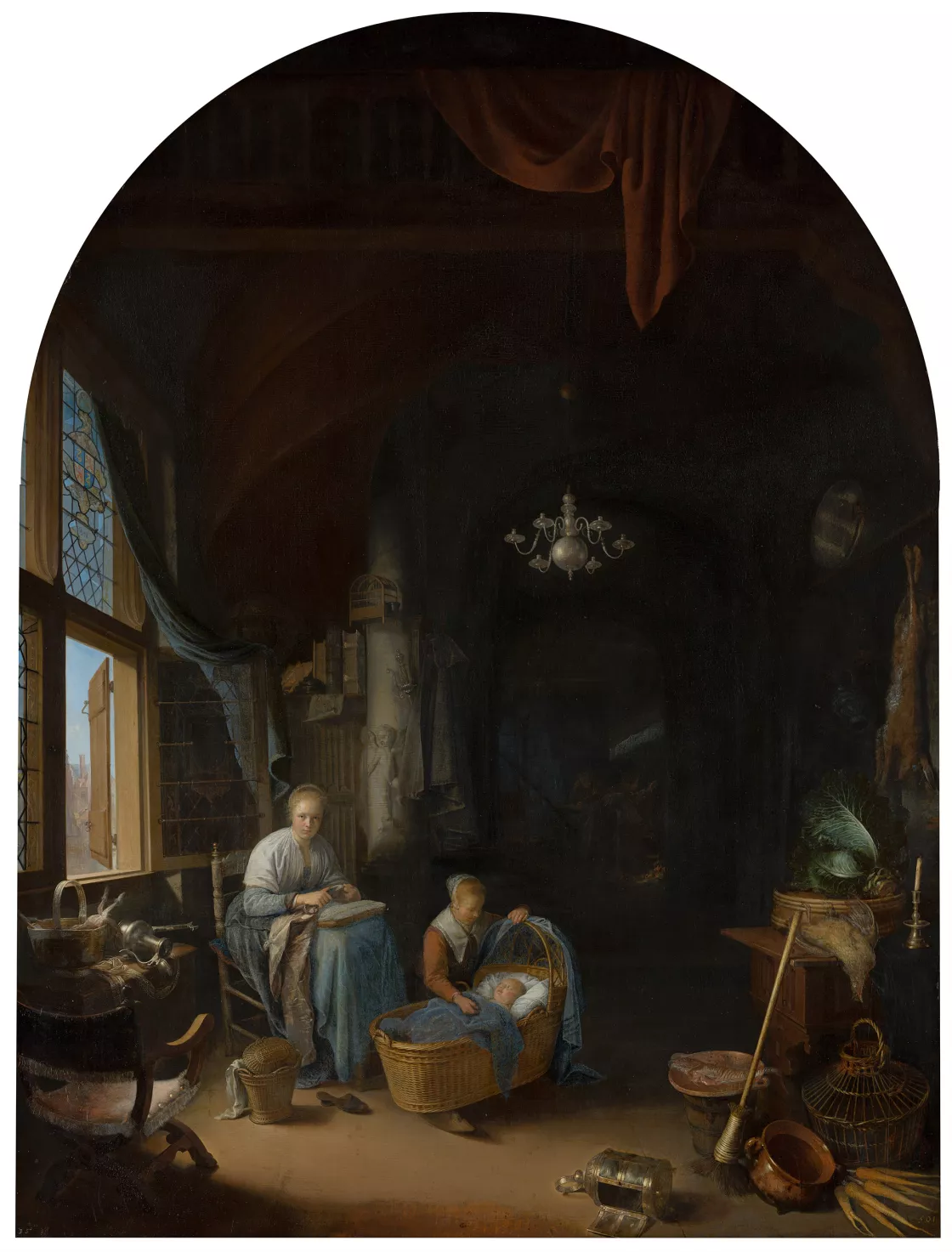
Gerrit Dou
Leiden, 1613-1675
The Young Mother
1658
Oil on panel
The Hague, Mauritshuis, inv. 32
The house, marriage and family reflected the structures and roles within Dutch society: everyone had their allotted task. In The Young Mother, Leiden painter Gerrit Dou depicts a woman in a rich interior, seated with her needlework next to her child and a maidservant. Preoccupied with domestic duties, she is the very embodiment of female virtue. As a housewife, she was head of the household and literally ‘the lady of the house’, a role in which she enjoyed a great deal of independence. The sword and coat behind the woman suggest that her husband held a military position. The books on the left are a reference to his learning, and the large shell must have come from a distant land. The marble column with a carved cupid forms part of a spiral staircase, suggesting an additional material world above, a subtle reference to the family’s wealth and status.
Dou was probably Rembrandt’s first pupil in 1628. Whereas Rembrandt’s expressive brushstrokes are visible to the naked eye in his later paintings, Dou made it his life’s work to render every individual brushstroke invisible. This allowed him to achieve an unprecedented degree of realism in the representation of various objects. According to an anecdote by engraver and art theorist Joachim von Sandrart, Dou is said to have spent over three days using a magnifying glass to paint a broom the size of a fingernail in 1640.
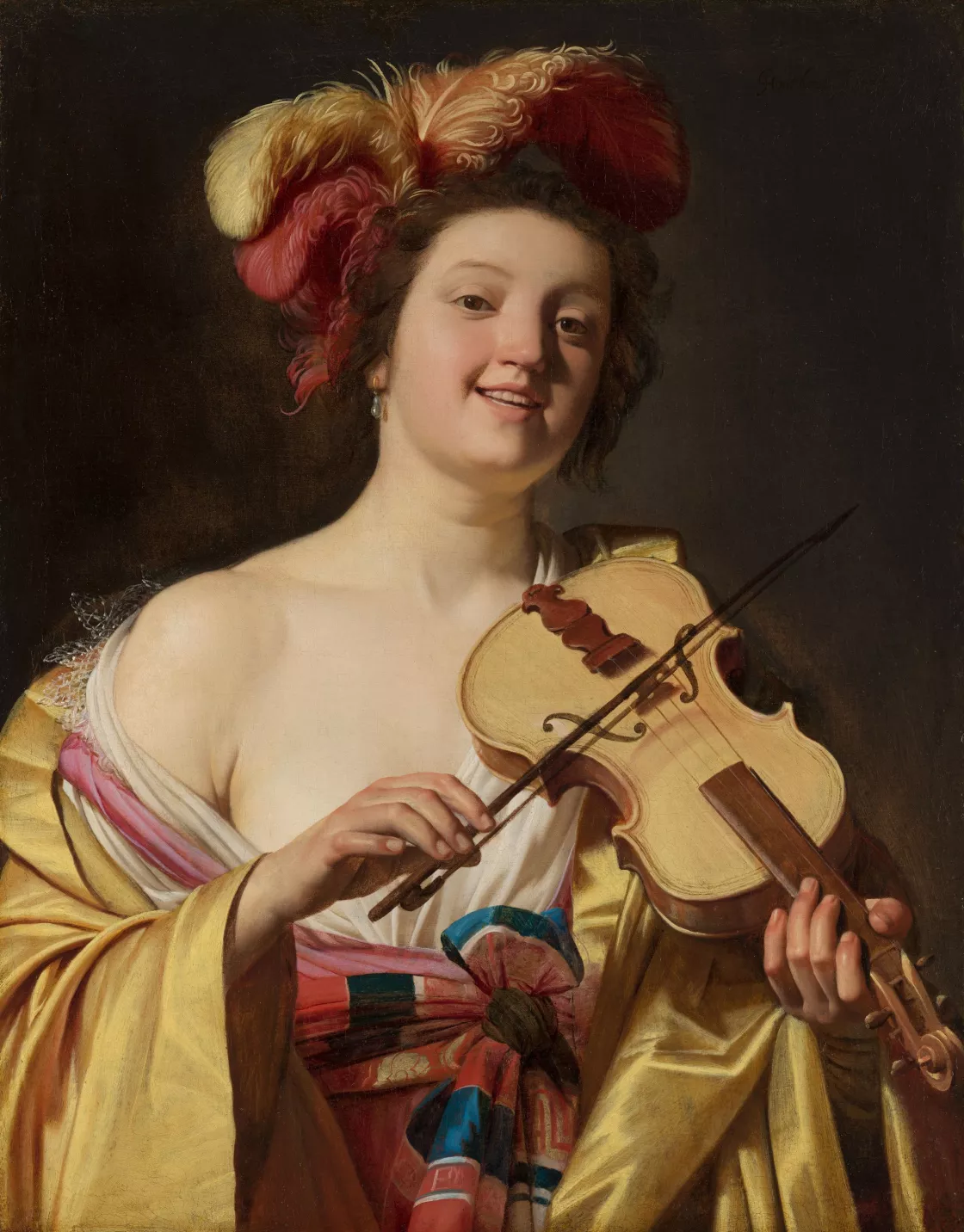
Gerrit van Honthorst
Utrech, 1592-1656
The Violin Player
1626
Oil on panel
The Hague, Mauritshuis, inv. 1107
After completing his training in Utrecht, Gerrit van Honthorst travelled to Rome to further his studies. There, he encountered Caravaggio’s work firsthand, which made a profound impression on him. Upon returning to Utrecht in 1620, he incorporated the stylistic and thematic innovations he had learned in Italy into his own work. This powerful figure depicted in half-length and illuminated by a light source on the left is rendered in intense colours and marked chiaroscuro, reflecting the influence of Caravaggio and his followers. The subject, who is a commoner, is silhouetted against a dark background. Her striking clothing has slipped down her shoulders, revealing part of her body, and her head is adorned with soft, cheerful plumes. Works of this kind were common in the painter’s repertoire and his subjects’ gazes are captivating: this woman’s is full of sensuality, while the man in the Museo Thyssen painting radiates the contentment brought on by wine.
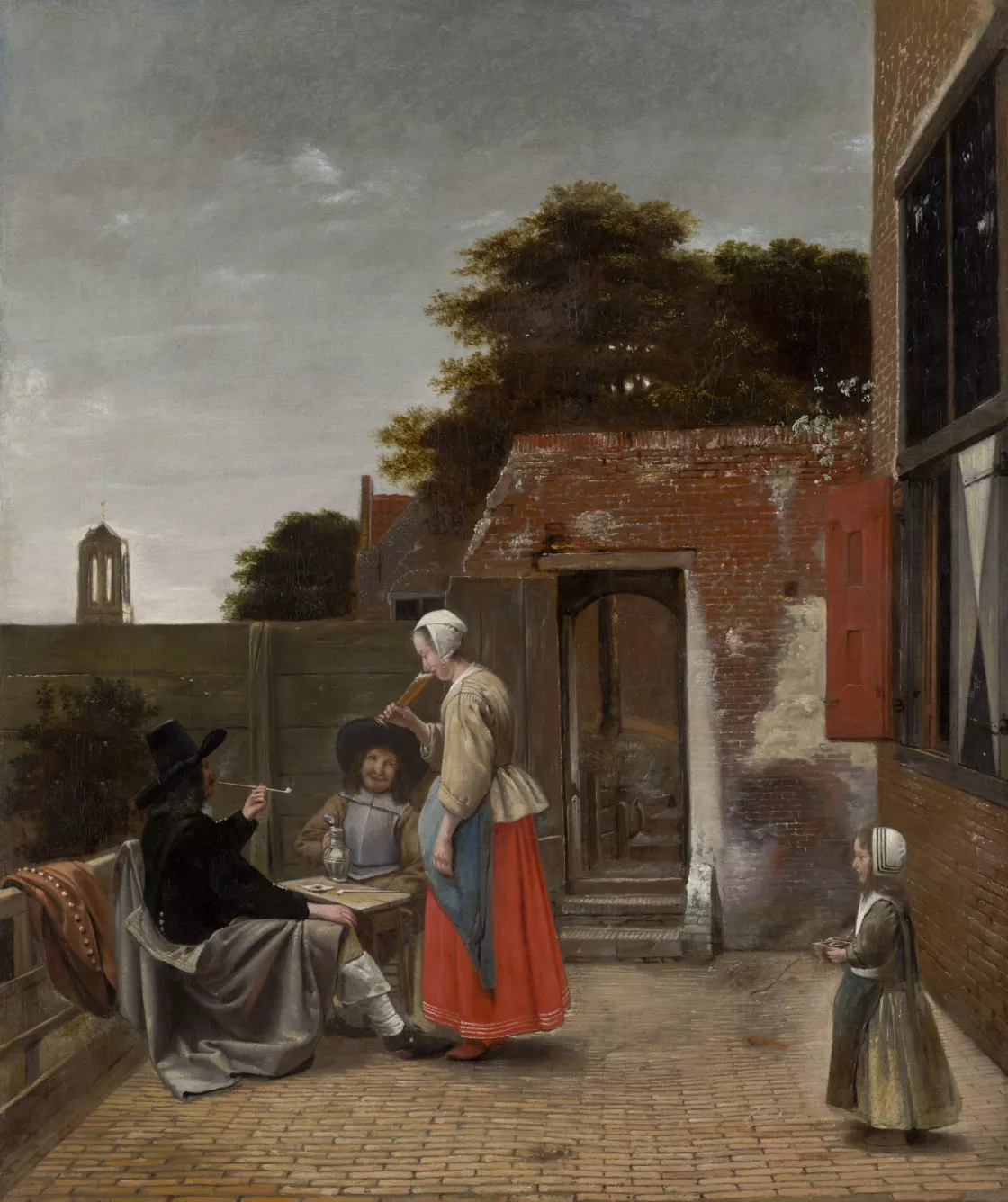
Pieter de Hooch
Rotterdam, 1629-Amsterdam, 1684
Figures in a Courtyard
Circa 1658-1660
Oil on canvas
The Hague, Mauritshuis, inv. 835
Pieter de Hooch Rotterdam, 1629-Amsterdam, 1684 Figures in a Courtyard Circa 1658-1660 Oil on canvas The Hague, Mauritshuis, inv. 835 In a sunny courtyard in Delft, a woman is drinking beer from a tall glass, standing next to two men at a table. The soldier is also drinking beer; the other man is smoking a pipe. Like the child just behind her, the woman is wearing a blue apron, the clothing of maidservants. Pieter de Hooch painted this scene around 1658–1660 with a great feeling for light, colour and space. On the left, we see the tower of Delft’s Nieuwe Kerk. The detailed rendering of the brick wall, with its remnants of plasterwork, is reminiscent of the facades in Vermeer’s celebrated The Little Street. Before 1660, the two painters inspired one another.
The quality of this painting is now visible again for the first time in years, thanks to a recently completed restoration in the Mauritshuis. Conservators removed a deeply yellowed layer of varnish and old overpainting. During the treatment, the contours emerged of a soldier who had been removed at some unknown point before 1822. Based on an earlier, almost identical version of this picture by De Hooch, a conservator was able to reconstruct the soldier. Now we know that he is playing a drinking game with the woman: he has just filled her glass, and she has to drink to the next stripe on this object.
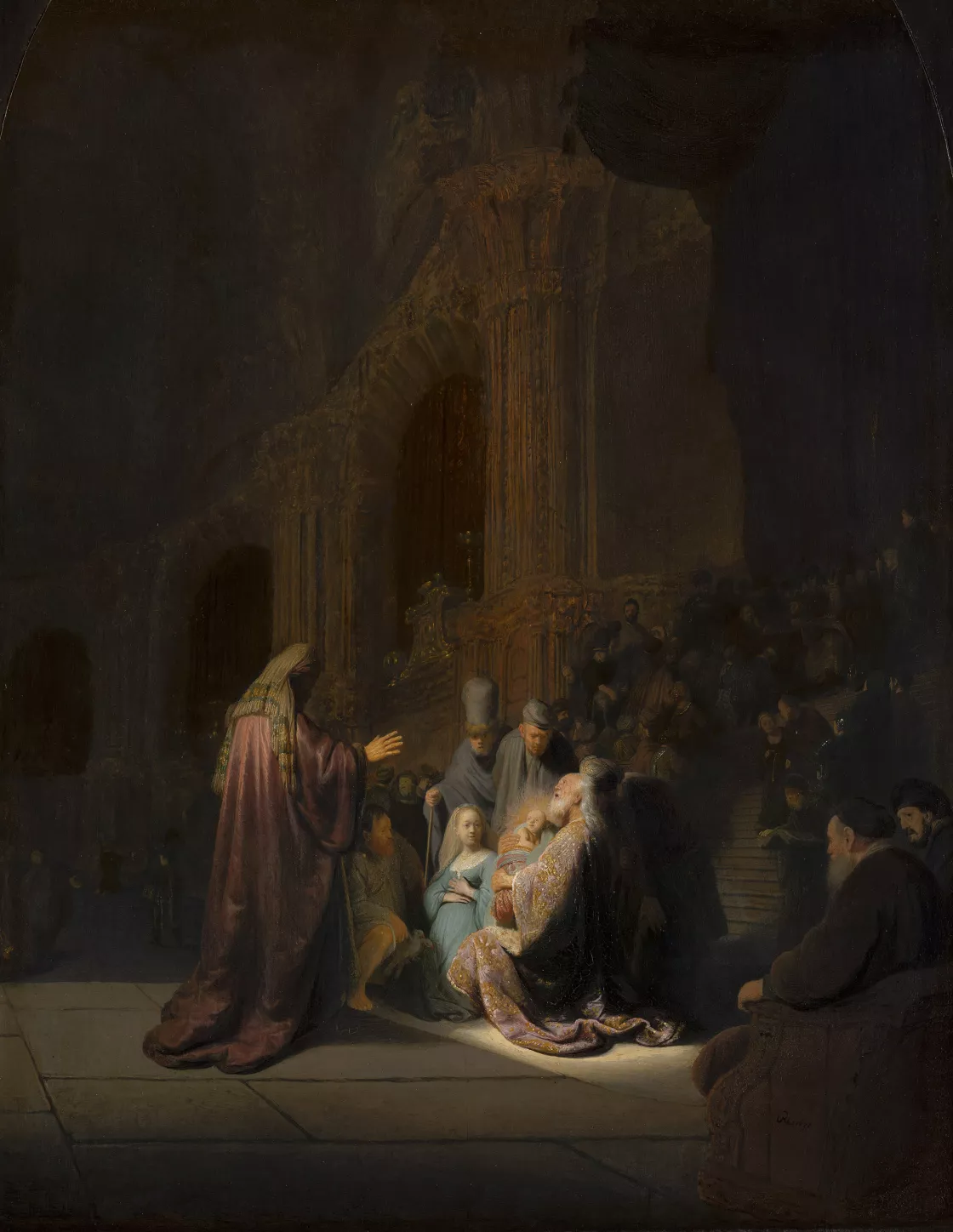
Rembrandt van Rijn
Leiden, 1606-Amsterdam, 1669
Simeon’s Song of Praise
1631
Oil on panel
The Hague, Mauritshuis, inv. 145
Rembrandt had a particular fondness for the Bible story of Simeon. After the circumcision of their child Jesus, Mary and Joseph went to the temple in Jerusalem to dedicate him to the Lord and make the customary sacrifice of two young turtledoves. In the temple, the child is met by the pious Simeon, who recognises Jesus as the Saviour. Rembrandt depicted this story in numerous paintings, drawings and etchings. He painted this panel, dated 1631, while still in his home city of Leiden, shortly before he moved to Amsterdam. It demonstrates his exceptional artistic talent, even at a young age. Although the abundance of detail is reminiscent of his teacher, Pieter Lastman (1583–1633), Rembrandt shows himself to be a theatrical master in the concentrated, dramatic play of light. All of our attention is focused on Simeon with the Christ-child in his arms, next to the kneeling Mary. Rembrandt has depicted the most moving moment in the story, when Simeon praises the Lord. Simeon’s words cause Mary to look up in astonishment, as Joseph kneels next to her holding the two doves in his hands. Together with the prophetess Anna, whom we see from behind in the foreground, they form a striking group in the caver nous space of the church.
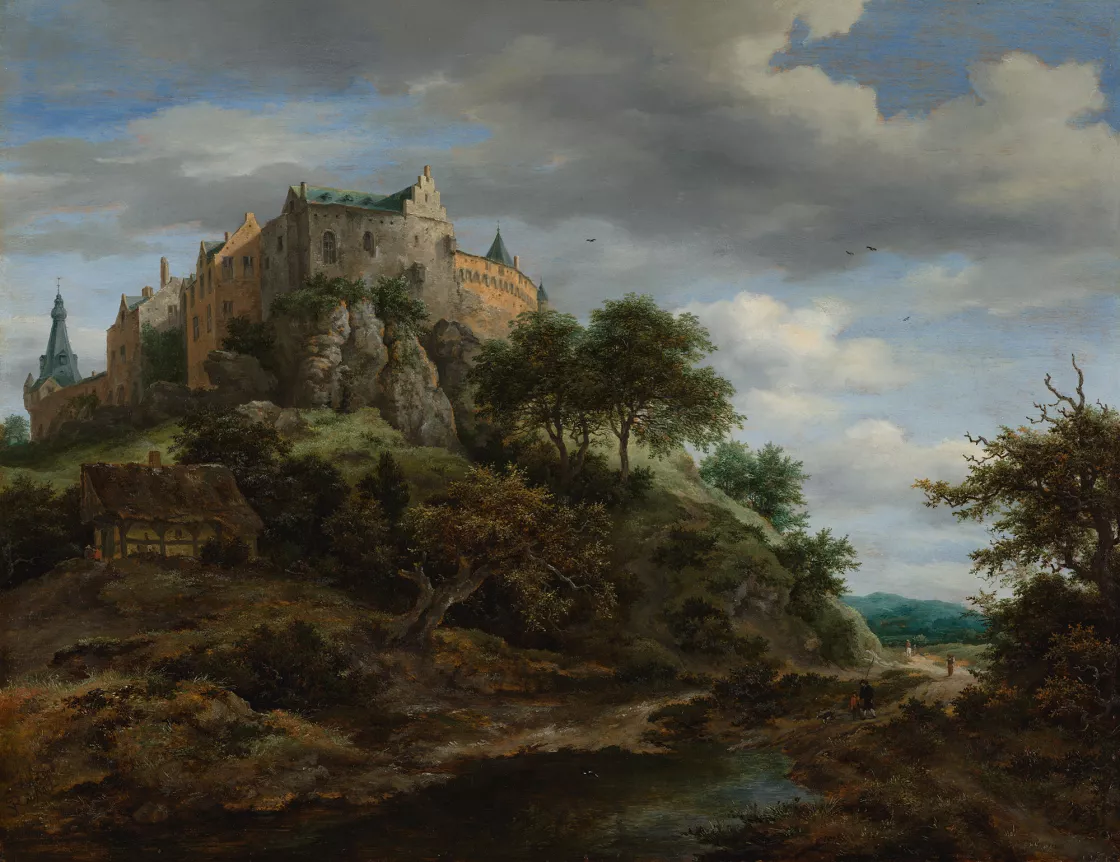
Jacob van Ruisdael
Haarlem, 1628/1629-Amsterdam, 1682
View of Bentheim Castle
Circa 1652-1654
Oil on panel
The Hague, Mauritshuis, inv. 1151
Scattered with rocks and covered with tall grasses and bushes, a lush landscape leads to a castle on an impressive promontory. Large cloud masses, dark and light, give the image its dramatic character. Bentheim Castle was an object of great fascination for Jacob van Ruisdael. In 1650, he made a journey to German Westphalia with his friend Nicolaes Berchem (1620–1683), during which he studied this castle in detail. Captured from different perspectives, it recurs in more than twelve of his paintings. Although the building is not actually situated on such a high mountain, by using a ground-level perspective, Van Ruisdael found an inventive way to make fantasy and reality converge.
Van Ruisdael of Haarlem was born into an artistic milieu. Both his father, Isaack, and his uncle, the celebrated landscape painter Salomon van Ruysdael, played an important role in his education as an artist. However, Jacob van Ruisdael took a different path at a young age and later transformed Dutch landscape painting with his monumental, complex compositions. Fascinated by the rugged hill formations in the dunes near his hometown, his earliest dated works already form a strong contrast to the ordered river landscapes of his Haarlem predecessors.
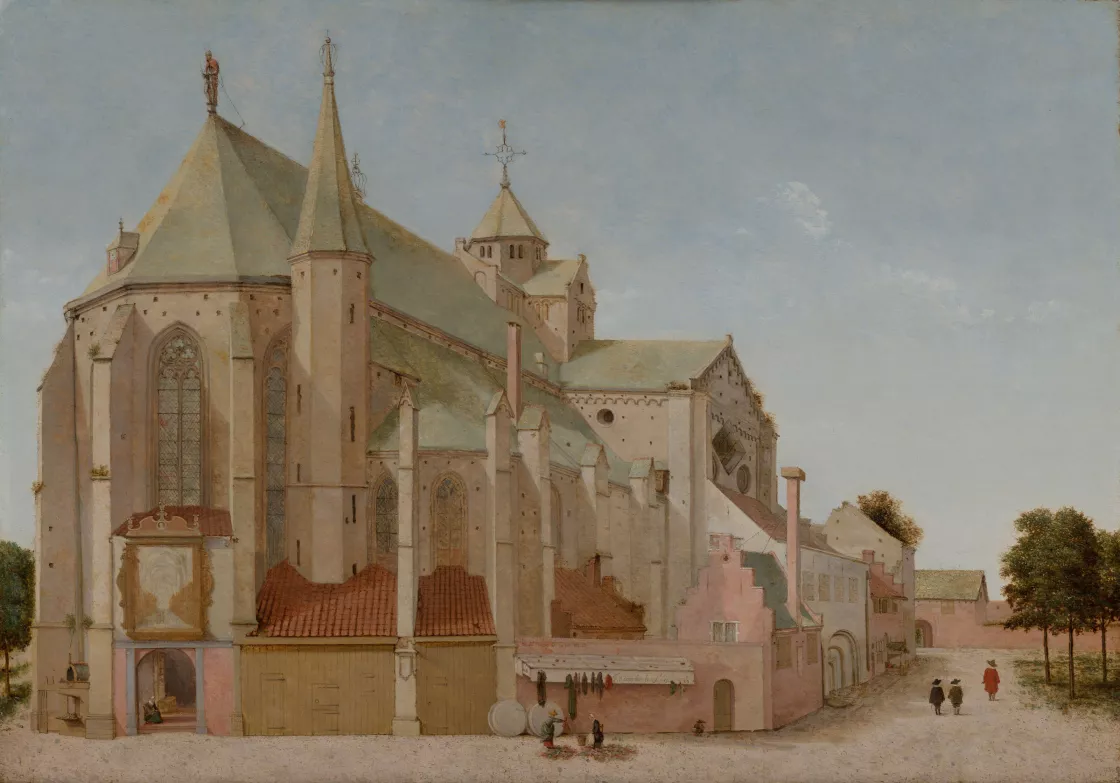
Pieter Saenredam
Assendelft, 1597-Haarlem, 1665
The Mariaplaats with the Mariakerck in Utrecht
1659
Oil on panel
The Hague, Mauritshuis, inv. 974
Pieter Saenredam was a Haarlem-based painter who focused his career on depicting architecture, particularly interiors. He visited the city of Utrecht between 29 May and 18 July 1636, painting several of its churches, including the Buurkerk, St Peter’s, St John’s, St James’s, St Catherine’s and, in particular, the Romanesque church of St Mary’s. Thanks to him, eleven paintings of this church have survived, including three of the exterior.
Before starting work, Saenredam took a great many measurements and made numerous technical drawings and sketches of the building from various angles. He used them to compose his pictures, which he created in his studio many years after his stay in Utrecht. The elegance of his lines and soft colours, and the clarity and simplicity of his compositions, make him one of the finest practitioners of this type of architectural painting.
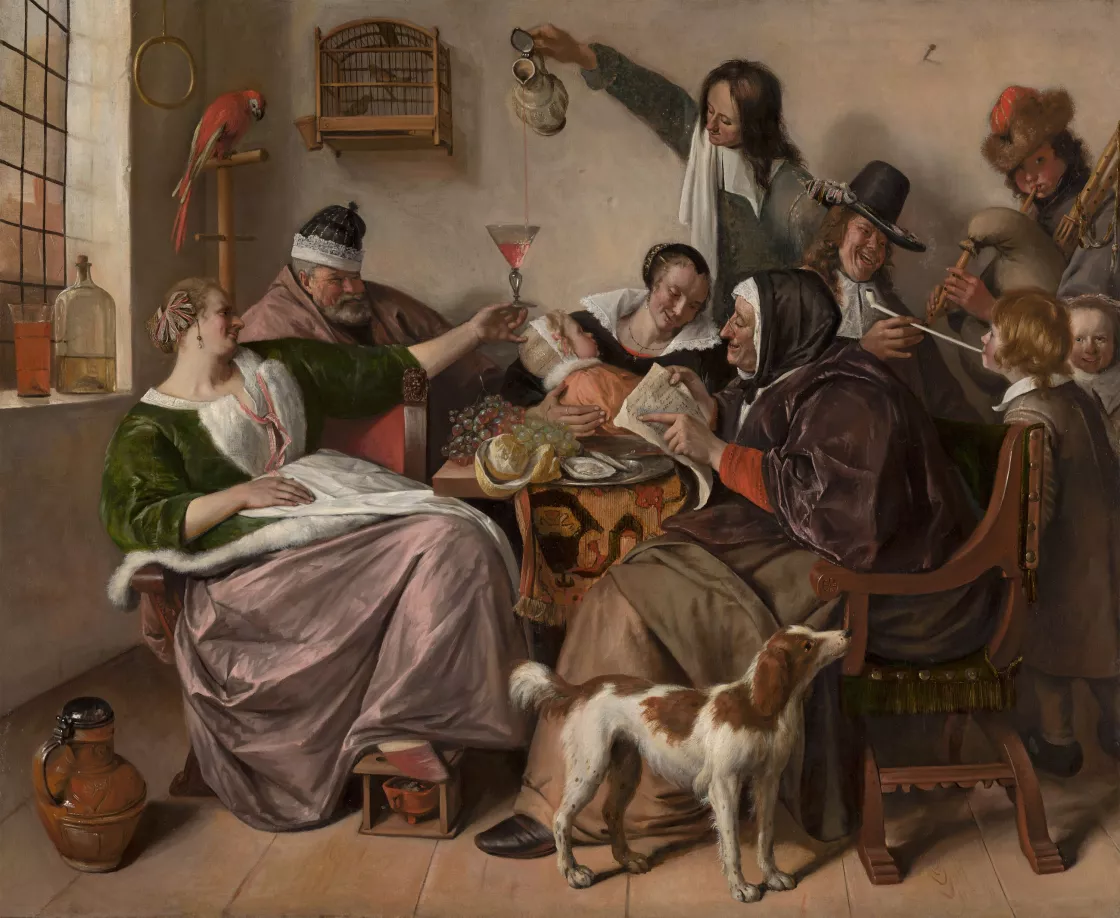
Jan Steen
Leiden, 1626-1679
As the Old Sing, So Pipe the Young
Circa 1668-1670
Oil on canvas
The Hague, Mauritshuis, inv. 742
No seventeenth-century Dutch painter depicted himself in his own paintings as often as Jan Steen. He also features in this monumental picture, dating from the late 1660s. A self-portrait by his hand confirms the laughing man in the black hat is modelled on Steen himself. The multi-talented artist had a liking for proverbs. The one here – ‘As the old sing, so pipe the young’ – is written on the sheet held by the older woman and extolls the virtues of napijpen, or following the wrong example. The adults in the picture demonstrate their bad habits of smoking and drinking to the younger generation: we see the painter mocking his paternal duties by teaching his son to smoke, while his wife, Grietje van Goyen, depicted on the left, raises her glass for more wine. The pouring of the wine literally forms the painting’s centrepiece. Grandfather, at the back on the left with a hat askew, is already drunk. The boys and girl on the right are sometimes described as Steen’s children. The three generations probably came together to celebrate the baptism of the child in the centre of the composition, depicted between the wineglass and the sheet with the proverb.
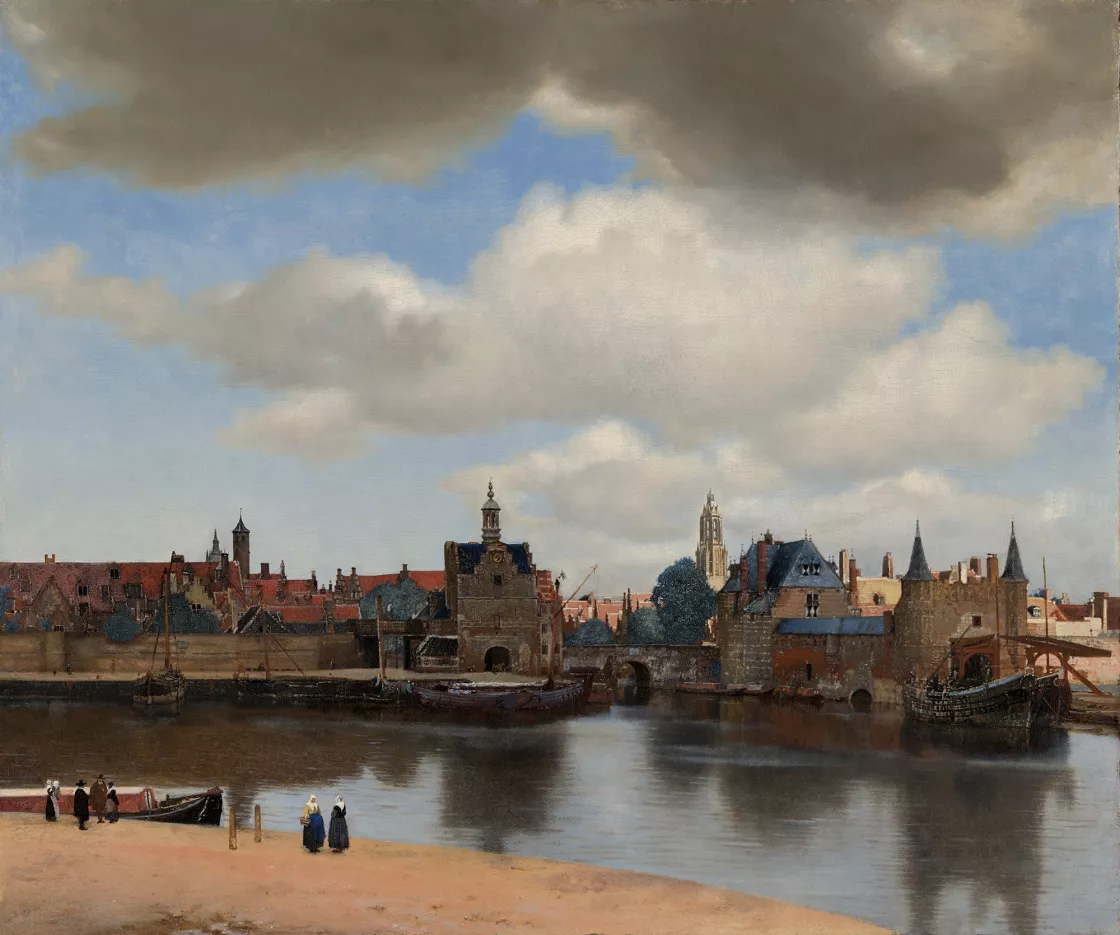
Johannes Vermeer
Delft, 1632-1675
View of Delft
Circa 1660-1661
Oil on canvas
The Hague, Mauritshuis, inv. 92
View of Delft, painted in the early 1660s, belongs to Vermeer’s mature period. Apart from The Little Street, it is the only cityscape in his small body of work. Vermeer presents an unusual view of his city from the south, inaccessible and not identifiable by its best-known landmarks. Delft appears frieze-like, behind the harbour and the city wall, its skyline defined by rooftops and gables. Rising above the buildings are the tower of the Nieuwe Kerk on the right, illuminated by sunlight, and the tower of the Oude Kerk on the left, in shadow. The foreground of the painting is dominated by the harbour, with the Rotterdam Gate and its two towers on the right, the Kapelsburg Bridge in the centre, and the Schiedam Gate with its bell tower and clock on the left. The sky takes up almost the entire upper half of the canvas, while the water with its diffuse reflections stretches to the lower edge, duplicating the buildings with its shadows. The composition is balanced and the soft light defines each element of the painting with precision, resulting in a calm and peaceful image that seems to be suspended in time.
Johannes Vermeer remained largely unknown to the wider public until the 19th century, when the French critic Étienne-Joseph Thoré began to study and promote his work. Vermeer was born in Delft in 1632, but very little is known about his training or his early teachers. We do know that in 1653 he was registered as an independent artist with the Guild of Saint Luke artist and held positions within the guild in 1662 and 1670. Like many artists of his time, he combined painting with activities in the art market. His early works can be classified as history paintings, such as Christ in the House of Martha and Mary (1654–55). He went on to specialise in simple interior scenes with a single figure, usually a woman, such as The Milkmaid (c. 1658–59), and gradually moved towards more sumptuous interiors with several figures, such as A Woman Seated at a Virginal and The Concert, both dating from around 1662–64. His carefully executed works with a quiet, serene atmosphere have also inspired interpretations that explore deeper layers of meaning and symbolism. Although he produced relatively few paintings, he left an enduring legacy: a masterful handling of light, precise attention to detail, subtle treatment of textures and an extraordinarily rich palette. All these qualities make him a unique figure in the history of painting.
How can I describe Rembrandt’s portraits to you? The paintings by Hals, and the View of Delft by Vermeer, are masterpieces akin to the works of the Impressionists.
Letter from Camille Pissarro to his son Lucien, 1882
Vermeer’s View of Delft is perhaps the painting that best expresses in the whole world the meteorological poetry, so to speak, of a landscape; and I could not say just how pretentious the loose and scattered brushstrokes of the Impressionist painters seem after gazing at length at this compact and substantial canvas.
Jean-Louis Vaudoyer, «Le mystérieux Vermeer», L’Opinion, 30 avril 1921
Indeed, the View of Delft is as much an ‘impression of light’ as an accurate and thorough rendering of a city. These two approaches to reality guided later artists in diametrically opposite directions, but in Vermeer they are paired with a skill that nobody will ever equal.
Gilles Aillaud, Albert Blankert, John Michael Montias, Vermeer. Obra completa, 2004
Ever since I saw a view of Delft in the museum in The Hague, I knew that I had seen the most beautiful painting in the world.
Letter from Marcel Proust to Jean-Louis Vaudoyer, 1921
But one of the critics having written somewhere that in Vermeer’s Street in Delft (lent by the Gallery at The Hague for an Exhibition of Dutch painting), a picture which he adored and imagined that he knew by heart, a little patch of yellow wall (which he could not remember) was so well painted that it was, if one looked at it by itself, like some priceless specimen of Chinese art, of a beauty that was sufficient in itself. […] At last he came to the Vermeer which he remembered as more striking, more different from anything else that he knew, but in which, thanks to the critic’s article, he remarked for the first time some small figures in blue, that the ground was pink, and finally the precious substance of the tiny patch of yellow wall.
Marcel Proust, In Search of Lost Time, 1913–27