
The Freudian Universe of Dalí
Extended works
Salvador Dalí
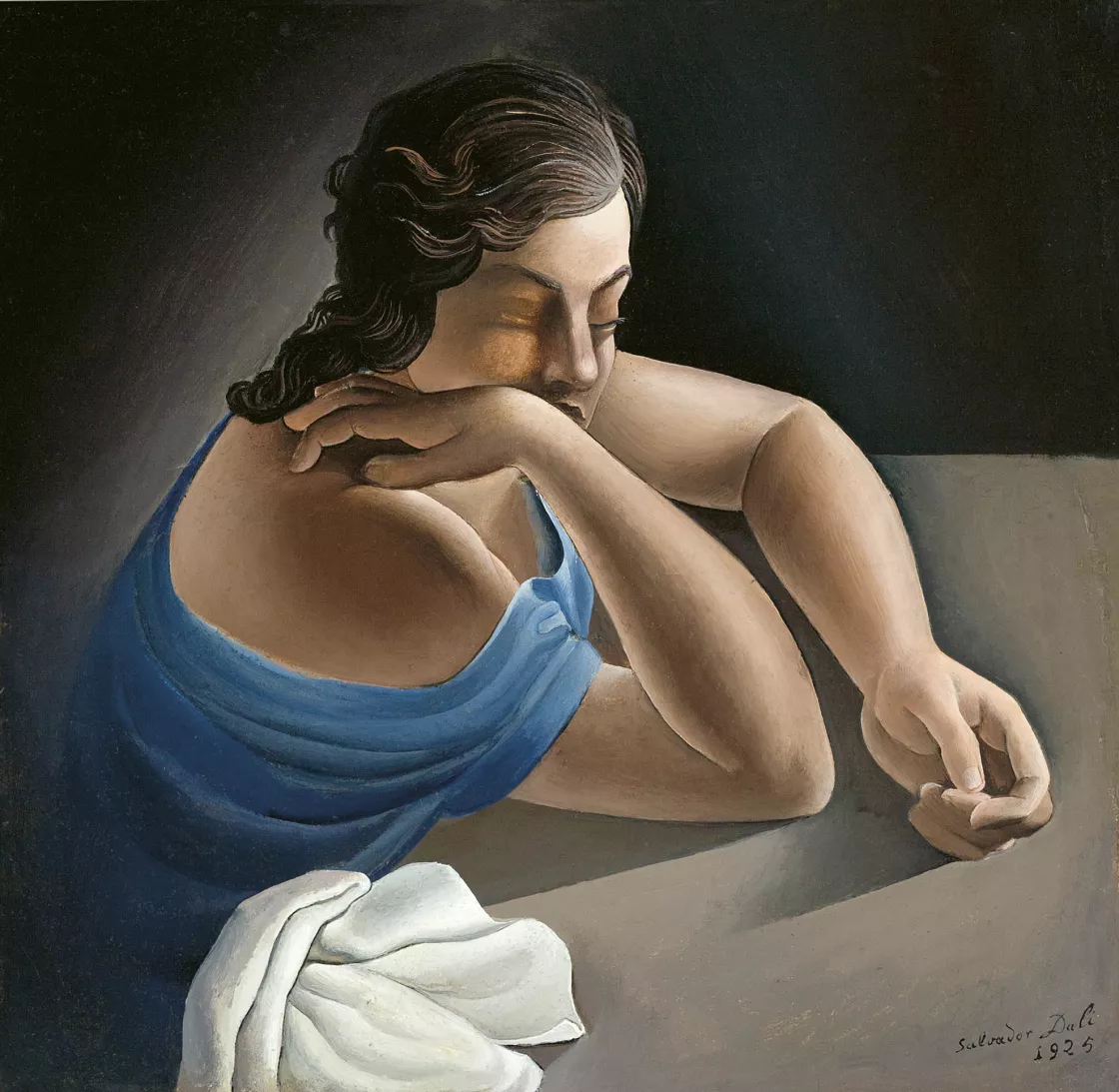
Figure at a Table (Anna Maria Dalí, the Artist’s Sister), 1925
Prominent among the avant-garde trends that influenced Dalí were the new figurative styles that spearheaded modern art in interwar Europe. Attentive to the aesthetics of the Italian Novecento and to German magical realism and New Objectivity, Dalí produced significant works such as the Portrait of Luis Buñuel (1924) and the numerous portraits of his sister dating from this period. This painting is a particularly unusual example of this formal approach, as it combines a figurative style with classical overtones with complex foreshortening and evocative lighting – characteristics that evidence his concern with renewal and modernity.
Yves Tanguy
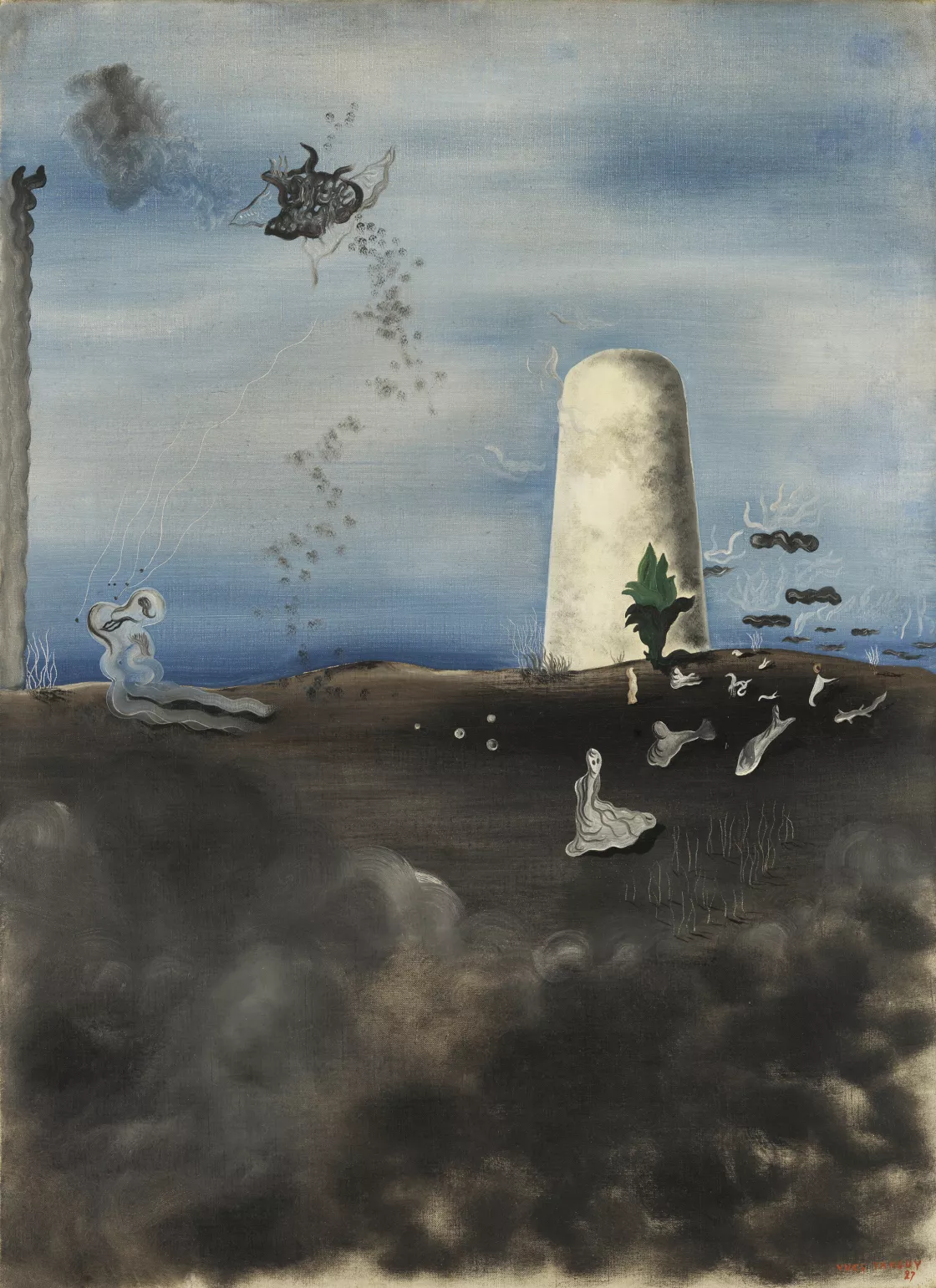
Death watching his Family, 1927; and the drawings of Cajal, Lorca and Dalí
Santiago Ramón y Cajal’s histological drawings of nerve tissue were published in the late 1800s. They were accessible not only to scientists, but also to other intellectuals and artists. When Surrealist painters such as Yves Tanguy and André Masson experimented with ‘automatic drawing’, their images revealed a striking resemblance to those of neural tissue, which provided a vivid map of human thought and imagination. At the Residencia de Estudiantes in Madrid, Lorca and Dalí had already read Freud by 1926. They had also heard about the Surrealist movement and had seen French publications featuring Tanguy’s and Masson’s automatic drawings. Cajal happened to be at the Residencia de Estudiantes around the same time, and Dalí and Lorca therefore had the opportunity to view the Spanish scientist’s drawings firsthand. The result of this confluence of circumstances was that the poet and the painter began to produce a series of drawings that blended all these influences.
Salvador Dalí
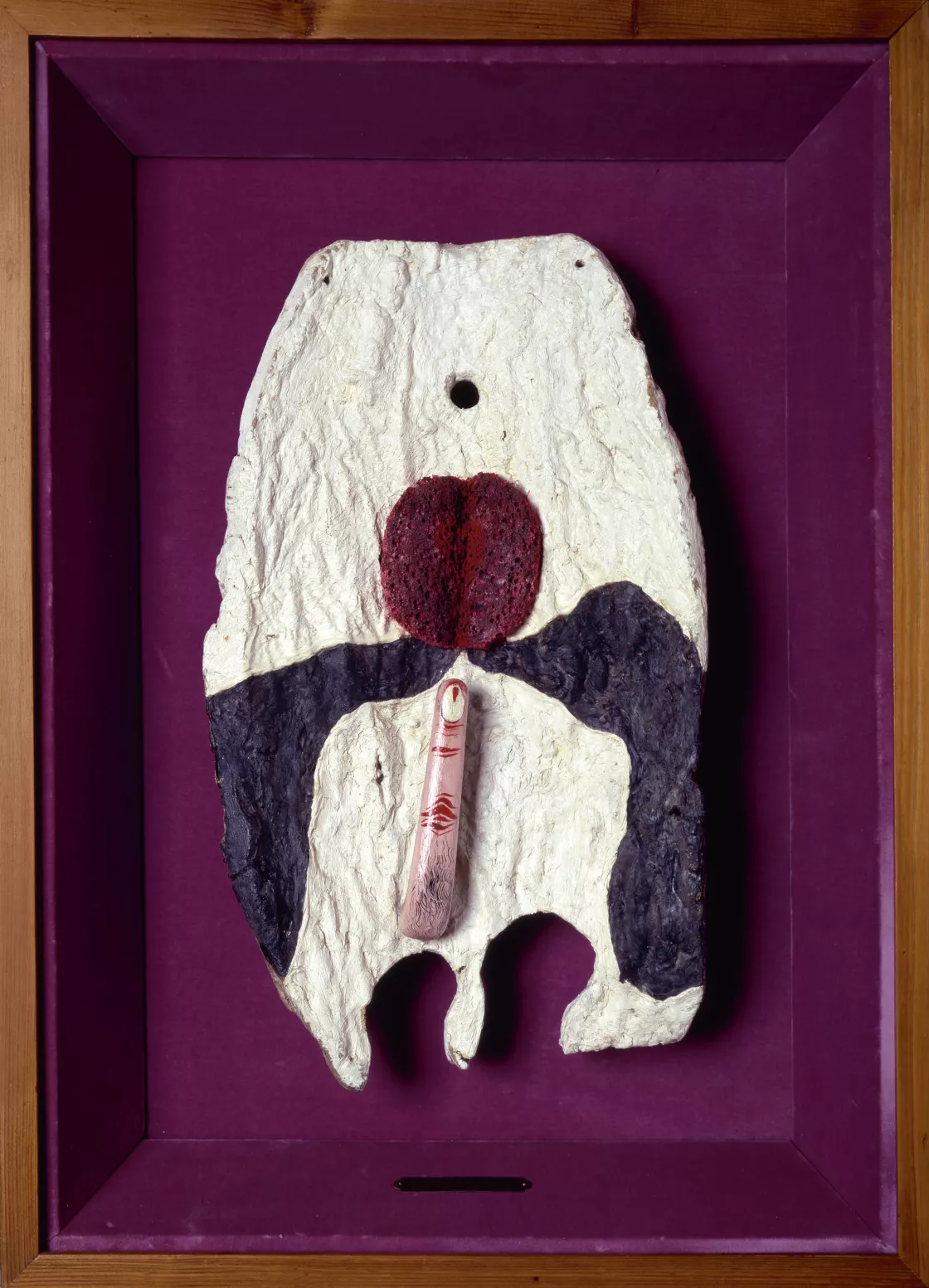
Anthropomorphic Beach (fragment), 1928/1948
This assemblage by Dalí is fully in tune with the biomorphic language that Hans Arp began to develop in the mid-1910s. Drawing on the recurring erotic context that the artist associates with the beach, it alludes directly to female masturbation. It is part of a visual language that the artist employed in two-dimensional works throughout 1928, exploring various Freudian themes. From 1929 onwards, this connection with Arp’s flat-coloured forms gave way to soft forms in which the treatment of perspective always suggested a three-dimensional nature. tridimensional.
Salvador Dalí
The Invisible Man, 1929-1933
Julio Romero de Torres
The Saeta, 1918
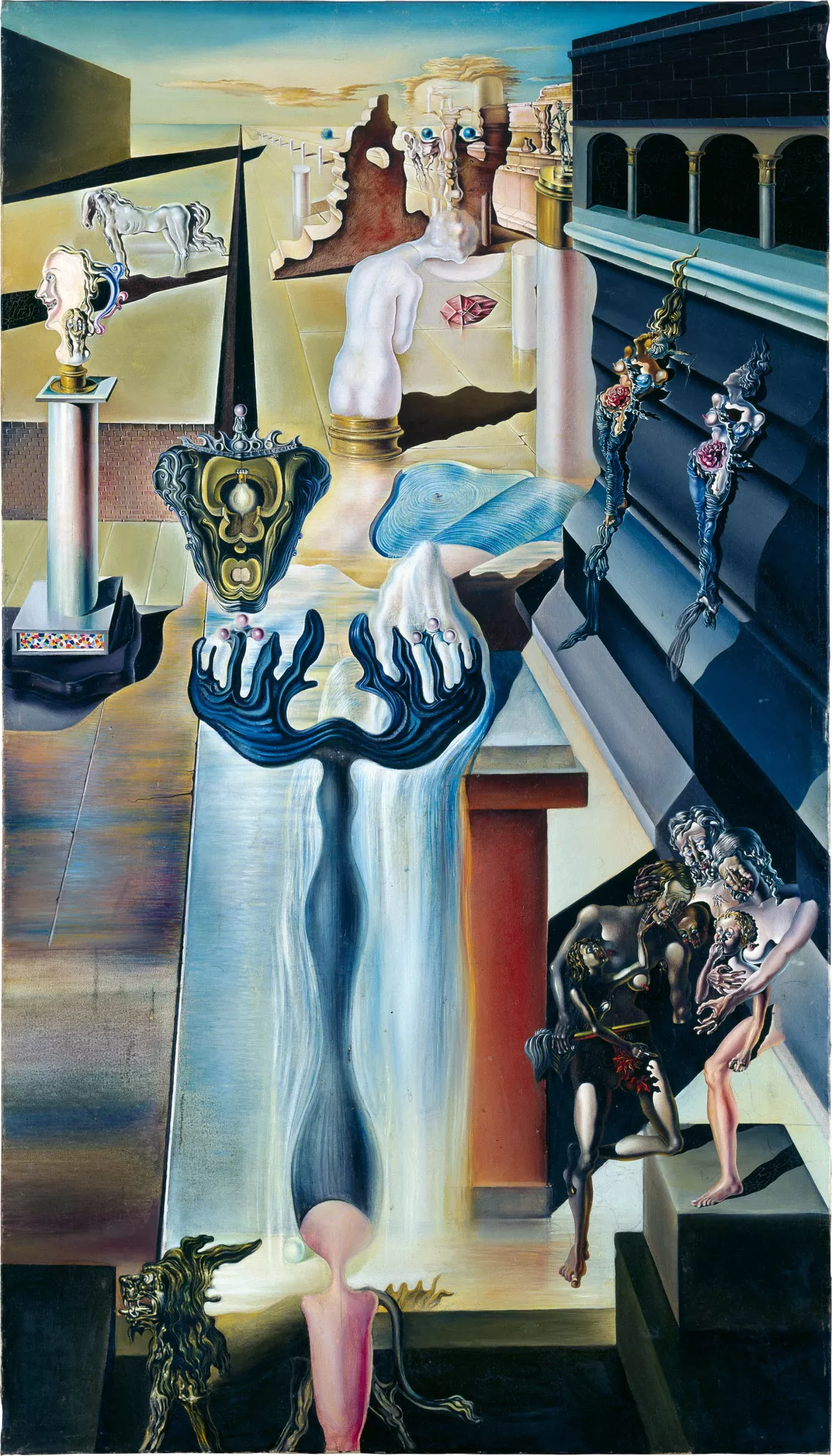
The Invisible Man is Dalí’s first work that explicitly features a ‘double image’, a visual device that became one of the key perceptual concepts in the theory of critical paranoia. In it, the viewer visually reconstructs the figure of the man who appears to be resting his hands on his knees, based on the strategic placement of various elements: clouds, furniture, spheres, a female nude seen from behind with her head leading forward, columns, water… In turn, there are a number of figures that complete the narrative space, such as a small horse which is also a double image containing a female nude, a symbolic self-portrait in the form of a jug on a column, nude women with roses on their bellies, the lion through which Dalí embodies sexual desire, and a paedophilic scene fraught with disturbing family resonances. The Invisible Man is also painting that has close connections with The Saeta by Julio Romero de Torres, who taught Dalí drapery at the San Fernando Academy.
Salvador Dalí
Remorse or Sphinx Embedded in the Sand, 1931
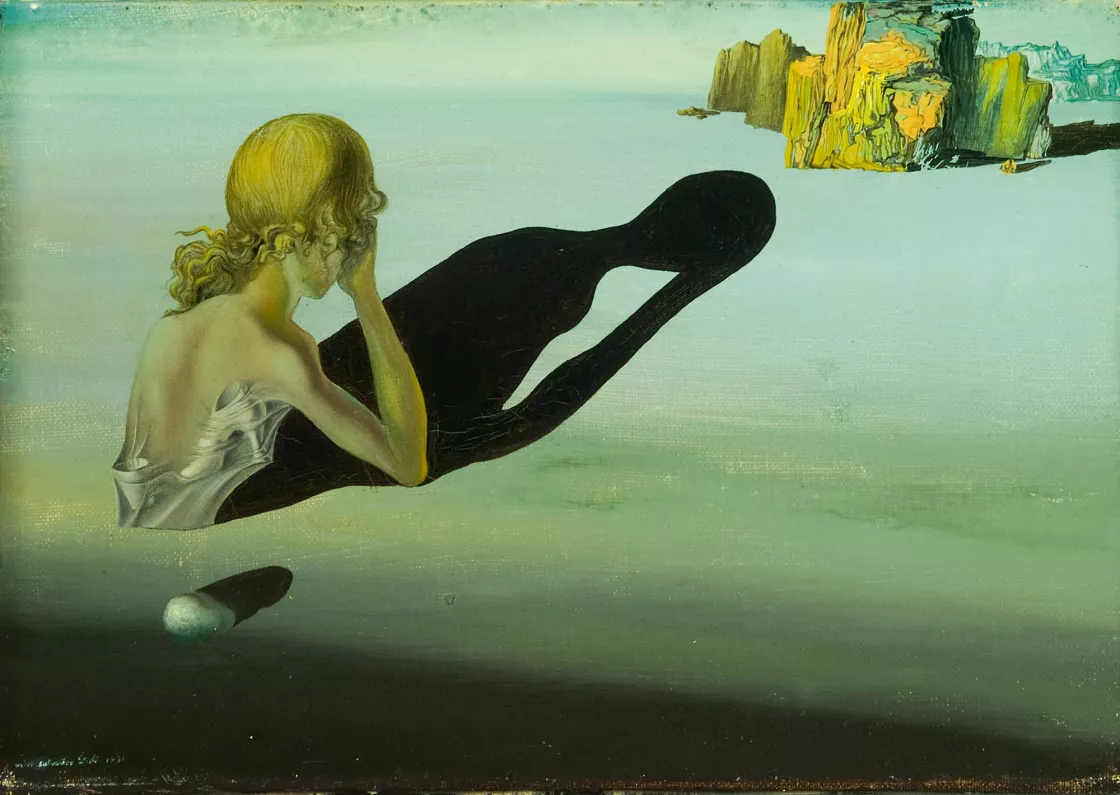
Remorse, a psychological impulse often explored by Freud, is expressed here through the female bust buried in a desert landscape, whose shadow resembles a male figure. The woman’s dress contains the double images of a fetishist high-heeled shoe and a steaming cup, infusing this remorse with a sexual undertone. The rock formations in the background are reminiscent of those on the coast of the Empordà, where Dalí spent his adolescence. The work is a good example of psychoanalytic introspection.
Salvador Dalí
Diurnal Fantasies, 1931
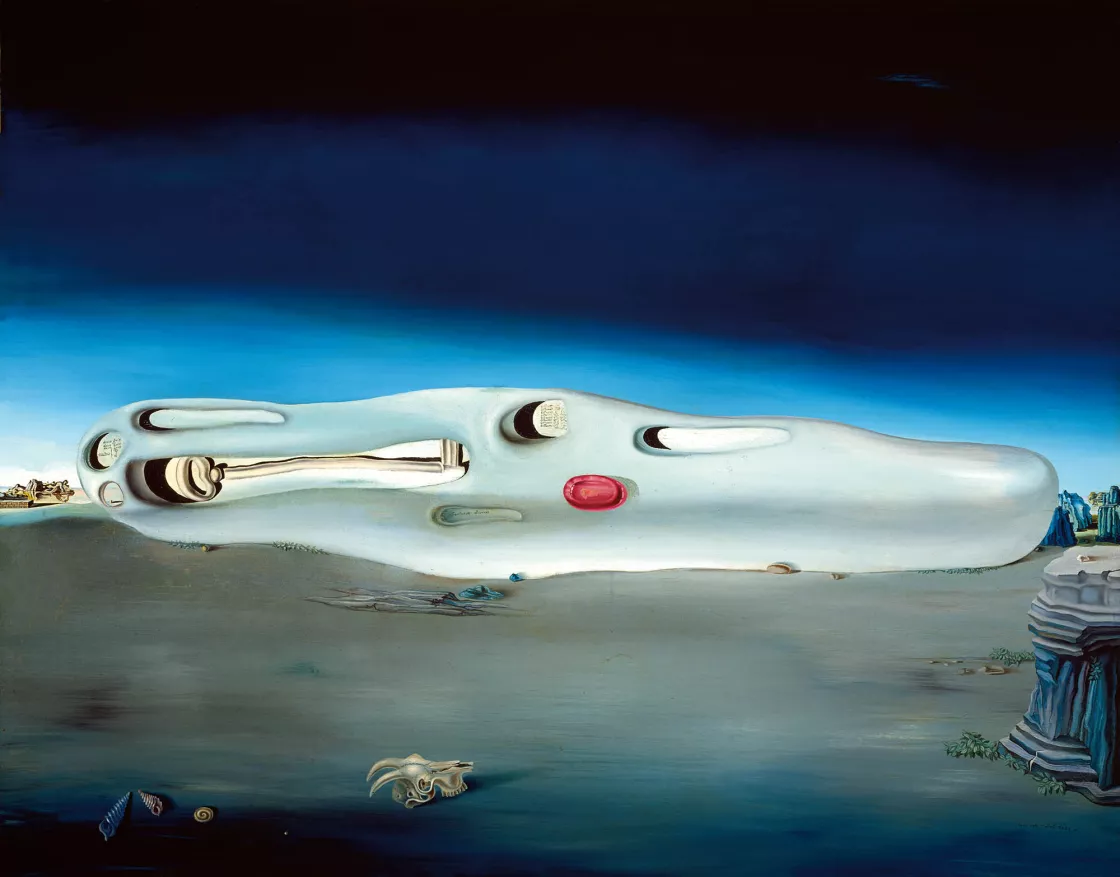
Dali’s ‘critical paranoia’ alludes to states of mind that transcend the appearance of things. The resulting landscape depicted here contains a motley assortment of diverse elements. In the distant horizon, where what appear to be various creatures and rocks can be made out, a huge, soft, whitish form suggesting something slimy shelters in its hollows a limp key to dreams, a cameo and possibly a soft watch. But its lower part is transformed into what could be a cloud. In the foreground, seashells, a goat’s skull and cliff rocks complete this ambiguous landscape.
Salvador Dalí
Man Fishing, 1931
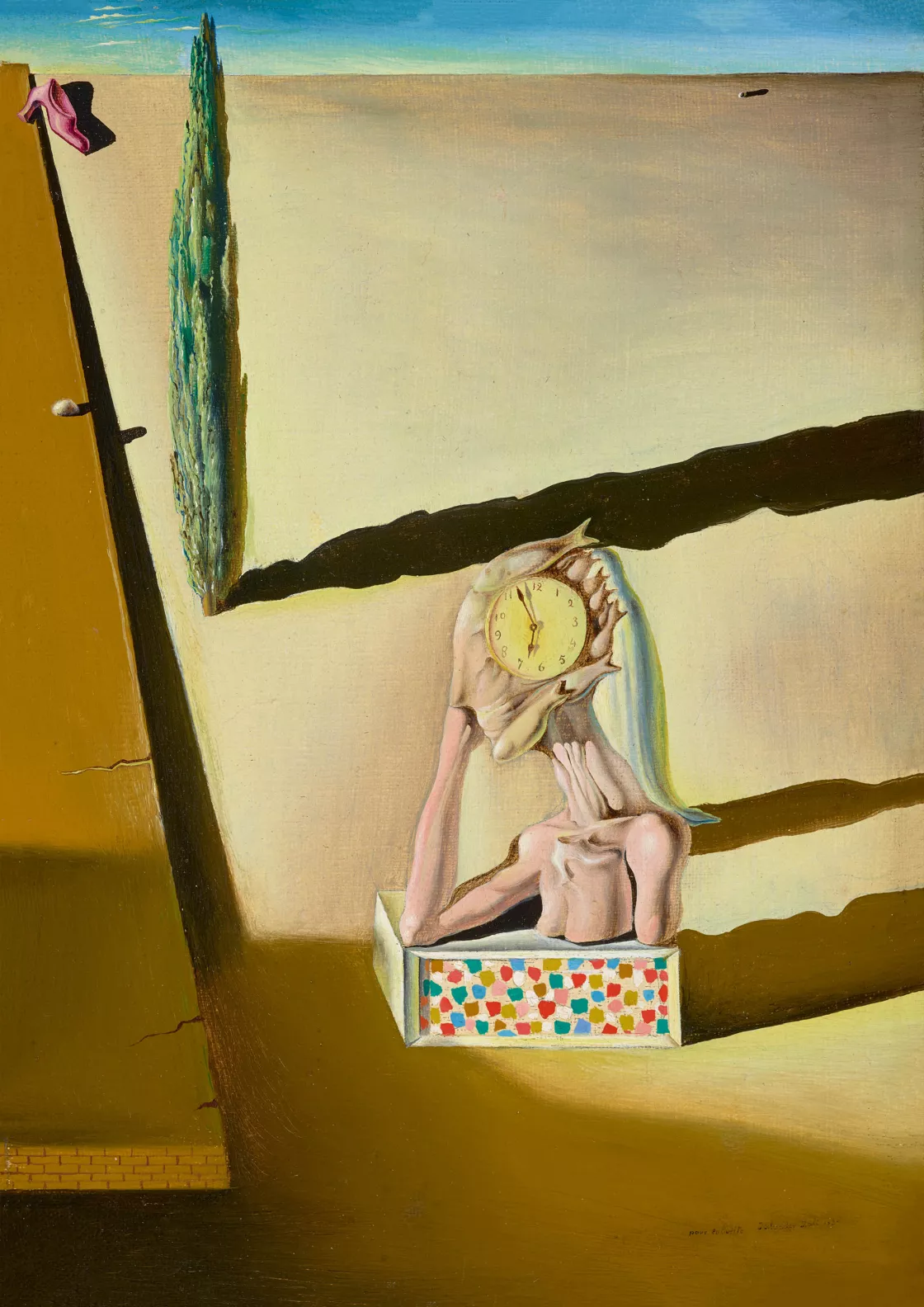
Visual polysemy in the form of double images is one of the key elements of the artist’s paranoiac-critical method. It is exemplified by the monumental bust of a male (or possibly female, or androgynous) figure, whose head merges with a cluster of fish surrounding a clock (time and memory) and whose collarbone is a fetishist high-heeled shoe. A cypress tree with phallic connotations, reminiscent of those in Arnold Böcklin’s paintings to which Dalí so often alluded, is set in a solitary landscape that once again features the image of a high-heeled shoe and the small sphere that references works by René Magritte and Max Ernst.
Salvador Dalí
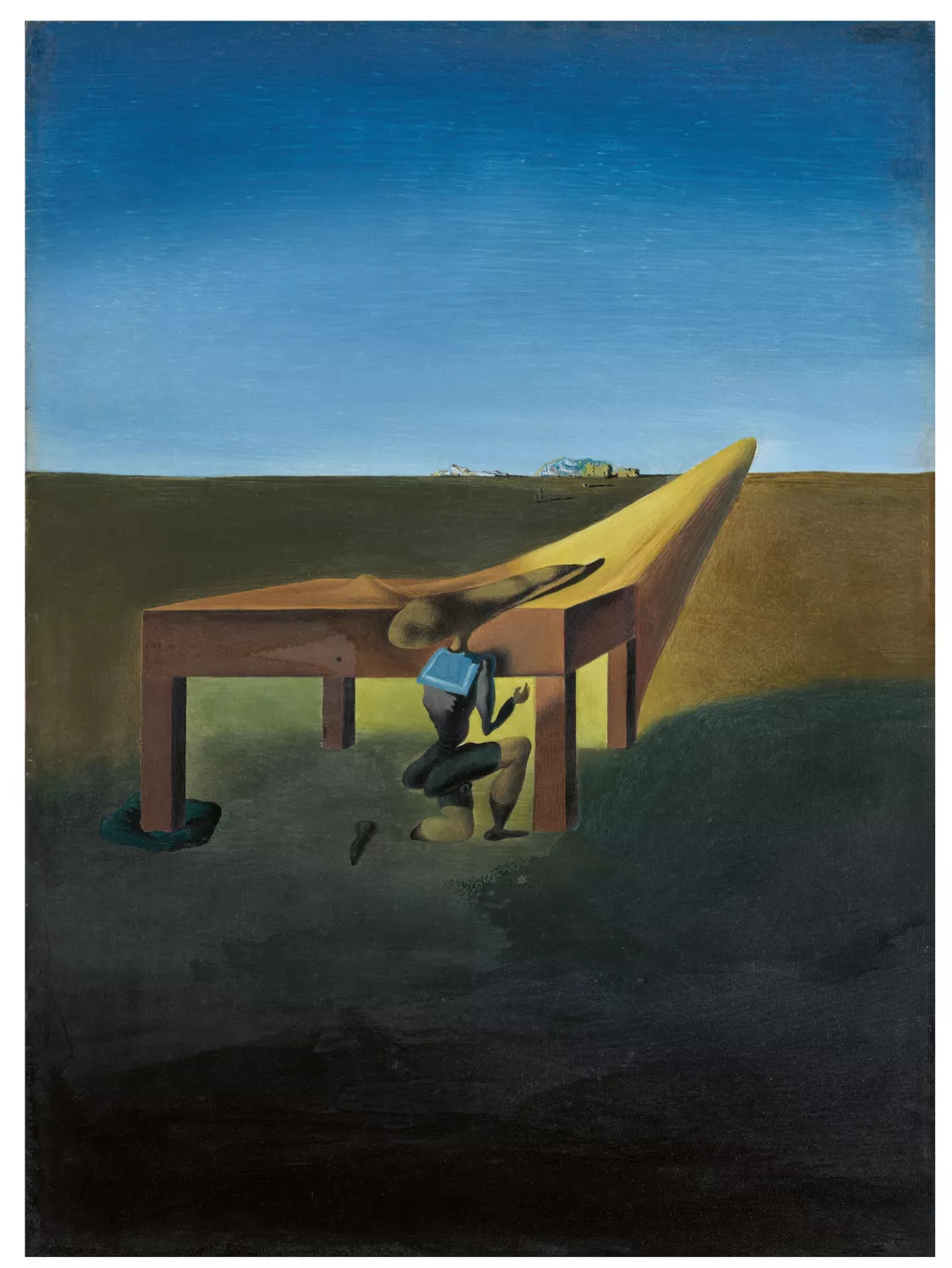
Myself at the Age of Ten When I was the Grasshopper Child, 1933
Freudian literature often referred to the idea of the castration complex. In the title of this symbolic self-portrait, Dalí alludes to his phobia of grasshoppers, an image he repeatedly used in the portraits of himself as a great masturbator. The painting conveys the sense of guilt associated with masturbation which can lead, precisely, to that complex. The table and the child’s head are distorted and elongated in a paranoid allusion to penile erection. The desolate, semi-desert landscape once again evokes scenes from the painter’s childhood.
Salvador Dalí
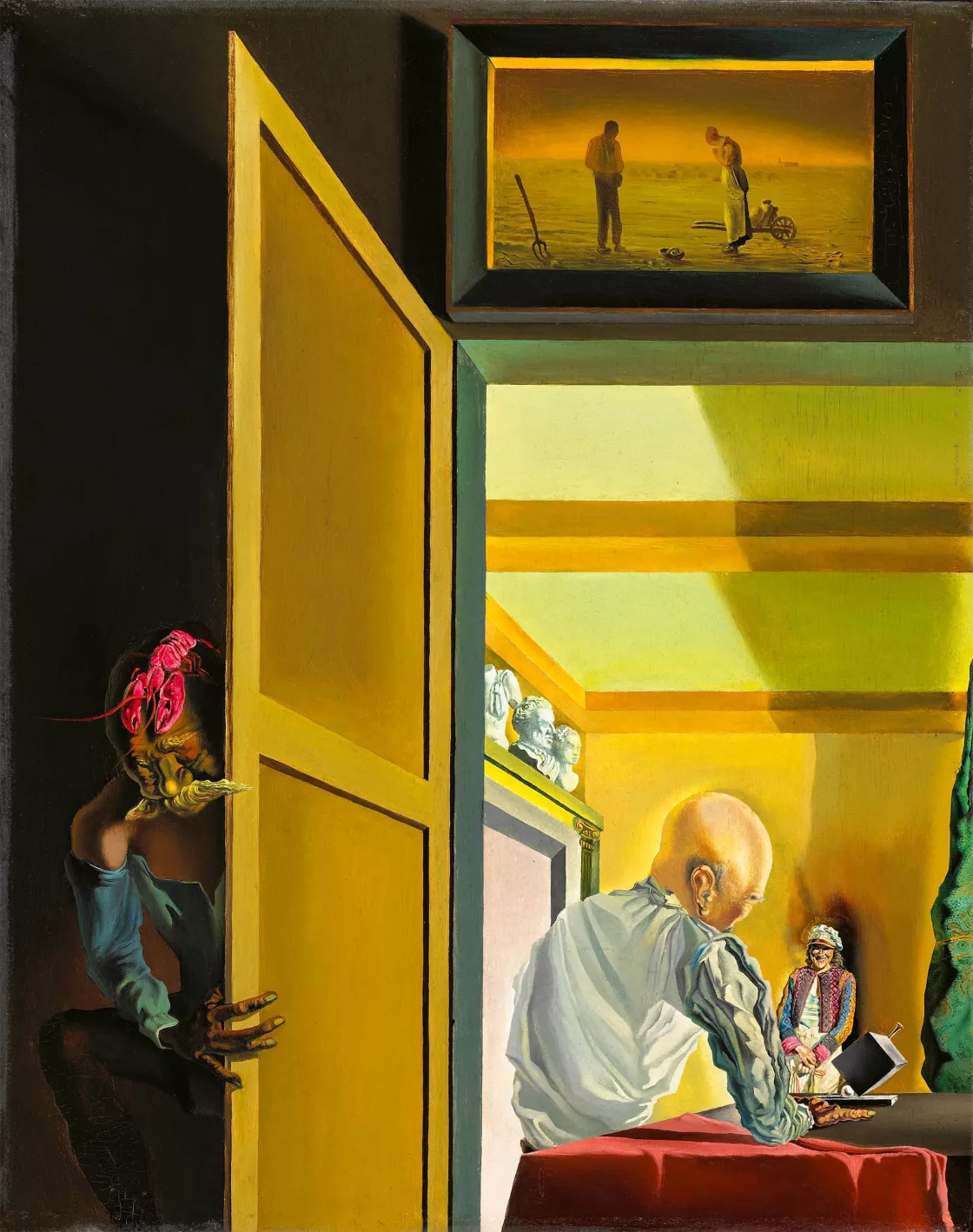
Gala and the Angelus of Millet Immediately Preceding the Arrival of the Conic Anamorphoses, 1933
Jean-François Millet’s The Angelus (1857–1859) was one of the works that most obsessed Dalí and the basis for many of the arguments of his paranoiac-critical method. Here, a figure with paternal connotations – whose head, covered by a lobster, is filled with blurred double images – opens the door to the magical moment of the anamorphoses. A smiling Gala observes the figure, seen from behind, who is balancing a cube and a small sphere with a hand that is disintegrating. The scene is dominated by a print of The Angelus as a symbol of alchemical power.
Salvador Dalí
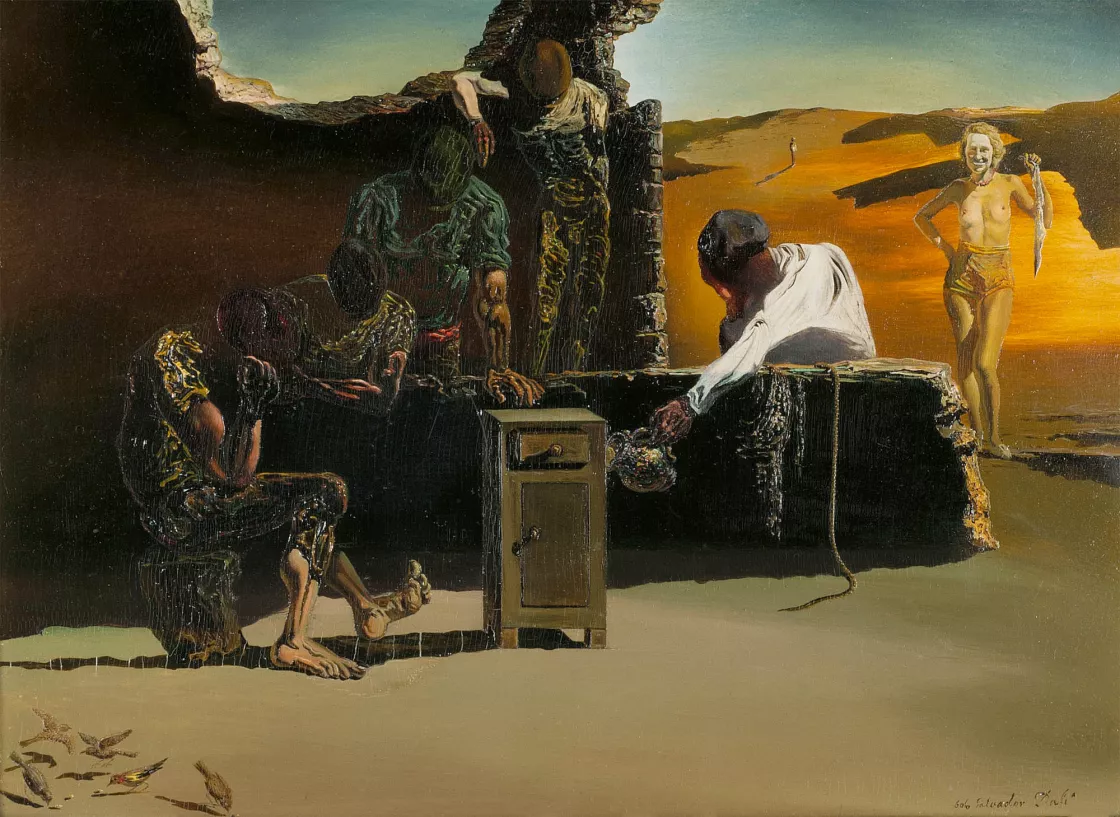
Cardinal, Cardinal!, 1934
This work brings together numerous Freudian images. At the centre of the composition is a bedside table with a half-open drawer, a reference to dreams. On it – a clearly sexual allusion – a self-portrait of the artist with his head turned away pours the liquid from a jug. Figures with concealed faces evoking the intriguing rocky formations of the Cape of Creus witness this scene in which an androgynous Gala gazes smilingly while holding a damp cloth. Meanwhile, some goldfinches peck away peacefully in the foreground.
Salvador Dalí
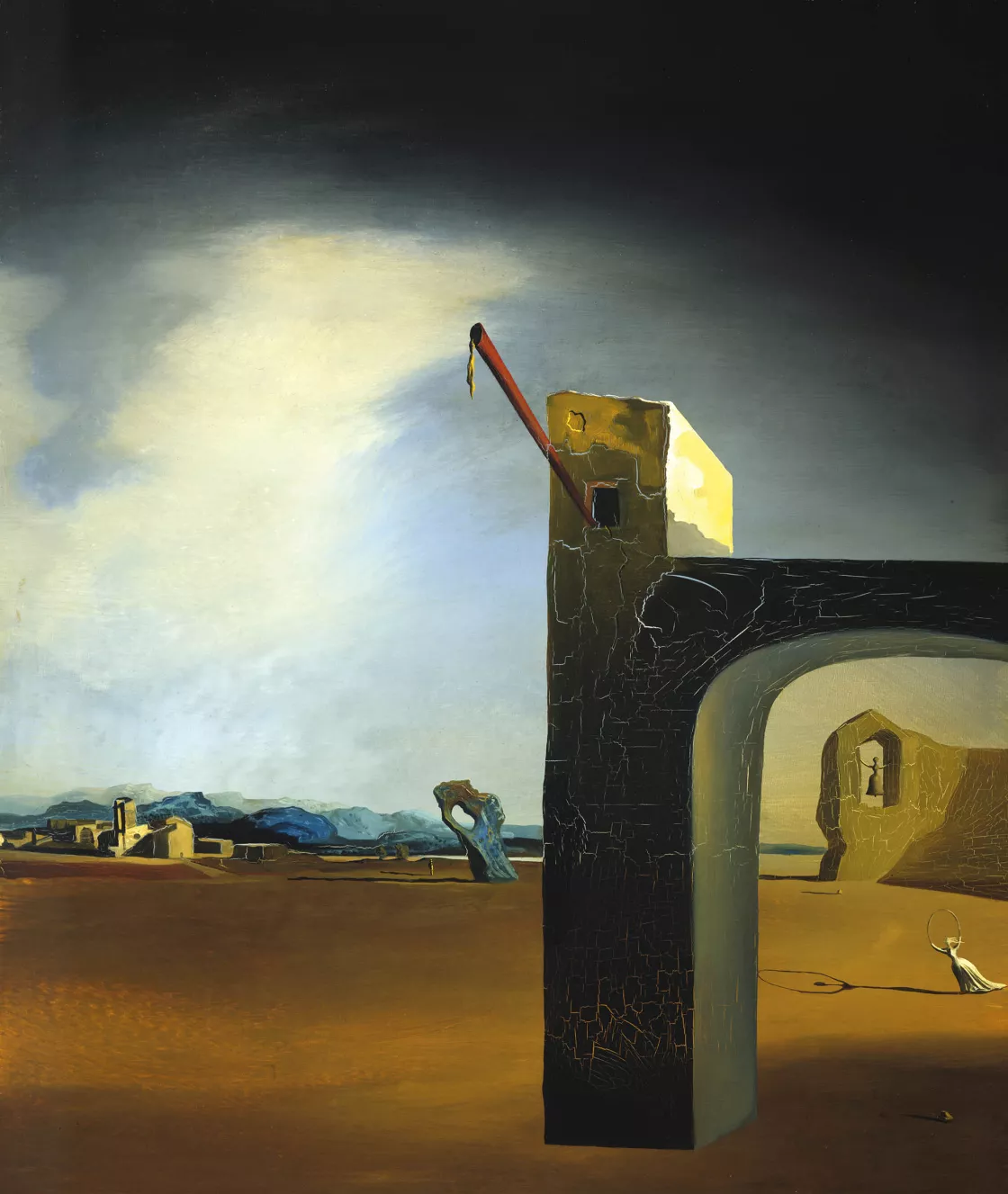
Morphological Echo, about 1934
This work depicts a strange structure with a dark window. Emerging from it is a tube, from which hangs a damp cloth or something deflated and limp. In the distance, beneath the visible fragment of the structure’s segmental arch, is a rock formation with an opening containing a bell whose silhouette recalls a female figure. Between the structure and this rock is a running woman who casts a strange shadow with what appears to be a curved rod in her hands. On the left, a hollowed-out rock seems to mirror the running woman’s posture. And between the rock and the sketchy background village is a tiny human figure that, once again, appears indecipherable and unsettling.
Salvador Dalí
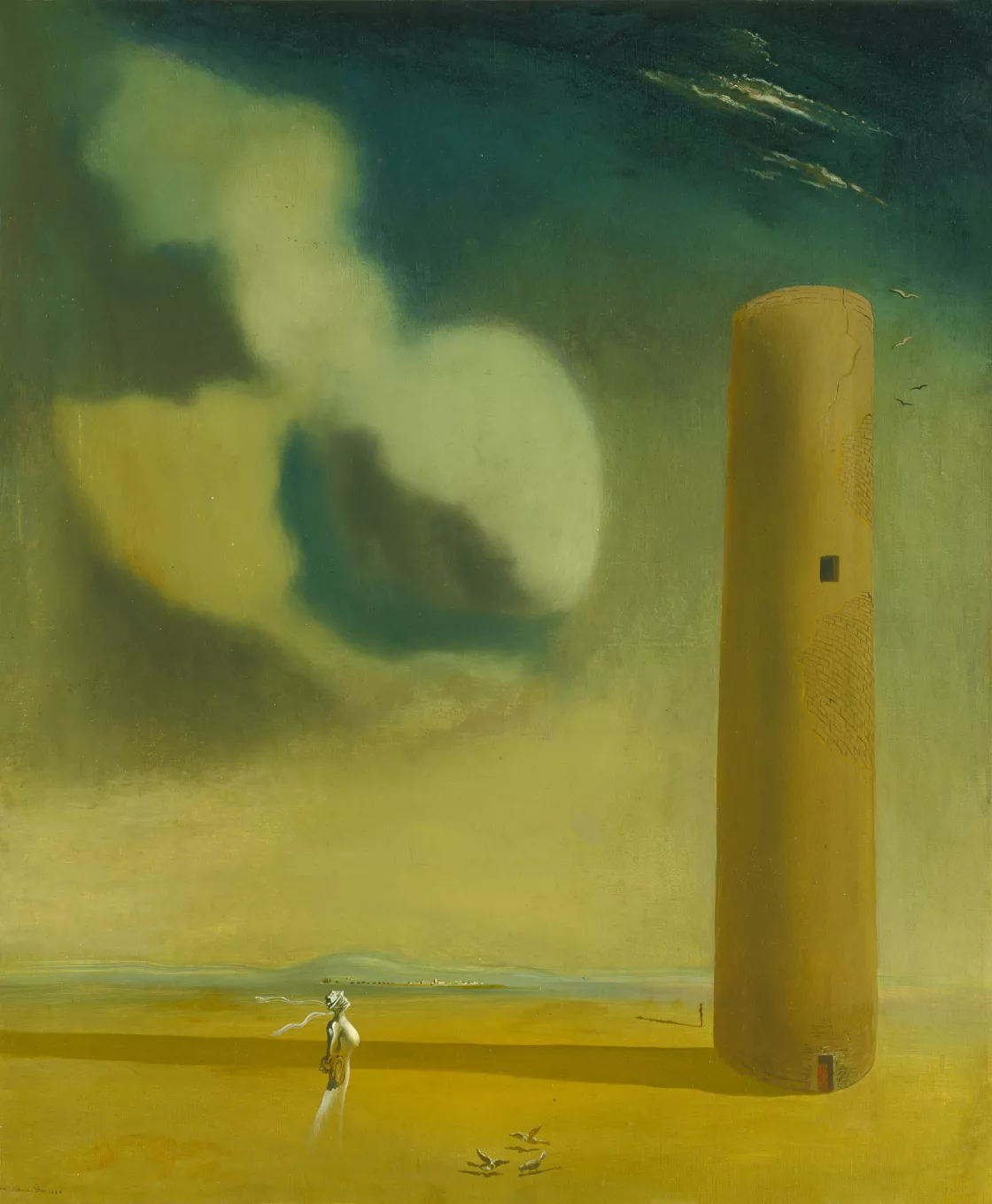
The Tower, 1936
A transparent, ghostly woman whose feet are fading away, severing her connection with reality, gazes at an enigmatic tower rising from a desert landscape. A hazy city can be glimpsed on the horizon, while in the foreground birds peck at the ground; at the same time, a distant male figure casts its elongated shadow, much like the tower. This landscape reveals certain Daliesque dream-like elements with evident Freudian overtones. The tower alludes to the phallus, the frayed clouds to ejaculation, and the cumulus clouds seem to represent, in a paranoiac double reading, a couple embracing.
Salvador Dalí
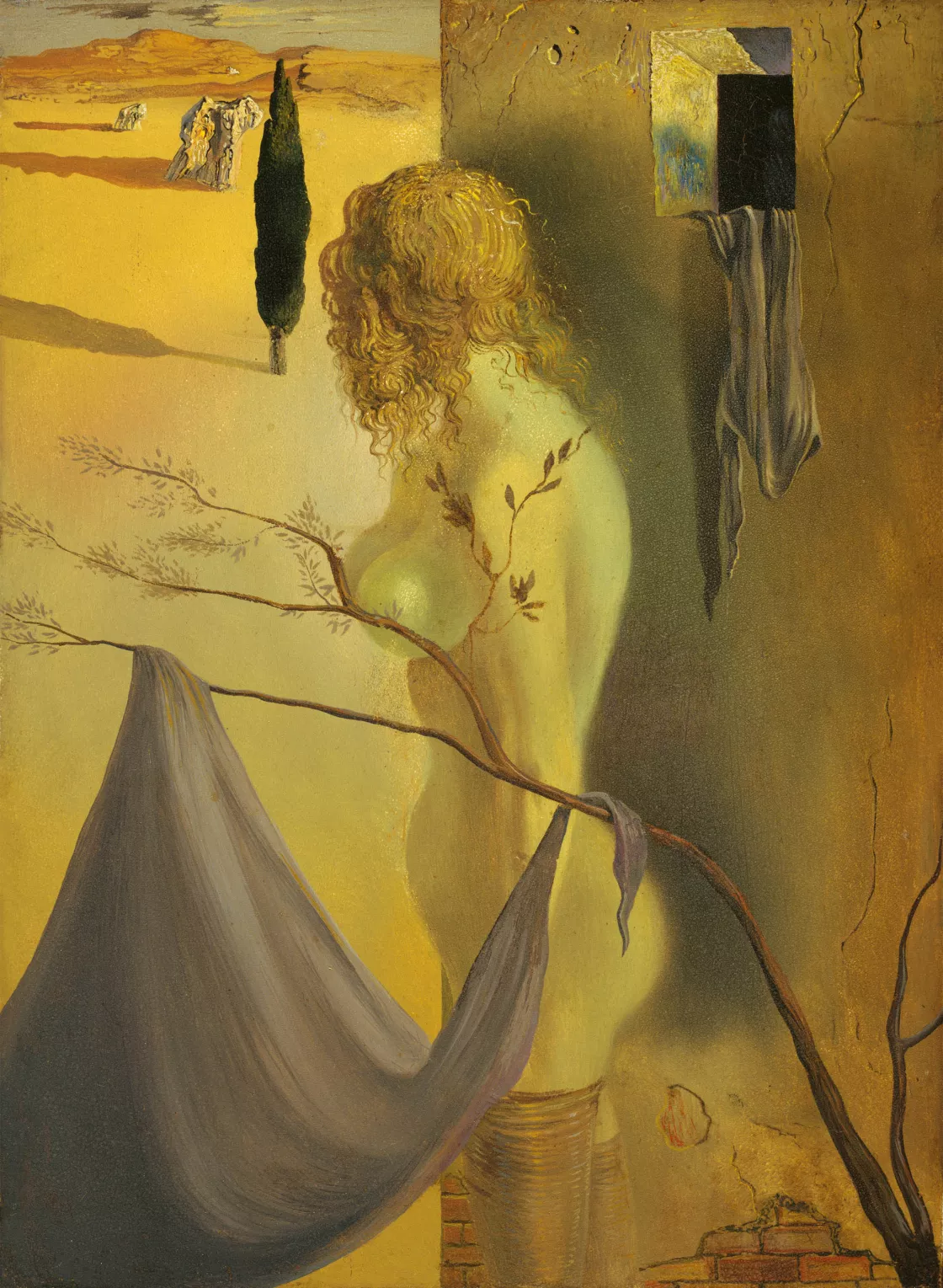
The Signal of Anguish, 1936
Fear of sexual intercourse was one of Dalí’s obsessive complexes. On the right and left of the female figure, obvious visual metaphors for penile erection and flaccidity – suggested by the cypress tree and the limp cloth – establish a distinctly Freudian frame of reference. The turned head and the stockings covering the naked woman’s legs allude to the conflict between desire and guilt that generates anxiety. The repetition of rocky yet anthropomorphic forms that fade into the distance constitutes double images that are the product of a paranoiac-critical gaze.
Salvador Dalí
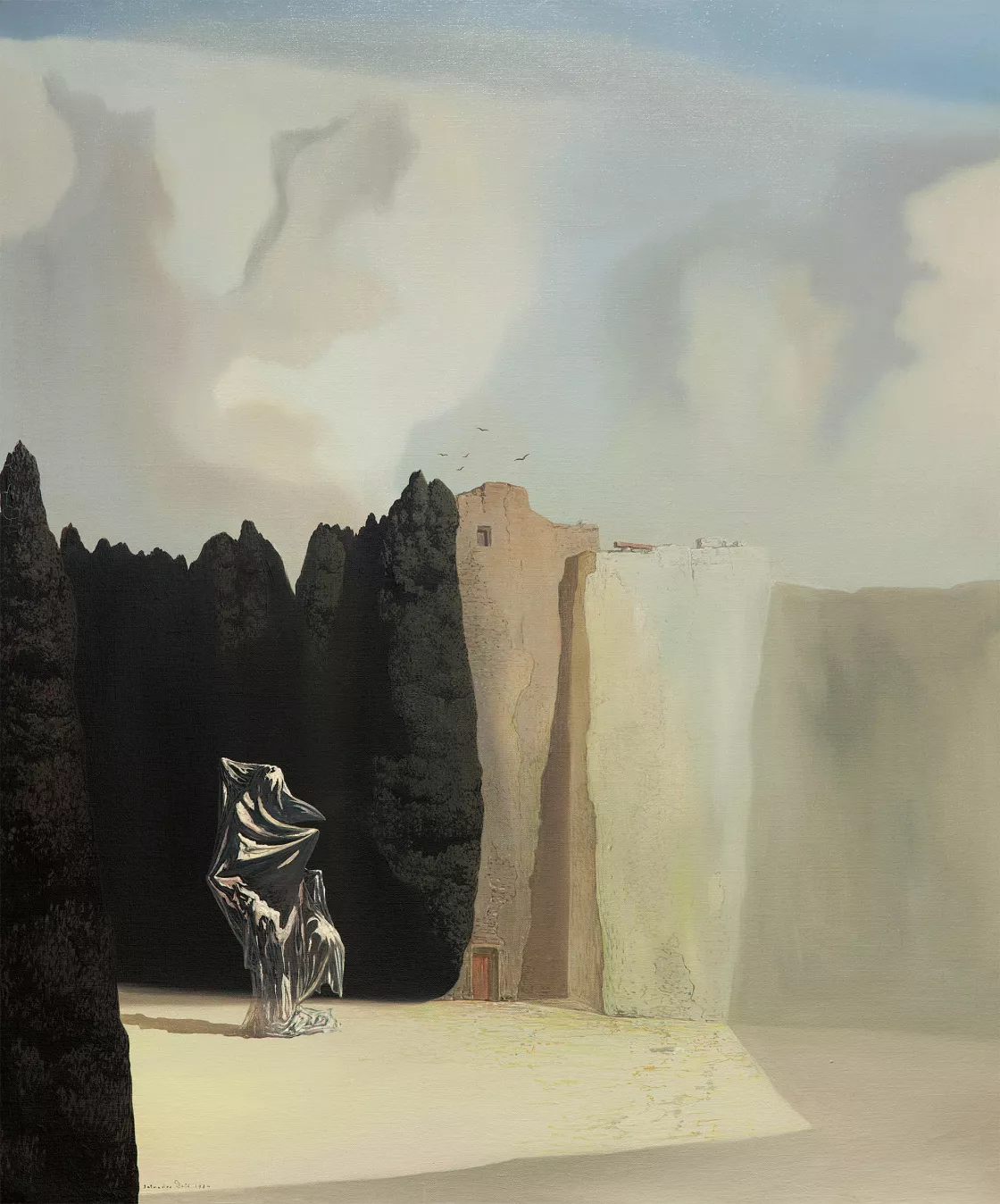
West Side of the Isle of the Dead (Reconstructed Compulsive Image After Böcklin), 1934
Arnold Böcklin’s painting of the Isle of the Dead, in its various versions, has always held great fascination even for figures as diametrically opposed as Hitler and Lenin. It is also one of the clearest links between Freud and Dalí, as the psychiatrist kept a reproduction in his Vienna studio and the painter made countless visual references to it. This work is one of Dalí’s most explicit examples, as it fantasises about an obsessive journey into the heart of that imaginary island. The steep cliffs with architectural remains, the cypress trees alluding to death and the phallus, and the ghostly figure of Charon the boatman, who seems to conceal an erection beneath his sinister robe, are highly characteristic.
Salvador Dalí
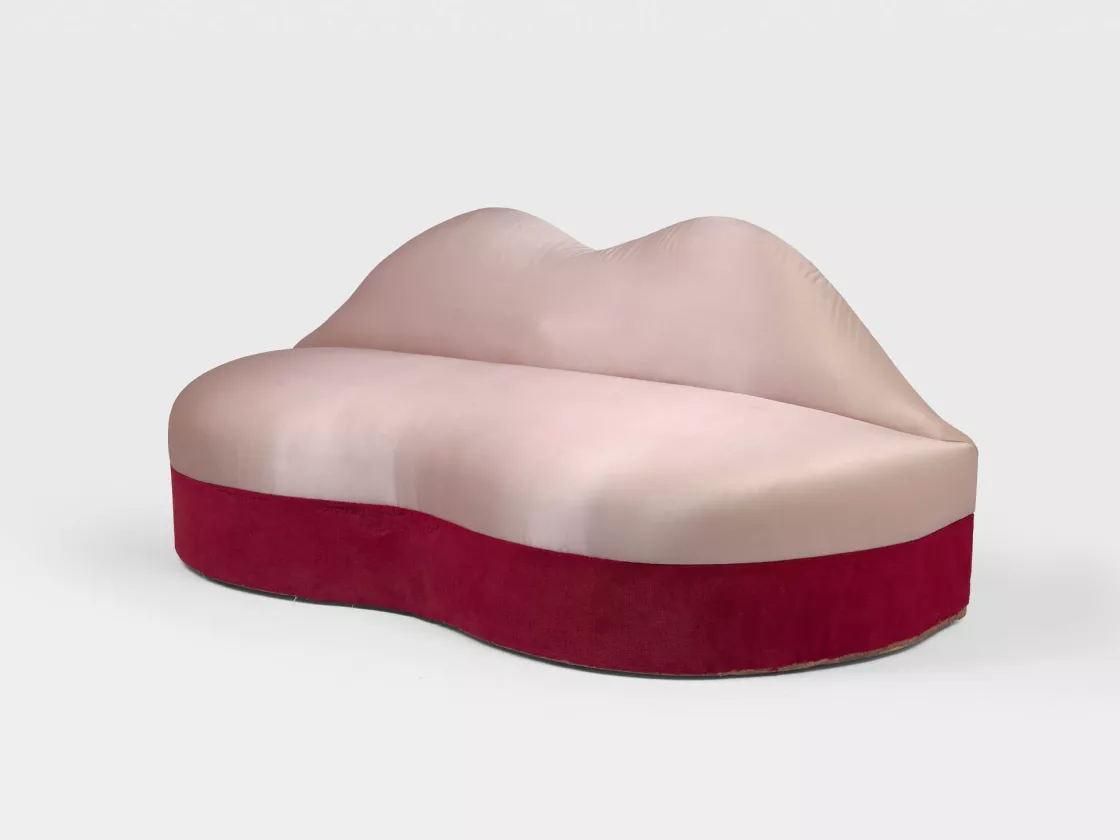
Mae West Sofa, about 1937
In 1937, Jean-Michel Frank designed several rooms for Baron Roland de l’Espée. Among them was a ballroom and cinema where he placed this Daliesque Mae West Sofa. It must have been one of the five examples made in 1935 by an English craftsman at the request of Edward James and acquired by Frank (or perhaps constructed in his workshops on Rue Montauban). Whatever the case, Frank placed it on display in his shop as early as January of that year.
Salvador Dalí
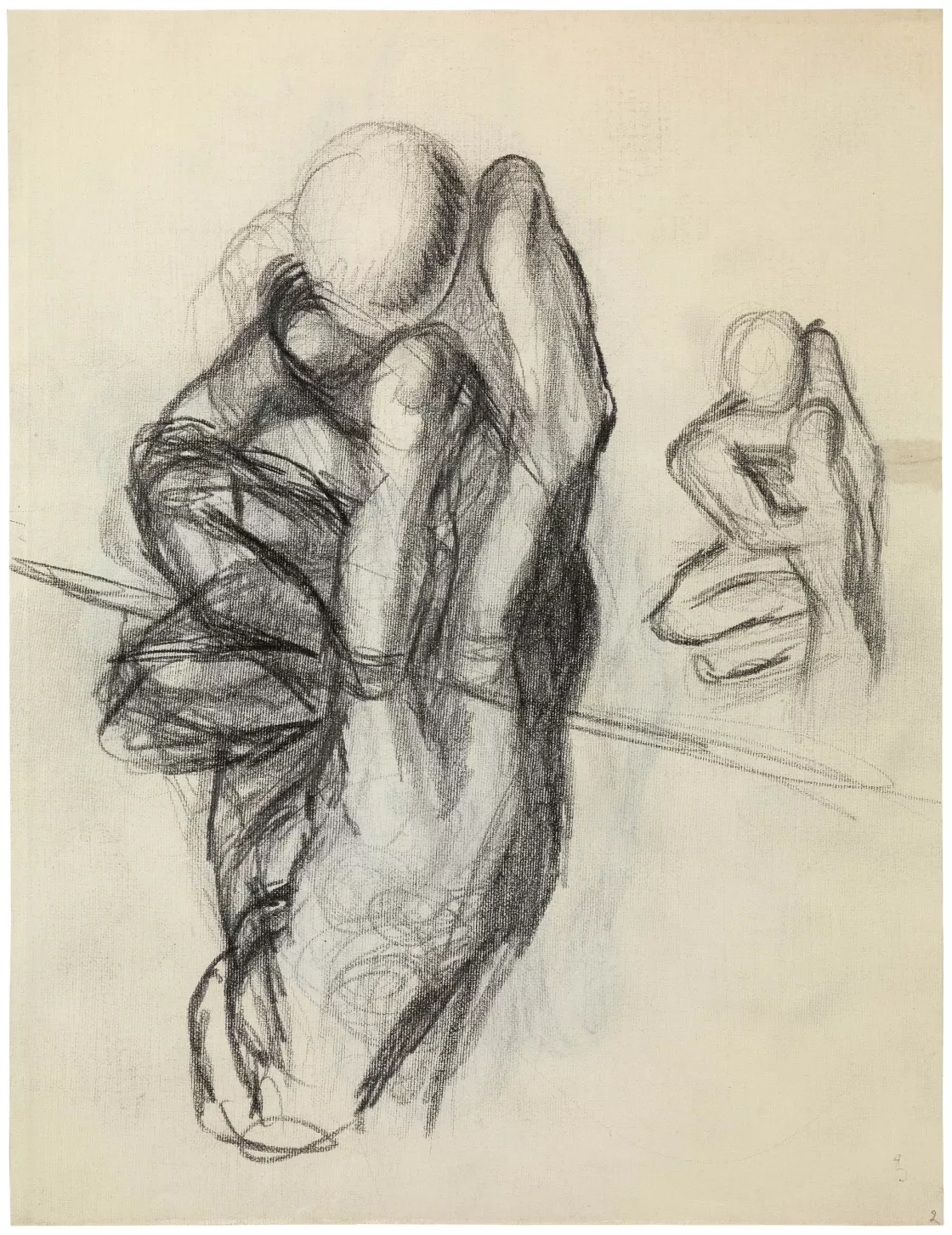
Study for “The Metamorphosis of Narcissus”, about 1937
This drawing shows one of the earliest ideas for The Metamorphosis of Narcissus, the painting Dalí chose to show Freud when they met in 1938. The classical myth of Narcissus gazing at his reflection in the water is evident in this preliminary drawing through the use of a double image. The appearance of a hand holding an egg is created by combining the figure of the kneeling Narcissus with his reflection in the water. Narcissism and onanism thus emerge as central themes.
Anonymous
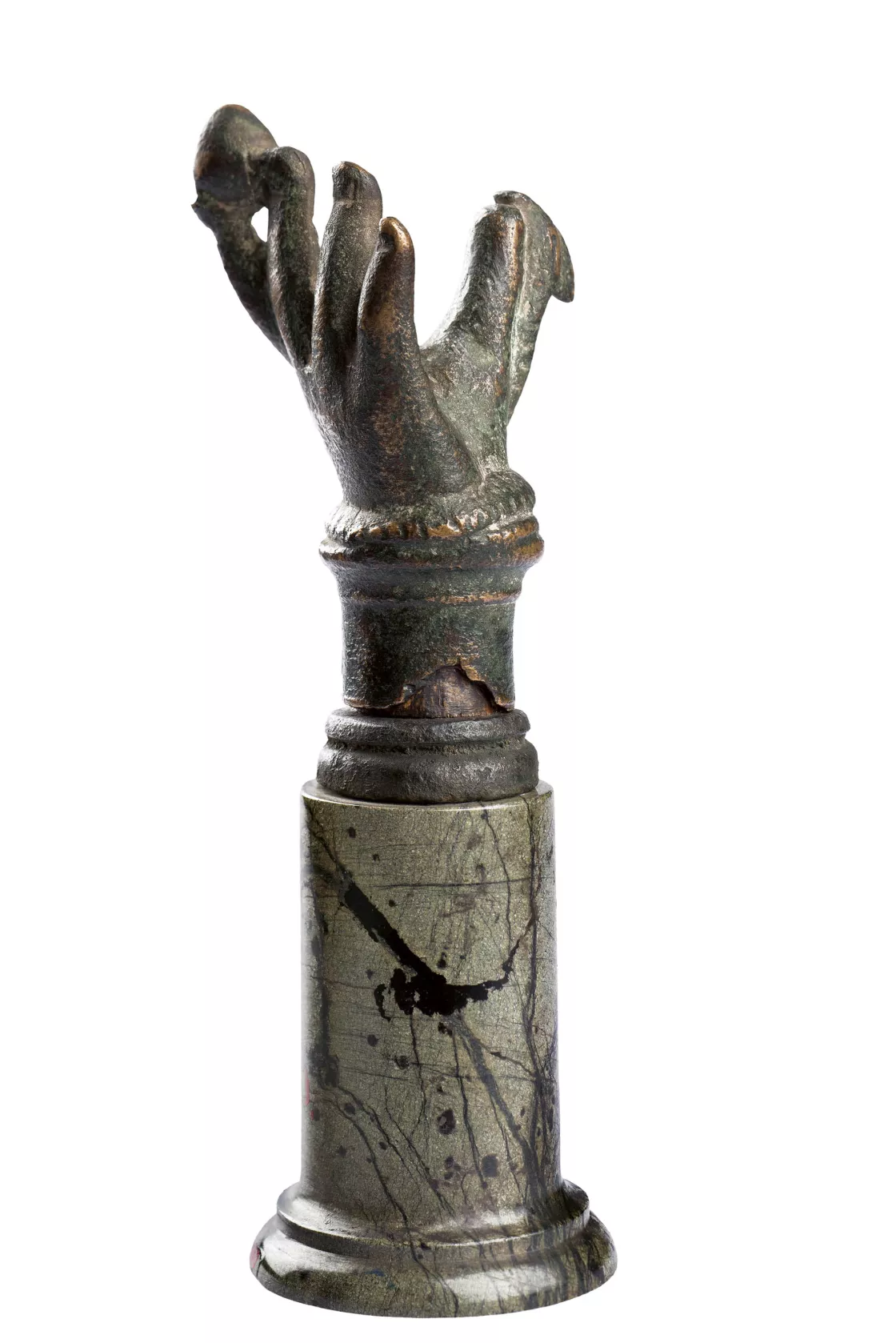
Figure of Hand holding an Egg, unknown date
It is a surprisingly prophetic coincidence that this Roman amulet representing a hand holding an egg or an acorn should have been among the collection of archaeological artefacts Freud kept in his London study. Dalí may possibly have seen it during his failed attempts to meet Freud in Vienna, in which case he might have devised The Metamorphosis of Narcissus with the intention of creating a subliminal link with the psychoanalyst.
Salvador Dalí
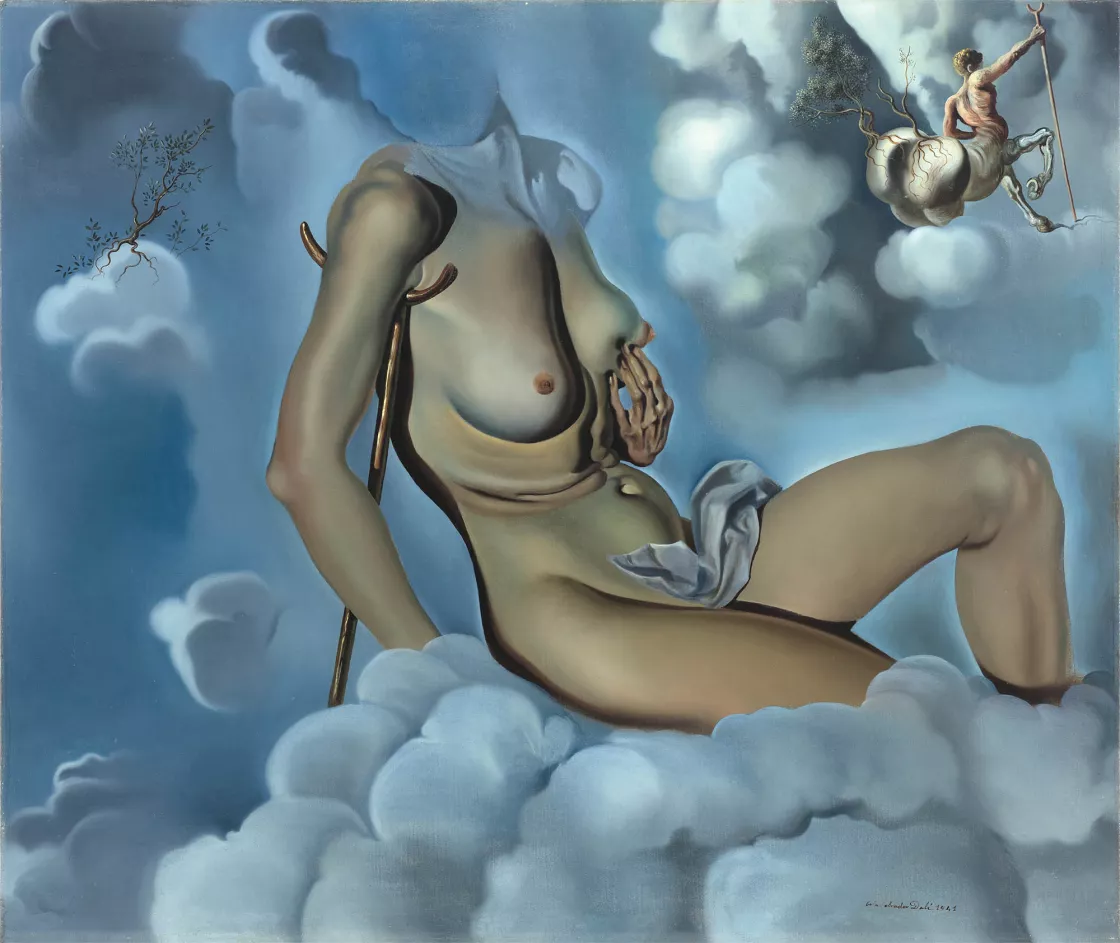
Honey is Sweeter than Blood, 1941
The title of this picture echoes that of another painted in 1927, now lost, which marked Dalí’s decisive espousal of Surrealist painting. From that moment on, the painter developed a universe of images that allowed the viewer to delve into his complex inner world. The head, merging with the clouds, of a naked Gala leaning on a crutch and, riding across another cloud, the centaur whose buttocks create the double image of two hooded faces kissing attest to the lingering presence of that Freudian universe.
Salvador Dalí
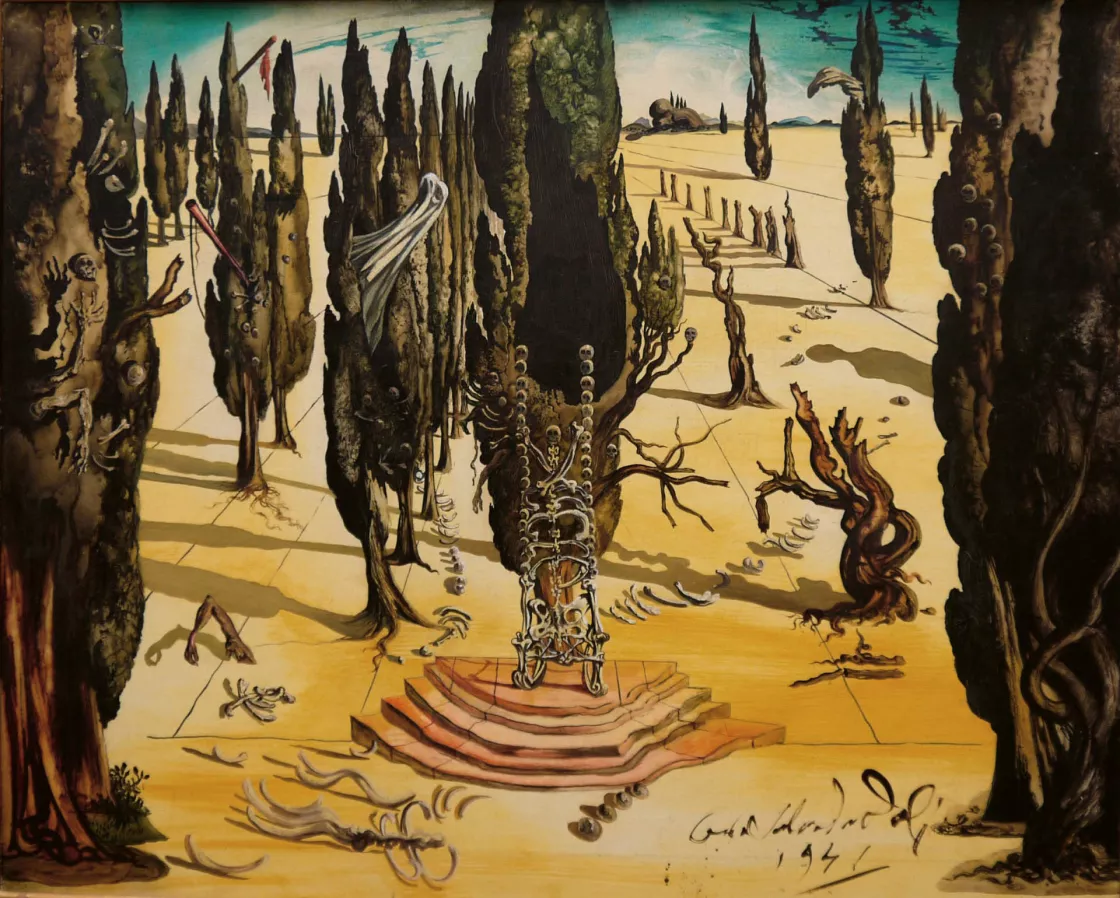
Design for Labyrinth II, 1941
Painted in the middle of the Second World War, this work is one of the sketches for the stage design of the ballet Labyrinth. Dalí was commissioned by the Ballets Russes to create the libretto, sets and costumes for this ballet, which premiered in New York in 1941 at the Metropolitan Opera House. The plot revolved around the love story of Theseus and Ariadne. This image obsessively explores the theme of death, associated with the labyrinth where the Minotaur devoured the young people offered to him as sacrifices. Human limbs and bones are scattered across a landscape of cypress trees, the latter forming a macabre throne. Erect tubes and elements concealed by cloths emerge from the cypress trees, once again alluding to the Eros-Thanatos dialectic.
Salvador Dalí
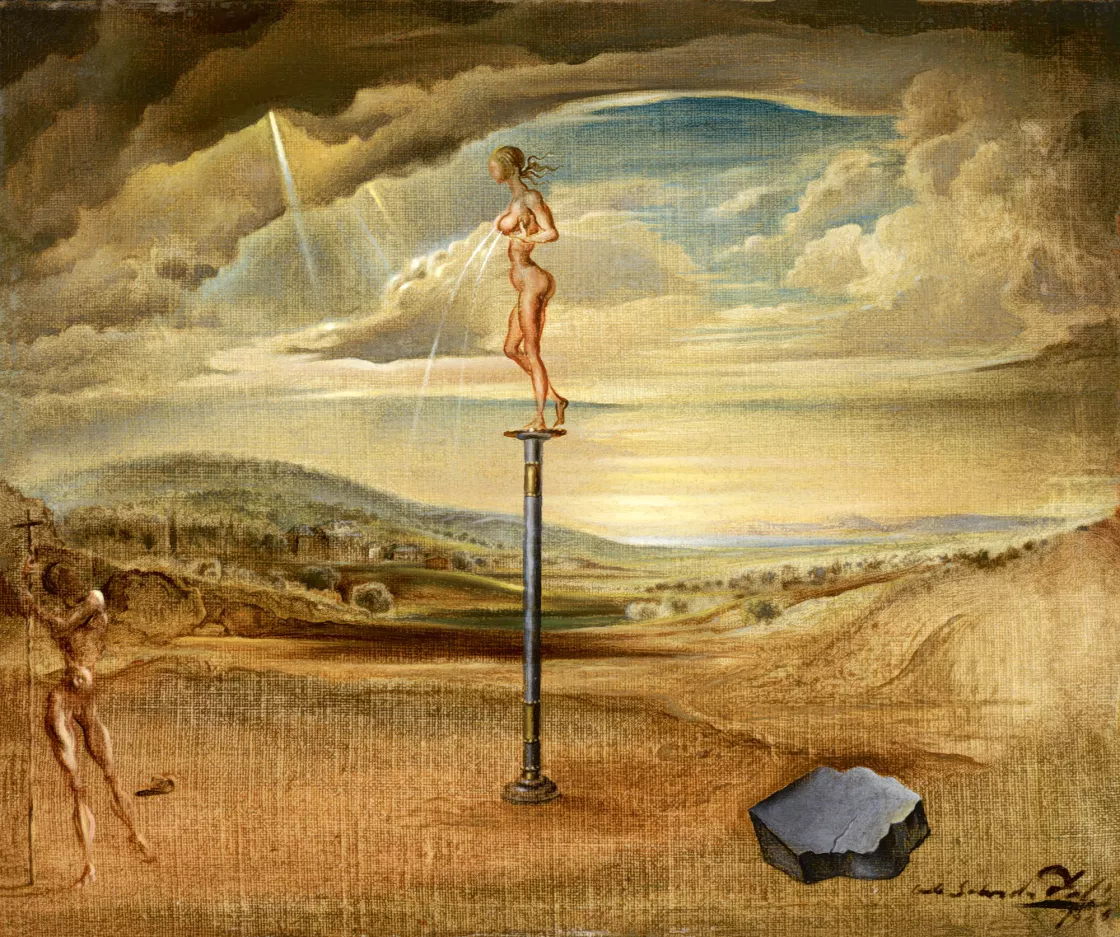
Fountain of Milk spreading Itself Uselessly on Three Shoes, 1945
The nude male figure with his head turned recalls the iconography of Saint John the Baptist. A woman on a pedestal spurts milk from her breasts onto some shoes, as the title of this work also suggests. In a way, we are looking at a Salome tempting the saint, an evident allusion to the Eros-Thanatos dialectic. But in accordance with Freud, the milk on those shoes may, in turn, connote ejaculation over the vagina, which in Dalí’s work is a recurring theme relating to the difficulty of sexual intercourse and sexual ambiguity.
Salvador Dalí
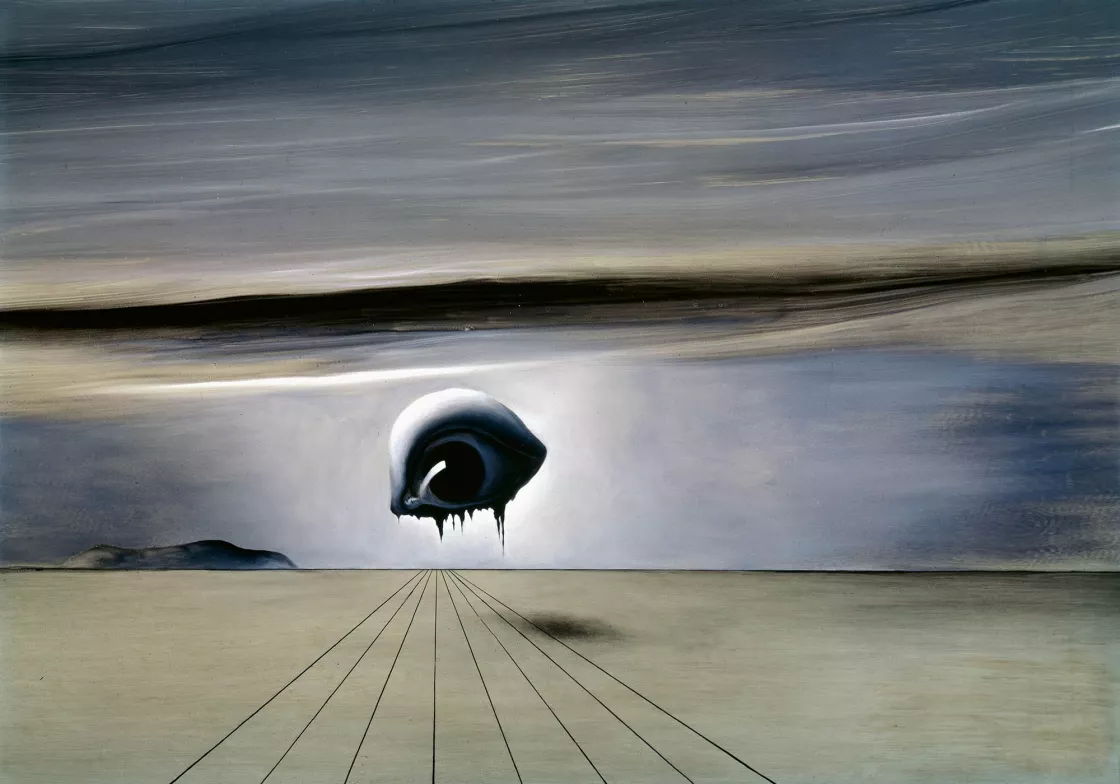
Design for Spellbound, about 1945
In 1945, Dalí moved to Hollywood to work with Hitchcock on Spellbound, a film based on the 1927 novel The House of Dr Edwardes by Hilary St George Saunders and John Palmer and starring Ingrid Bergman and Gregory Peck. Dalí was the ideal artist to visualise the landscapes of the unconscious for this plot, which revolved around a mystery requiring a supposed doctor’s memories to be subjected to psychoanalytical analysis. For this purpose, he produced several designs that gave rise to memorable scenes in the film. In this one, the main subject is the eye and the parallel lines on a monochrome background that tormented the character suffering from amnesia.
Salvador Dalí
Design for Destino, about 1946
This is one of the sketches Dalí produced for his contribution to a film directed by Walt Disney. Combinations of elements rise from two Renaissance-style paved floors that recede towards different horizons. In the one on the left, an explicit depiction of Pieter Brueghel the Elder’s Tower of Babel (1563) is topped by a female figure uncoiling itself from a strange structure whose slender columns rest upon the tower in the same way that elephants pose their insect-like legs in other works by the artist. In the image on the right, there are two halves of arches whose keystones are suspended in mid-air without any support, and above them a bust of Homer.
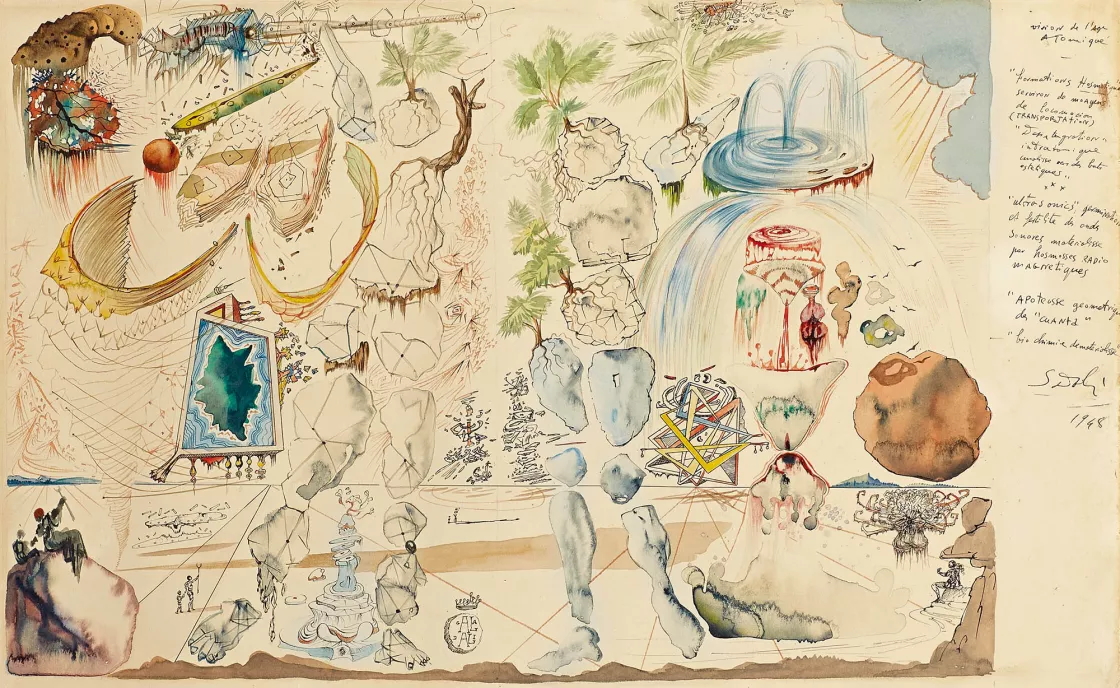
A Vision of the Atomic Age, 1948
In this allegory of the atomic age, with the bombings of Hiroshima and Nagasaki as a backdrop, everything seems to be deconstructed through double images. We see human beings composed of rocks and plant elements, geometric patterns, fountains and insects. Small figures of prophetic adults with crutch-like staffs point out the apocalyptic spectacle to some children.
Salvador Dalí
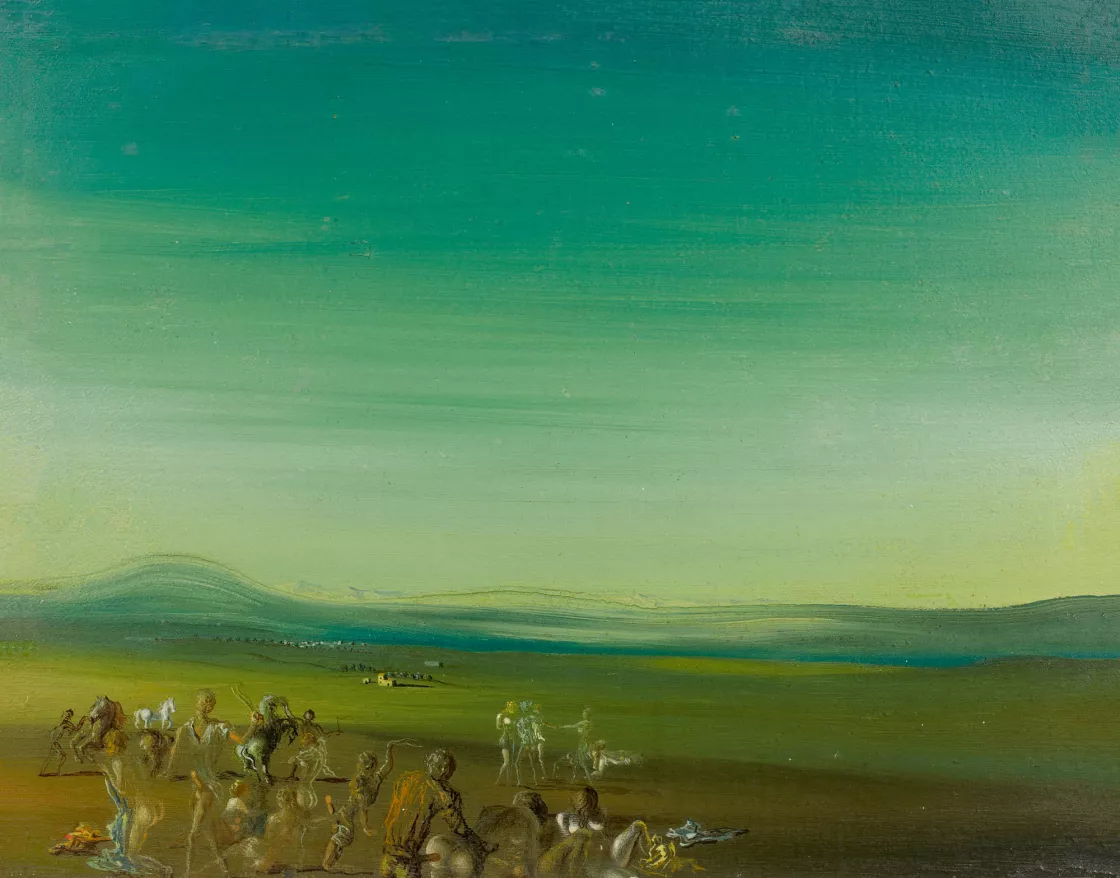
Erotic Beach, 1950
Characters performing acts of sodomy, masturbation and sadism are depicted on a beach whose sea forms an undulating line on the horizon. A city is visible between the sea and these figures. In a sort of retrospective exegesis, Dalí once again shows us – this time explicitly – the range of erotic urges that the beach had aroused in him since childhood.
Salvador Dalí
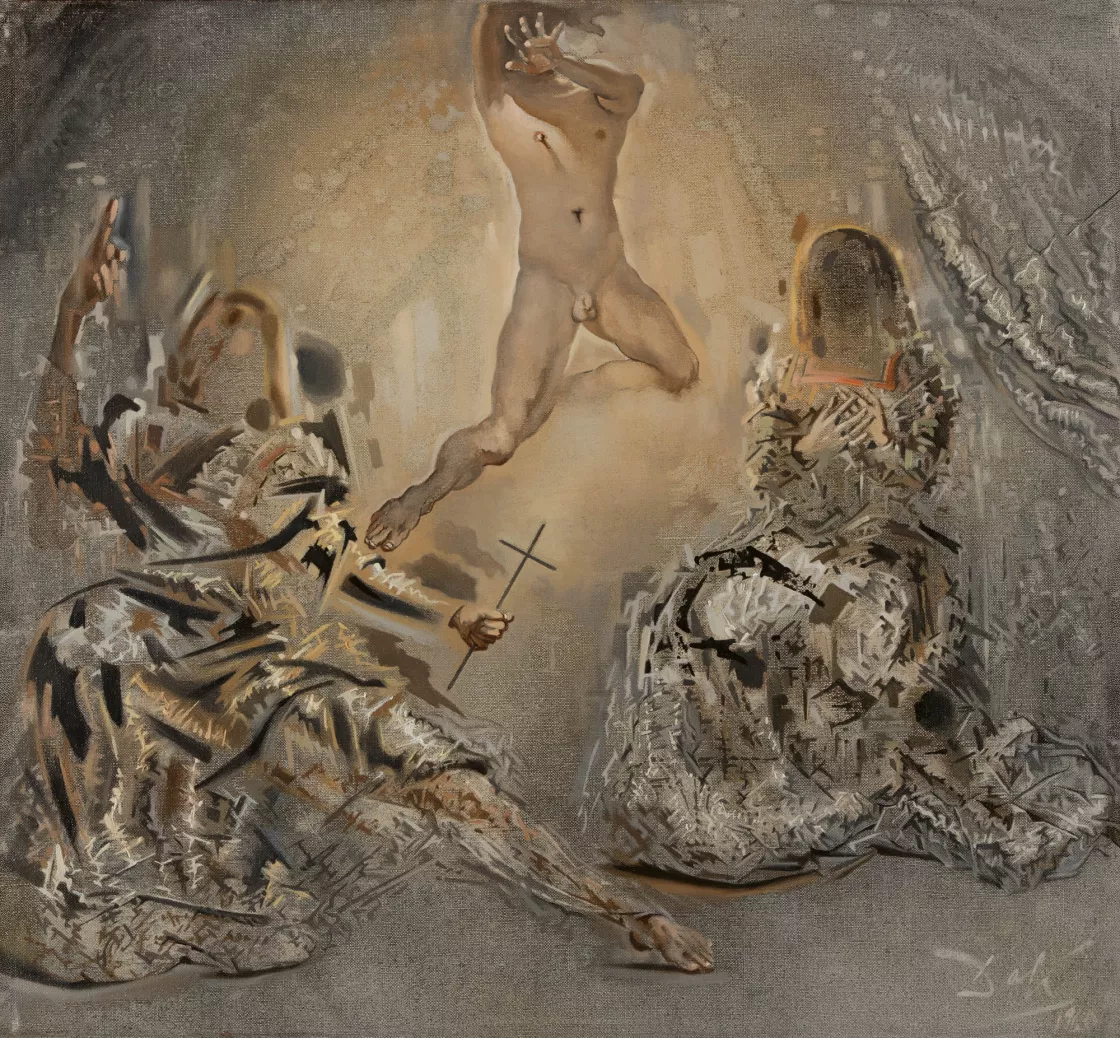
The Trinity, 1960
Rather than a Trinity in the strict sense, what this work evokes is a deesis, the Byzantine iconographic formula in which Saint John the Baptist and the Virgin Mary flank Christ. As in other religious works from this period, Dalí portrays Gala as the Virgin Mary and himself as Christ, who conceals his face. In contrast, Dalí’s visual references for Christ are taken from a pair of figures painted by Michelangelo in the Last Judgement in the Sistine Chapel. Saint John the Baptist and the Virgin Mary vaguely recall the androgynous Saint John the Baptist and Mona Lisa painted by Leonardo da Vinci.
Salvador Dalí
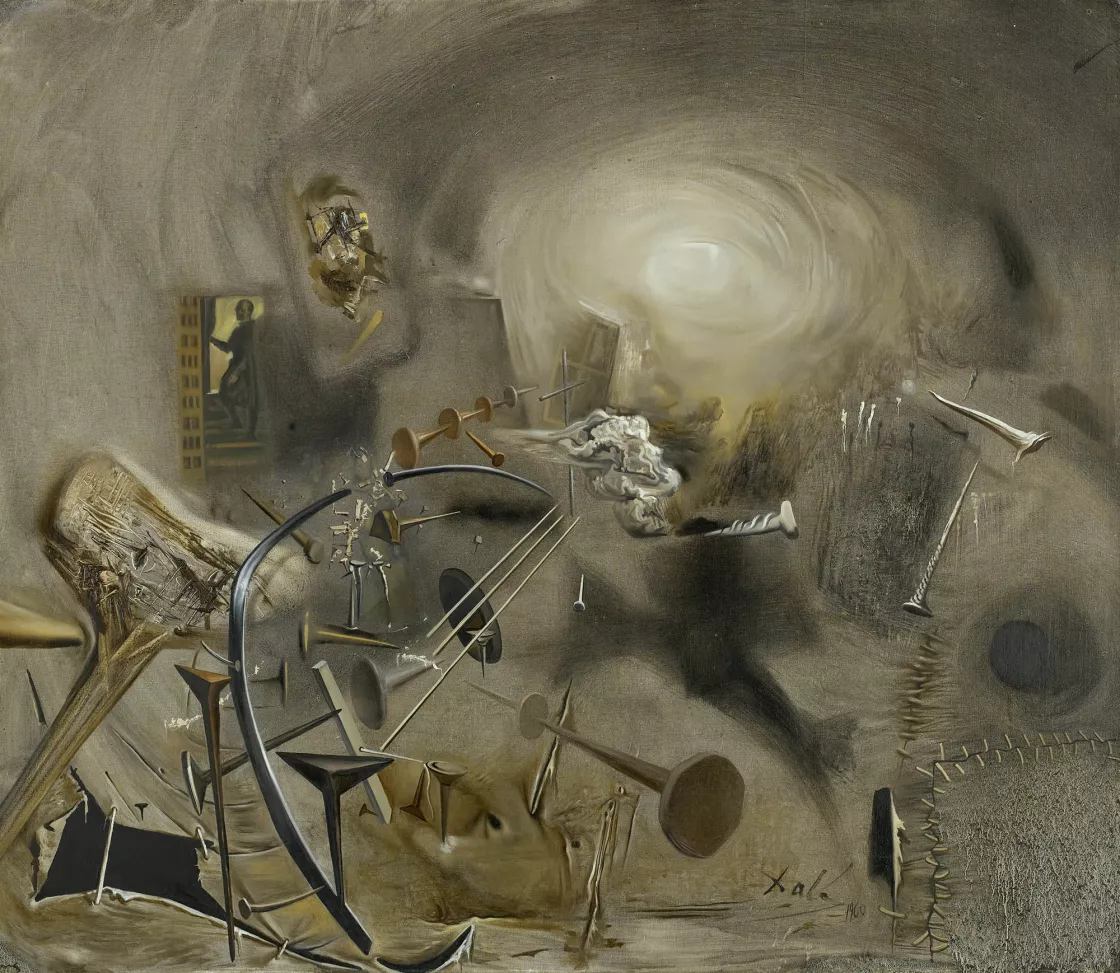
Portrait of Juan de Pareja, the Assistant to Velázquez, 1960
As well as with other artists, Dalí had an obsessive fascination with Velázquez. In this work, the painting Las Meninas undergoes a paranoiac-critical deconstruction. All that remains of Velázquez’s masterpiece – which Dalí copied a couple of times that year, making some modifications – is the figure of José Nieto climbing the staircase, though moved further to the left, and part of the mirror in which the monarchs were reflected. The rest of the composition has been completely transformed. Its figures and elements have been replaced by holes of shade and light, tears and rips in the canvas, paintings seen from the reverse, the tautness of a mandolin’s strings and an exhaustive depiction of some nails whose meaning, as in other works from this period, is half-religious and half-erotic.
Salvador Dalí
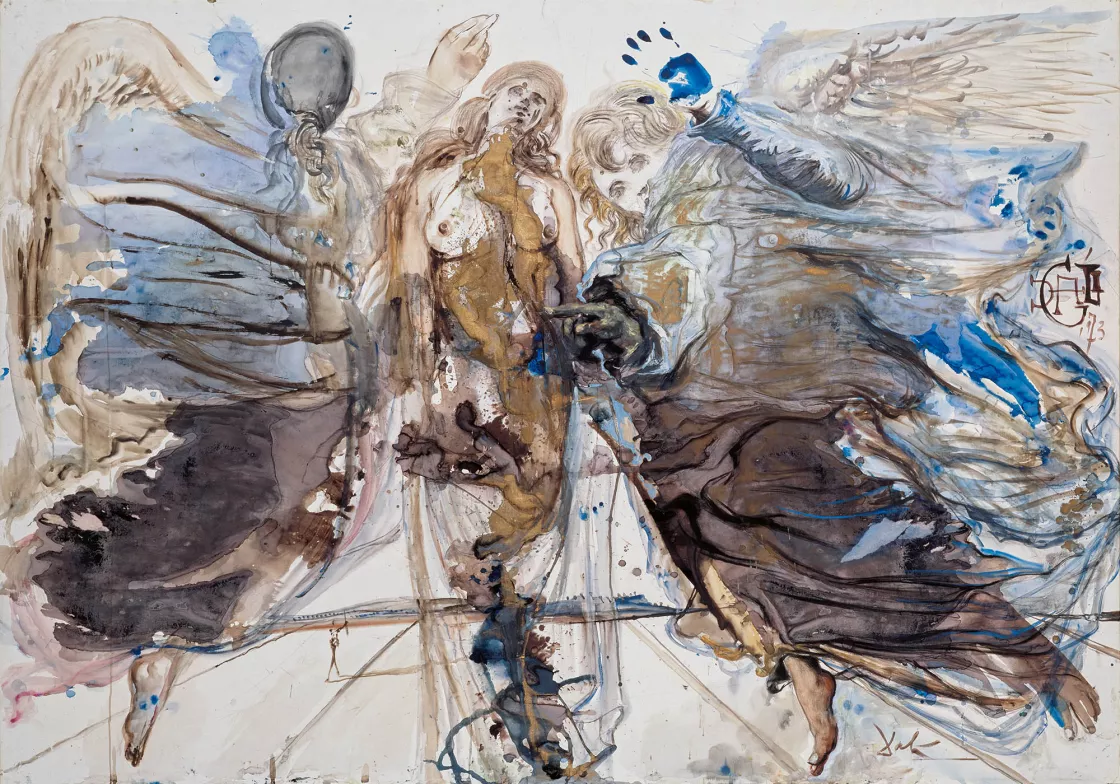
Metamorphosis of Butterfly Angels, 1973
In a way, the idea of metamorphosis overlaps here with that of a double image, as the nude female figure flanked by two angels takes the shape of a butterfly. The angel on the right points to the woman’s belly, while a cross is faintly discernible on her sex. Sexuality and religion are thus intertwined through a kind of transubstantiation comparable to the metamorphosis of butterflies. It has been assumed that the landscape hinted at on the horizon represents the coast of the Empordà.
Salvador Dalí
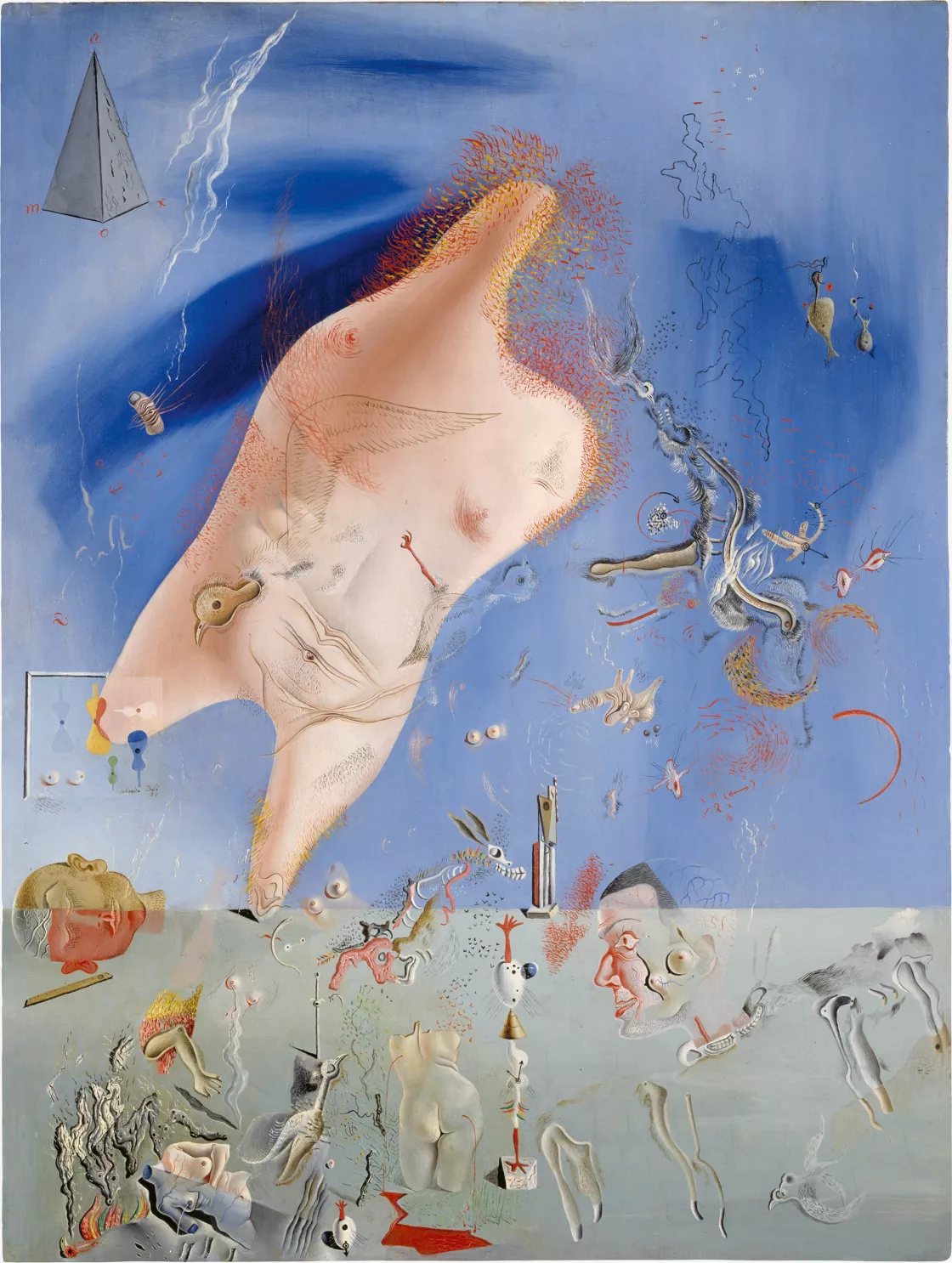
Futile Efforts. Little Ashes, 1927-1928
This work brings together many of the visual elements that shaped Dalí’s artistic language from 1929 onwards. An androgynous, mutilated body floats above a flat surface and the vague background behind it appears to be a sky dotted with ghostly clouds. Blood-like elements that express a pleasure-pain dialectic issue from (or flutter around) the upper part of the body. This dialectic is corroborated by the numerous elements surrounding it, such as the severed head reminiscent of Lorca’s, another head whose eyes are ablaze with fervour that is a symbolic self-portrait of Dalí himself, mutilated female bodies, arms, breasts, and phallic and ejaculatory allusions. There are also monoliths that link, or are superimposed on, geometric or biomorphic forms.
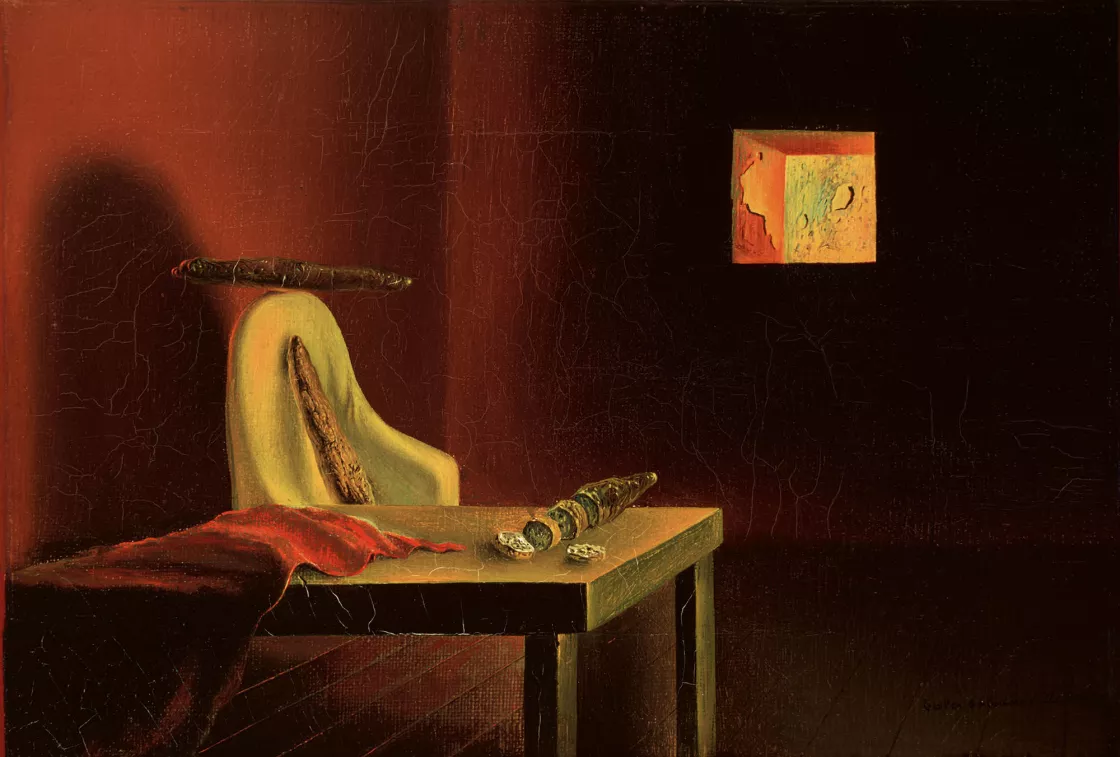
Salvador Dalí
The Invisible Man, 1932
In several passages of his autobiography, The Secret Life of Salvador Dalí, the painter links bread to sexuality, always associating it with childhood memories. In these three works from 1932 the main subject is a loaf of bread in a form reminiscent of an erect penis.
In The Invisible Man the artist uses loaves of bread as a metonym for masculinity. He seats one in an armchair, balances another on top of it, conceals others beneath a cloth and, lastly, cuts another into pieces. By doing so, he alludes to experiences ranging from desire to the impotence complex, including concealment and the fear of castration.
In Anthropomorphic Bread he repeats this visual metaphor with a loaf of bread leaning against the wall. But now he superimposes it with double images that suggest a woman’s leg covered by a stocking and a glans resembling a female breast.
In Catalan Bread the resemblance of the loaf to an erect penis is striking. Here, it is a rope that sustains the fleeting erection, while a limp watch on top of the loaf alludes to the fragility of memory and an inkwell serves as a reminder.
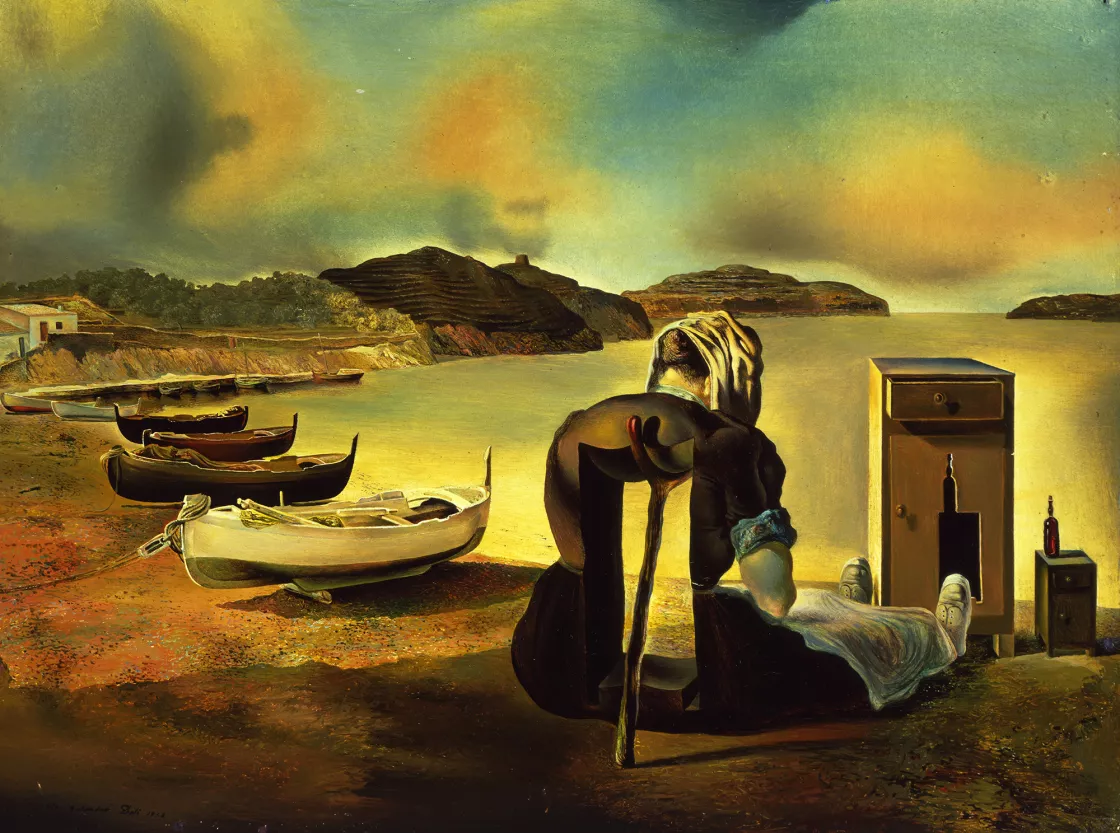
Salvador Dalí
The Weaning of Furniture-Nutrition, 1934
The female figure seen from behind, seated in the position adopted by the women of Cadaqués when they sewed boat sails, has been interpreted as an allusion to Llúcia Gispert, the nanny to whom Dalí felt very close. This woman has spawned a bedside table with a half-open drawer and needs a crutch to support her sagging body. An identical but smaller table has in turn sprung forth from this one, its outline and that of the bottle on top of it leaving a visible gap. The setting for these enigmatic elements is a faithful representation of the landscape of Cadaqués. However, the large cloud on the left could be the double image of a child with an outstretched arm seen from behind, about to be breastfed by the nanny.
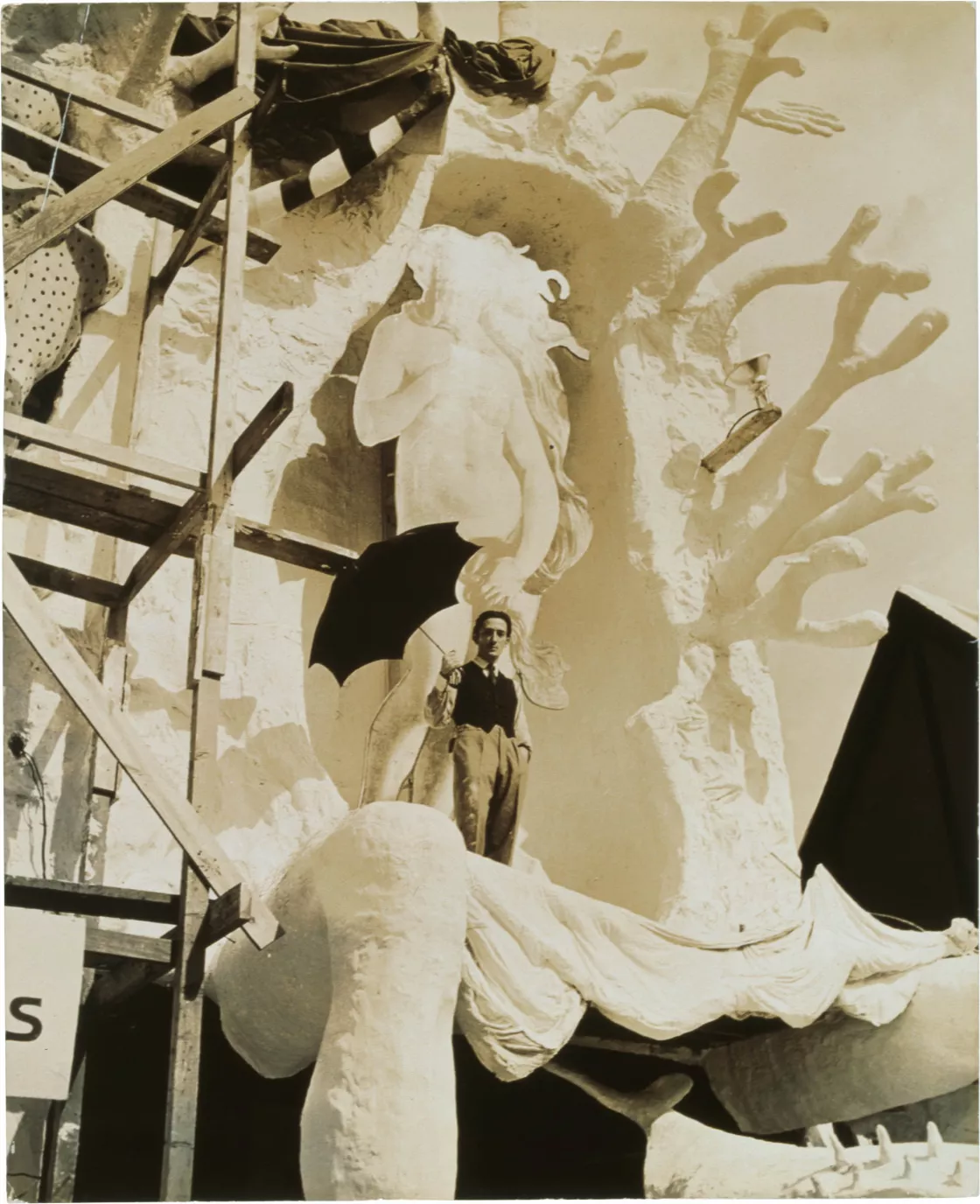
Eric Schaal
Salvador Dalí on the Façade of The Dream of Venus, Under Construction, 1939
The Dream of Venus was a pavilion designed by Salvador Dalí for the 1939 New York World’s Fair. It was a huge, deliberately provocative architectural installation containing mermaids, dreamlike objects and an underwater landscape. Created on the initiative of the gallery owner Julien Levy, the pavilion was intended to introduce American popular culture to Surrealism. The entrance had a chaotic structure made up of gigantic bare legs, tentacles, a reproduction of Botticelli’s Venus and an enormous fish’s head. The interior was divided into two areas. One had a water tank where semi-naked, flesh-and-blood mermaids interacted with Surrealist objects (pianos and typewriters, for example). The other was decorated with dreamlike elements, including mummified cows and dresses designed by Dalí.