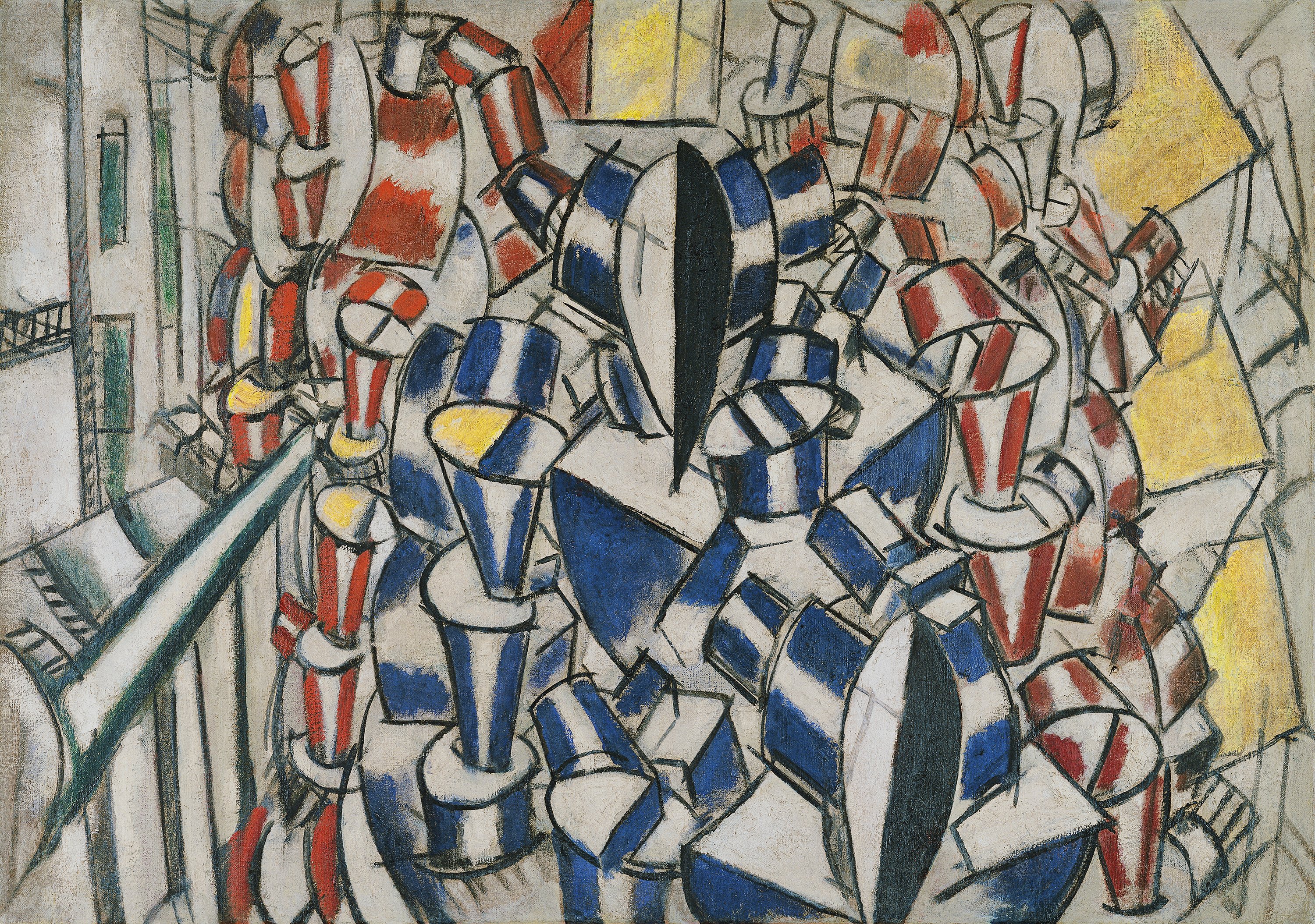
The Staircase (Second State)
1914
Oil on canvas.
88 x 124.5 cm
Museo Nacional Thyssen-Bornemisza, Madrid
Inv. no.
645
(1977.9
)
Room 42
Level 1
Permanent Collection
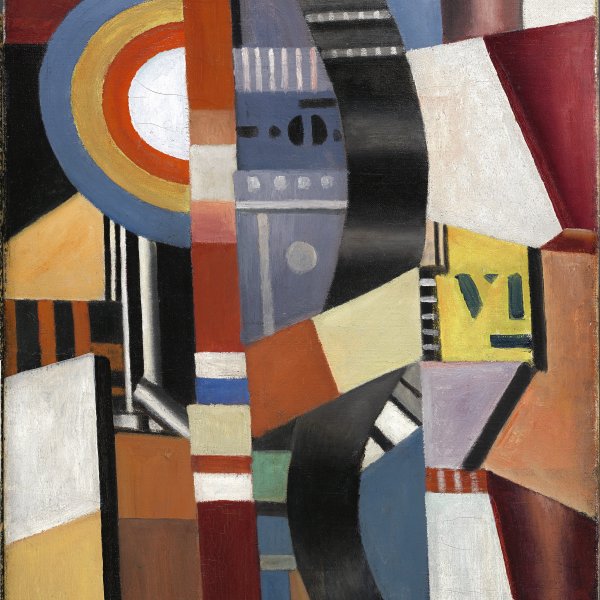
On 5 May 1913 Fernand Léger, one of the participants in “Salle 41” at the Salon des Indépendants of 1911, which gained acceptance for the Cubist movement, stated in a lecture delivered in Paris on “Les Origines de la peinture contemporaine et sa valeur representative” that “Pictorial realism is the simultaneous ordering of three great plastic components: Lines, Forms and Colours.” While Picasso and Braque were the inventors of a new plastic language that broke away from all earlier painting, Léger strove to find a new beauty in the world and to capture the contrasts of modern life through pictorial contrasts, combining Cubism with the use of colour. Léger put this new aesthetic idea into practice in a series of forty-five paintings which he called Contrasts of Forms, executed in 1913 and 1914, which mark the decisive moment in his career during the period prior to the Great War. In this suite of works, although Léger employs a language close to abstraction, he hints at the human figure — a dehumanised and mechanised human figure that fuses with the fragmented setting which is none other than the world of machines and technology. In contrast to the flatness of more orthodox Cubism, Léger endowed objects with a sense of physical volume: “I oppose curves to straight lines, flat surfaces to moulded forms.” This spurred him to use tubular forms with concave and convex planes and mechanical rhythms shaped from contrasts of pure colours.
In his study of the present painting, Christopher Green refers to a letter from Léger dated 14 November 1915 mentioning a group of works executed in Normandy a month before the outbreak of war, entitled The Staircase and derived from his abstract explorations of contrasting forms and colours. George Bauquier’s catalogue raisonné includes, in addition to The Staircase belonging to the Thyssen-Bornemisza collection, a further five works from the same series. In the version in the Museo Thyssen-Bornemisza, a group of mechanised figures constructed from cylindrical forms descend a staircase towards the viewer. The foreshortened banisters can be clearly discerned together with a few yellow stairs on the right of the composition. The tubular forms delimited by the black contour lines are given volume by a few touches of red, blue and yellow which cover the surface only partially, leaving the rest of the canvas exposed. Depth is achieved by superimposing planes and forms and, although there is no defined light source, Léger uses a few white brushstrokes to highlight certain areas and enhance the threedimensionality of the cylindrical forms. The motion, created by the apparent rotation of the various articulated pieces of the figures and their advancement towards the viewer, links Léger to other contemporary painters interested in representing scenes in movement: his friend Robert Delaunay, Marcel Duchamp — whose Nude Descending a Staircase of 1911 was shown at the Salon de la Section d’Or in 1912 — and the Italian Futurists, whose interest he shared in capturing the mechanisation and fast pace of modern life.
In other respects, the representation of the contrasts, fragmentation and simultaneity of the modern city which Léger reflected in his work may be related to the exaltation of the city and representation of the ego fragmented in space and time that is found in the poetry of Guillaume Apollinaire. Léger’s notion of Simultanism, to which the very title of the series, Contrasts of Forms, refers, is embraced by Apollinaire in his poetry from 1912 onwards. The poem Zone, written in 1912, translates his own experience of the city and provides a kaleidoscope of images through new poetic procedures, such as free verse and the aesthetic of simultaneity and fragmentation.
Paloma Alarcó
In his study of the present painting, Christopher Green refers to a letter from Léger dated 14 November 1915 mentioning a group of works executed in Normandy a month before the outbreak of war, entitled The Staircase and derived from his abstract explorations of contrasting forms and colours. George Bauquier’s catalogue raisonné includes, in addition to The Staircase belonging to the Thyssen-Bornemisza collection, a further five works from the same series. In the version in the Museo Thyssen-Bornemisza, a group of mechanised figures constructed from cylindrical forms descend a staircase towards the viewer. The foreshortened banisters can be clearly discerned together with a few yellow stairs on the right of the composition. The tubular forms delimited by the black contour lines are given volume by a few touches of red, blue and yellow which cover the surface only partially, leaving the rest of the canvas exposed. Depth is achieved by superimposing planes and forms and, although there is no defined light source, Léger uses a few white brushstrokes to highlight certain areas and enhance the threedimensionality of the cylindrical forms. The motion, created by the apparent rotation of the various articulated pieces of the figures and their advancement towards the viewer, links Léger to other contemporary painters interested in representing scenes in movement: his friend Robert Delaunay, Marcel Duchamp — whose Nude Descending a Staircase of 1911 was shown at the Salon de la Section d’Or in 1912 — and the Italian Futurists, whose interest he shared in capturing the mechanisation and fast pace of modern life.
In other respects, the representation of the contrasts, fragmentation and simultaneity of the modern city which Léger reflected in his work may be related to the exaltation of the city and representation of the ego fragmented in space and time that is found in the poetry of Guillaume Apollinaire. Léger’s notion of Simultanism, to which the very title of the series, Contrasts of Forms, refers, is embraced by Apollinaire in his poetry from 1912 onwards. The poem Zone, written in 1912, translates his own experience of the city and provides a kaleidoscope of images through new poetic procedures, such as free verse and the aesthetic of simultaneity and fragmentation.
Paloma Alarcó