Thyssen-Bornemisza Museo Nacional Search Ir al contenido principal

Navegación superior (EN)

About Us Support Friends Shop Tickets
Español
Visit Collection Exhibitions Activities Education Search
  • Visit
  • Collection
  • Exhibitions
  • Activities
  • Education

Thyssen - Navegación superior (EN)

About Us Support Friends Shop Tickets
Español
©
Richard Estes. Courtesy Schoelkopf Gallery, New York
Richard Estes

Telephone Booths

1967
Acrylic on Masonite.
122 x 175.3 cm
Museo Nacional Thyssen-Bornemisza, Madrid
Inv. no.
539
(
1977.93
)
Room 51
Level 1
Permanent Collection
30 31 32 33 34 35 36 37 38 39 40 41 42 43 44 45 46 47 48 49 50 51 52 53 54 55 56 Postpop rooms Rodin room
30 18th and 19th Centuries. Transatlantic Relations 31 19th Century. American Landscape and Environmental Awareness 32 19th Century. American Landscape and Urban Life 33 19th Century. The Impressionist Period 34 20th Century. Expressionist Landscapes 35 20th Century. Expressionist Portraits 36 20th Century. The Language of the Body 37 20th Century. Urban unrest 38 20th Century. Flowers 39 20th Century. Pioneers of abstraction 40 20th Century. Popular flavor 41 20th Century. The Cubist Tradition I 42 20th Century. The Cubist Tradition II 43 20th Century. Abstract Utopias 44 20th Century. Dada and Surrealism 45 20th Century. Interwar Realisms 46 20th Century. American Abstraction I 48 20th Century. Post-ward American Art 49 20th Century. Post-ward European Figurative Art 50 20th Century. Informalisms 51 20th Century. Homo Ludens 52 20th Century. Pop Art 53 Postpop rooms 54 Postpop rooms 55 Postpop rooms 56 Postpop rooms • Exhibition room

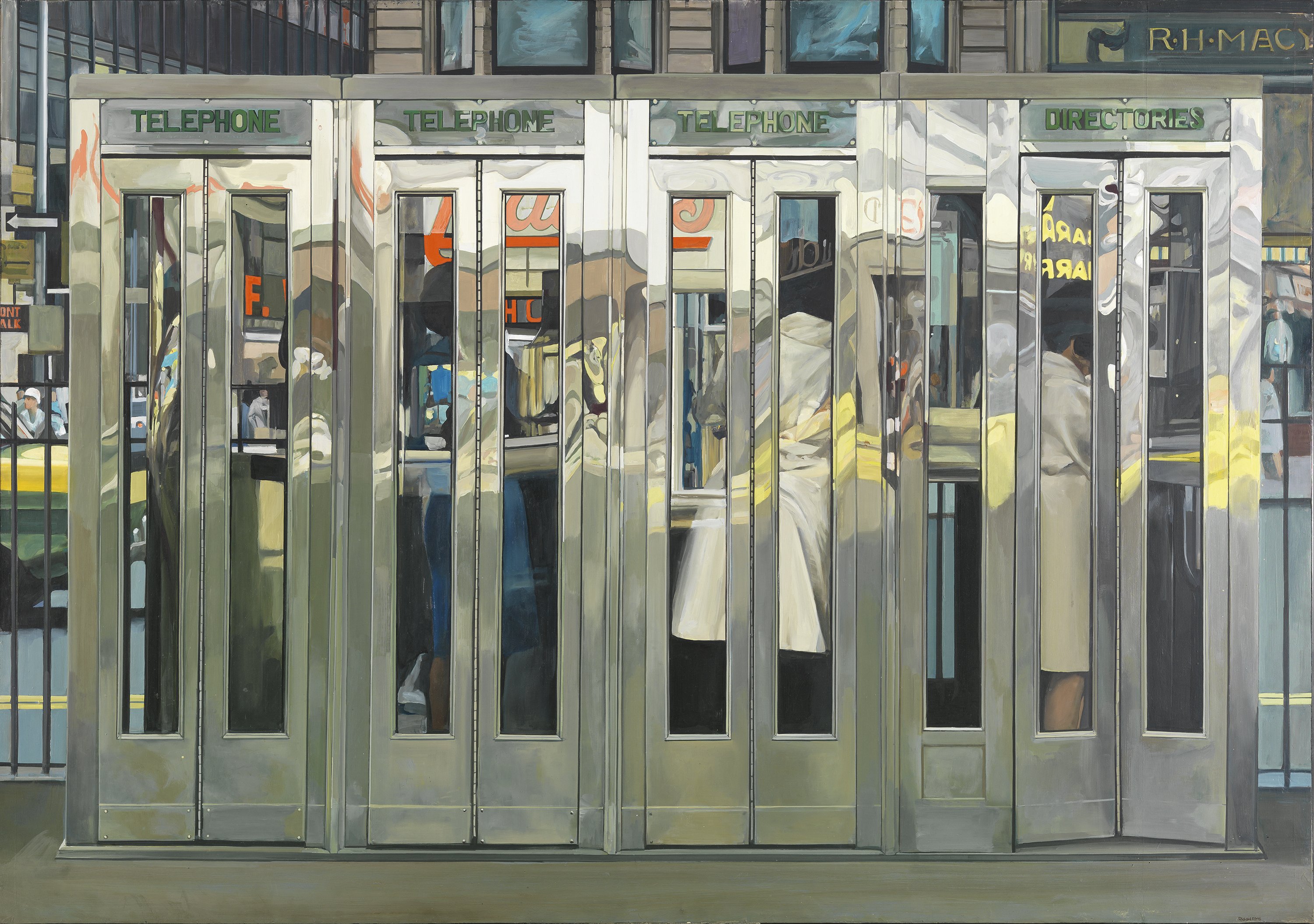
Richard Estes is held to be one of the foremost practitioners of American Photorealism. Most of his paintings portray urban landscapes and specific details of life in big cities, particularly New York, as with the present Telephone Booths executed in 1967. The starting point for the composition was several photographs he took of a row of telephone booths located at the intersection of Broadway, Sixth Avenue and 34th Street, which the artist combined and transformed into a pictorial motif. The complexity of the image is typical of Estes’ realism — a realism that might be linked to the tradition of trompe l’oeil painting on account of its intention to confound and perplex the viewer. Although the scene depicted is recognisable, the complexity of the optical angle and the jumble of reflections require an additional effort of concentration, as nothing can be registered at first sight. As in most of his paintings, Estes explores the ability of glass to mislead, as it can both be transparent and reflect at the same time, a fact which further heightens its bewildering effect. In the present painting the mass of reflections — some clearly defined (on the glass) and others distorted (on the metal surfaces) — allow us to view simultaneously the scene in front of us and the buildings behind us; indeed, the signs of the department stores Macy’s and Woolworth can be made out.

Although Estes’ cities are generally deserted, the Telephone Booths are occupied, making this a rare example of a work that features human figures. Enclosed in each of the booths is a person with their back to the viewer. Sandro Parmiggiani describes them as “metaphors of chopped voices, and of faceless people, who stay unknown inside those impenetrable spaces, to which hint, like a visible rhyme, the patches bordering their metal edges and increasing the mystery and visual dizziness.”

The writer John Updike, who devoted a delightful text to this work, made the following reflection: “We know nothing of the two people on the right but their light clothes. Of the pair on the left we know even less; they appear transparent in the swim of reflections. By the etiquette of metropolitan crowding their persons have been reduced to mere signifiers that the booths are taken; like computer bytes or slugs of type, they fill their slots and give the information. The bleakness of this information contrasted with the richness or the visual information the painter has unstintingly imparted, makes for an utterly tender artistic irony.”

Paloma Alarcó
20th Centurys. XX - Arte pop en NorteaméricaPaintingAcrylicMasonite
Listen
Download image Print page

Tours to find it

Arte y literatura estadounidenses de los siglos XIX y XX 
Tours
Arte y literatura estadounidenses de los siglos XIX y XX 
El presente recorrido es una aproximación a la colección de la pintura estadounidense del Museo Nacional Thyssen-Bornemisza desde la literatura cuyo objetivo es un mayor enriquecimiento en la interpretación de ambas disciplinas creativas y una experiencia estética más gratificante para las personas visitantes.
Inventions
Tours
Inventions
The guiding thread of this survey is that of inventions,frequently not the principal subject of the painting: on the contrary, they are secondary objects that illustrate the numerous inventions that have made our lives easier and more comfortable.
A day in New York
Tours
A day in New York
An opportunity to turn travellers, and discover the throb and thrill of this fascinating city.
Invisible Cities
Tours
Invisible Cities
A tour of cities represented, imagined and narrated, establishing a dialogue between the novel Invisible Cities by Italo Calvino.

Products and publications

Richard Estes Poster: Telephone Booths

Richard Estes Poster: Telephone Booths

12,50 €

Telephone booths

Telephone booths

17,00 €

White notebook sewn Telephone Booths

White notebook sewn Telephone Booths

3,50 €

Museomaquia Comic

Museomaquia Comic

17,00 €

Visit online shop

More from the collection

Richard Estes
Richard Estes
Nedick's
1970
Richard Estes
Richard Estes
People's Flowers
1971
Romare Bearden
Romare Bearden
Sunday After Sermon
1969
Tom Wesselmann
Tom Wesselmann
Nude No. 1
1970
  • Private and/or didactic use
  • Commercial use
Private and/or didactic use
Telephone Booths. Cabinas telefónicas, 1967
Telephone Booths
Richard Estes

©

Richard Estes. Courtesy Schoelkopf Gallery, New York

Terms of Use

The exploitation rights of the images correspond to the Fundación Colección Thyssen-Bornemisza, F.S.P. The Fundación authorizes the downloading of high-resolution images from its website for private use, use for educational and research purposes and non-commercial uses.

However, this work is protected by copyright. Therefore, regardless of the terms of use of the images set out by the Fundación, it will be necessary to obtain a license from the author or copyright holder known to the Fundacion in order to reproduce or exploit the work.

Use for educational and research purposes is understood as the non-commercial use of images in presentations, conferences, school or university work, in classes at regulated education institutions, as well as in academic publications, with a circulation of less than 1,000 copies, provided that it is non-profit.

Non-commercial use is understood as the use of the images in a context where no profit, monetary or commercial, is generated, directly or indirectly.

Any use other than those indicated above will require the prior written authorization of the Fundación.

Any request for educational and research use or for non-commercial use (including academic publications), should be directed by email to the Museum Photo Library through the email address archivo.fotografico@museothyssen.org. This department manages the worldwide distribution of the images of the works of the Museo Nacional Thyssen-Bornemisza and the management of their reproduction rights for those uses.

The user agrees to use the image of the website solely and exclusively for the purposes described above and in accordance with the following terms of use, which, however, do not apply to the reproduction of the works included in the photographs, as they are protected by Copyright.

Terms of use

  • If the image is used for reproduction, the work must be reproduced in its entirety. The image may not be manipulated, deformed, modified or altered in any way. In particular, no superposition (of images or texts) on the reproduction is allowed.
  • The reproduction of a detail or part of the work may only be made with the prior written authorization of the Fundación P. In this case, the credit line must include the following mention: “detail”.
  • Any total or partial reproduction of the images of the Fundación. that has been previously authorized must be accompanied by the copyright text indicated by the owners or their copyright holders as well as the following mention: Provenance: Museo Nacional Thyssen-Bornemisza, Madrid”.
  • The user will send free of charge to the Museum Photo Library. One (1) free copy of the edition, publication or reproduction to the following address: Archivo Fotográfico, Museo Nacional Thyssen-Bornemisza, Paseo del Prado, 8 28014 Madrid, Spain.
Download image
Commercial use
Telephone Booths. Cabinas telefónicas, 1967
Telephone Booths
Richard Estes

©

Richard Estes. Courtesy Schoelkopf Gallery, New York

Terms of Use

The Photographic Archive of the Museo Nacional Thyssen-Bornemisza offers sale and rental service of photographic material of all the works on its Permanent Collection.

To request images or permits for commercial use in academic or research publications, that is, catalogues of other institutions, monographs and other specialized publications, you should contact the Museum's Commercial Archive by email at the e-mail @email.

To request images or permits for other commercial or advertising uses (general publications, merchandising, exhibitions, audio-visual works, web pages, etc.), you should contact the Museum's Commercial Archive by email at the e-mail @email.

The Photo Library and the Museum's Commercial Archive manage the worldwide distribution of images of the Museo Thyssen-Bornemisza works, as well as their reproduction rights. The applicable rates are calculated based on the nature and proposed use of the images, as well as the availability of the requested image.

Requests for scans or new photographs will be reviewed on a case-by-case basis. Once approved, an additional fee will apply. Re-photographing a work will require a minimum of six weeks to complete.

However, photographed works are protected by copyright. Therefore, regardless of the terms of use of the photographs set out below by the Foundation, it will be necessary to obtain a license from the author or copyright holder known to the Fundacion in order to reproduce or exploit the work.

Download image
Thyssen-Bornemisza Museo Nacional

Navegación secundaria (EN)

  • #Thyssenmultimedia
  • Press
  • Corporate events
  • Tourism
  • Join our team
  • Newsletter
Instagram
Facebook
X
Youtube
TikTok
iVoox
LinkedIn

The Museo Nacional Thyssen-Bornemisza would like to thanks for the collaboration of:

Fundación Mutua Madrileña Master Card Comunidad de Madrid
©2026 Thyssen-Bornemisza National Museum

Menú al pie (EN)

  • Legal terms
  • Public tenders
  • Transparency site
  • Whistleblower channel
  • Use of images
  • Accessibility and quality
  • Environment, Sustainability & 2030 Agenda
  • Contact
Ministry of Culture España es cultura | Spain is culture. The website promoting Spanish culture Paisaje de la Luz | Paseo del Prado y Buen Retiro. Paisaje de las Artes y las Ciencias
Certificación de Conformidad con el Esquema Nacional de Seguridad. Categoría Media. RD 311/2022