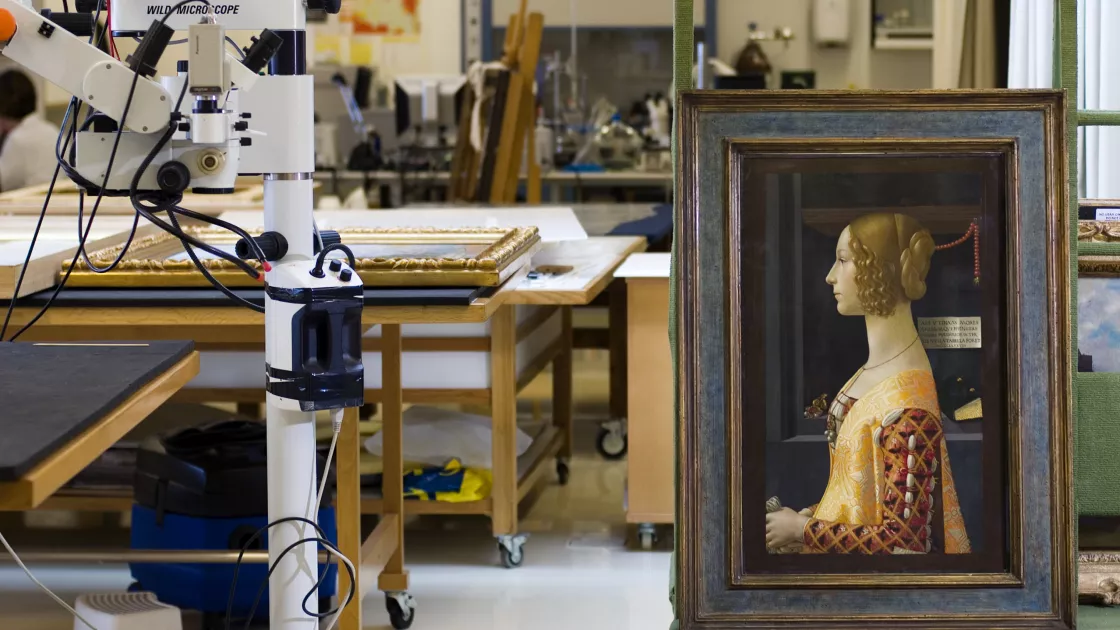
Technical studies and special display
The technical study of the painting Portrait of Giovanna Tornabuoni presents detailed information about the research conducted by the Conservation Department of the Thyssen-Bornemisza Museum to shed light on the creative process, techniques and materials used by Ghirlandaio.
The ensuing exhibition and publication display the results obtained in the Museum’s laboratory using X-radiography, infrared photography and microsamples, which have been crucial in identifying the working technique and the material composition, as well as the distribution of strata in the painting.
The enigmas of Giovanna
Infrared radiation penetrates paint, making it possible to see and analyse the underdrawing. This technology reveals a very important part of the artist’s working process which is usually hidden from the general public. Infrared imaging also picks up alterations to the composition or pentimenti.
Ghirlandaio’s first design, which recalls the composition of Roman commemorative medals, is shown in a lighter tone. It may have been inspired by a medal featuring the bust of Giovanna Tornabuoni created on the occasion of her marriage.
In the definitive drawing, the artist moved the figure slightly to the right and rearranged the decorative elements of the dress. There are also noticeable compositional differences in the area of the neck, the bust and the hands.
Neck: The drawing hidden beneath the paint reveals the change made to the design of the neck area, where a necklace of round beads was replaced by the black string pendant shown in the final design. The artist also altered the hairstyle by pulling back and shortening one of the ringlets.
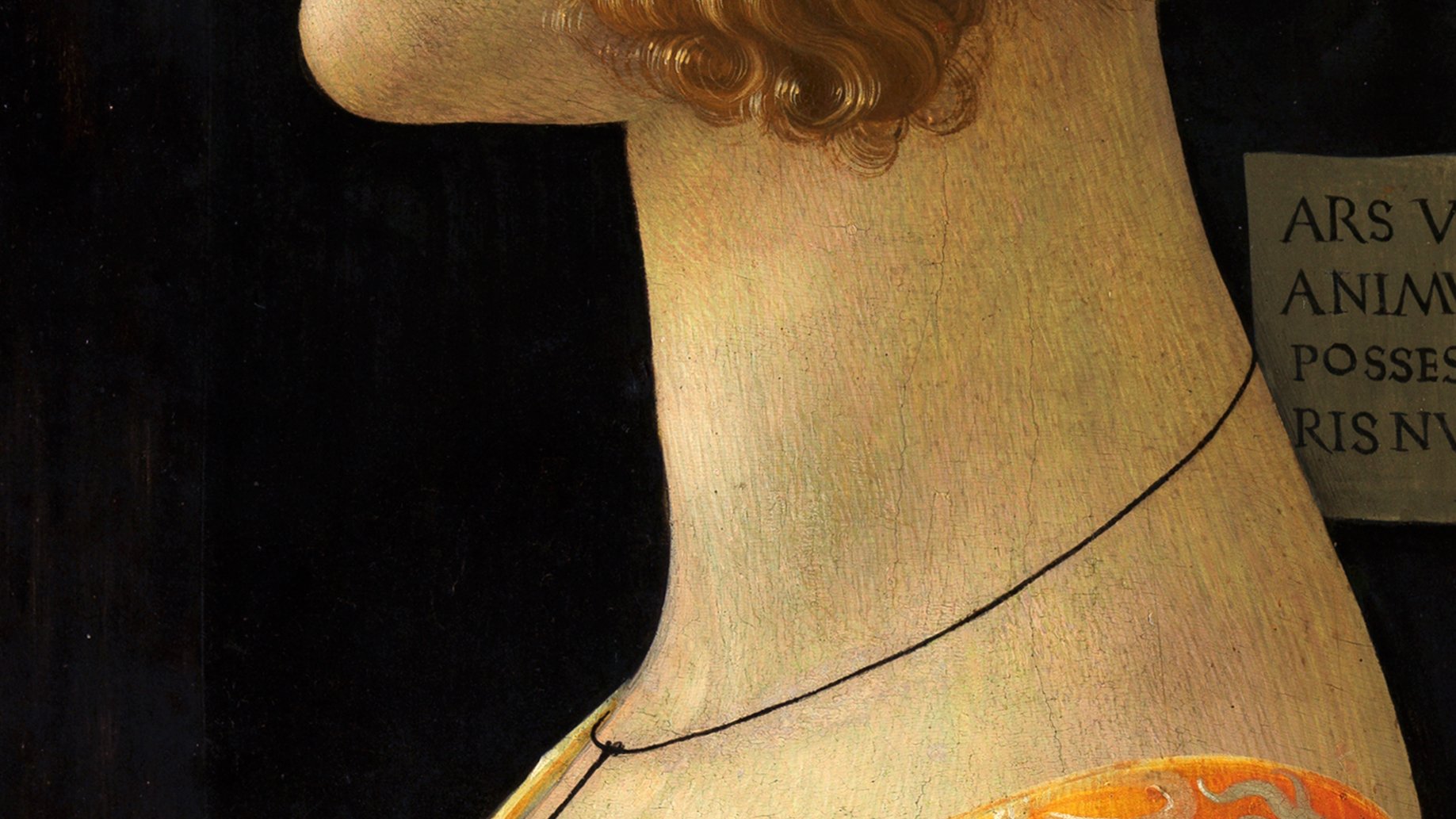
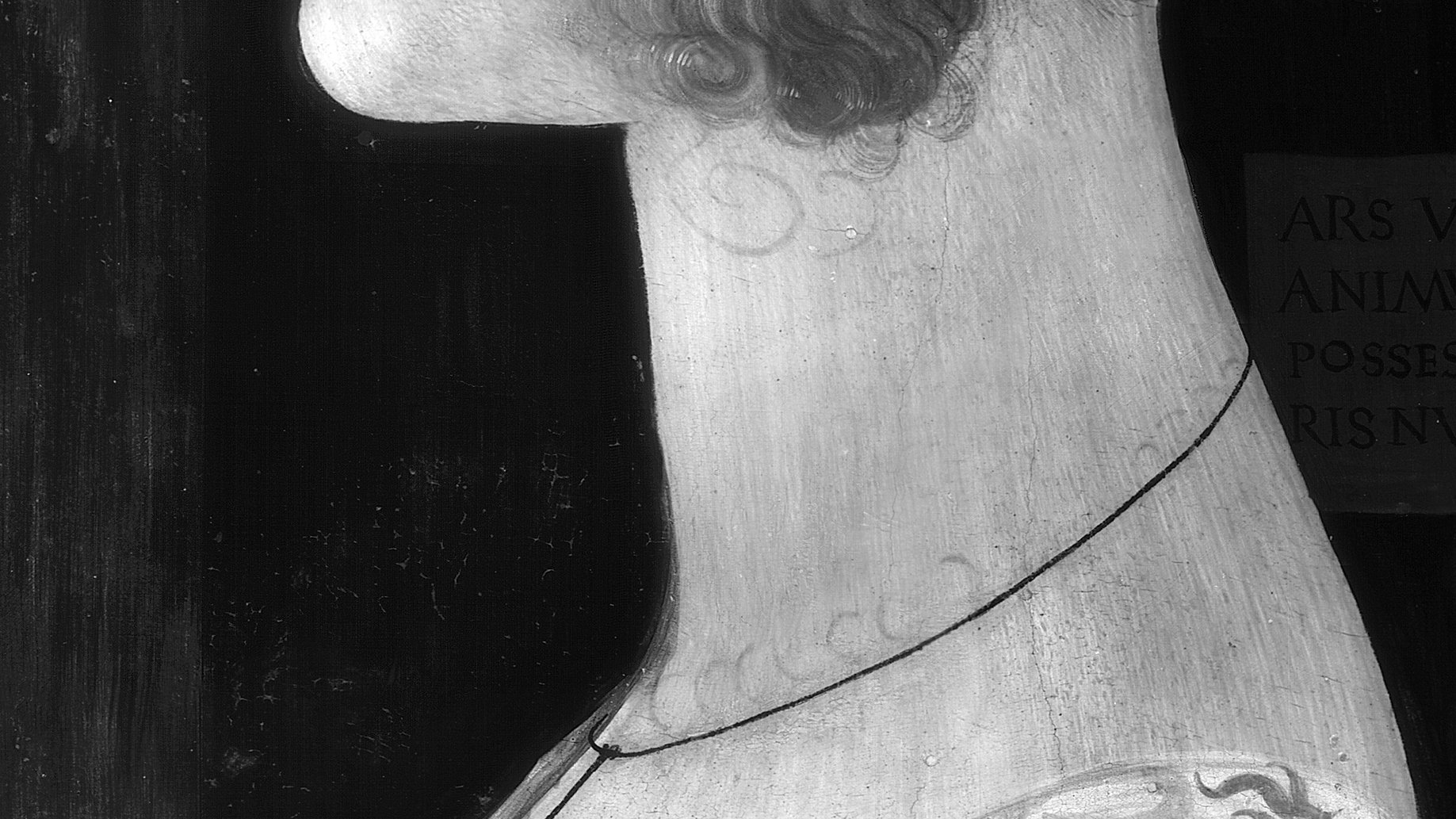
Ghirlandaio modified the profile of the chest to reduce its volume.
In the first sketch he drew a pleated dress cinched at the waist, but in the final composition this was changed to a “giornea” or open-sided overgown included in the dowry presented by the family of Giovanna’s husband, Lorenzo Tornabuoni.
We can also see that the decorative elements of the gown were slightly shifted. The artist altered the position of the inverted “L” (for Lorenzo) woven into the pattern of the fabric on Giovanna’s shoulder.
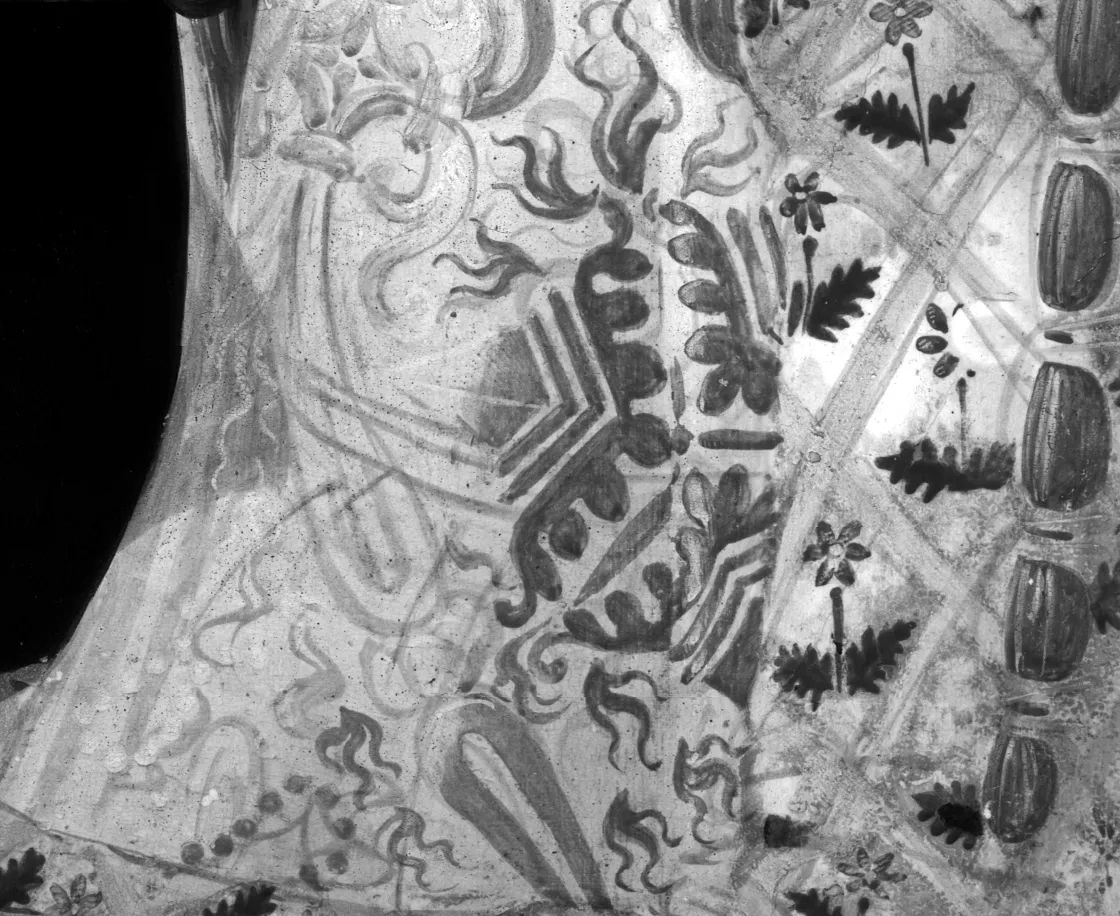
The pictorial technique
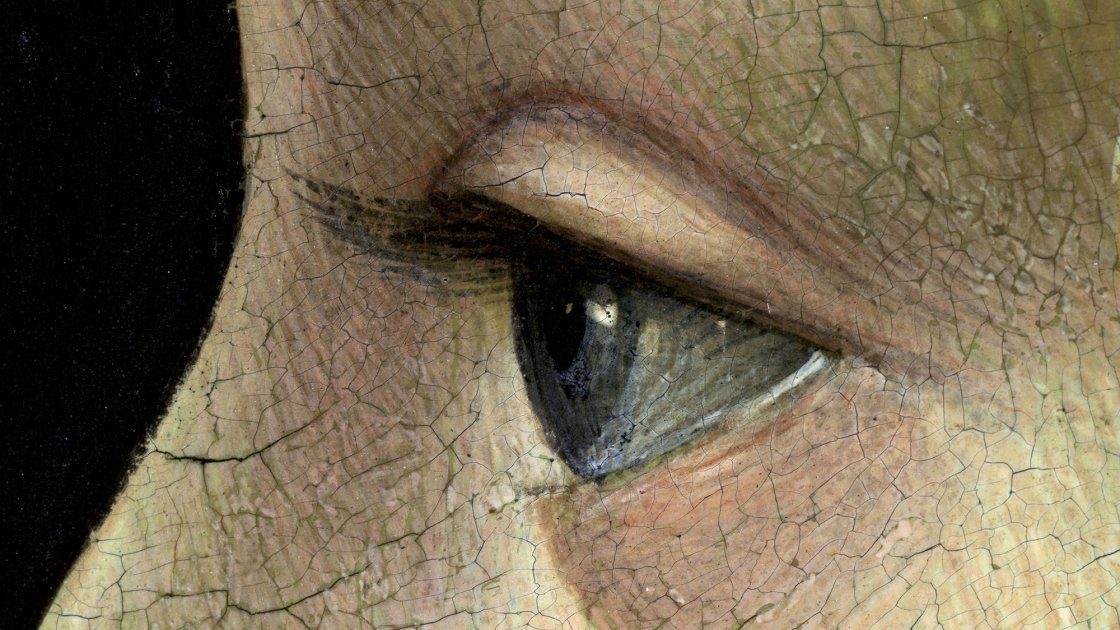
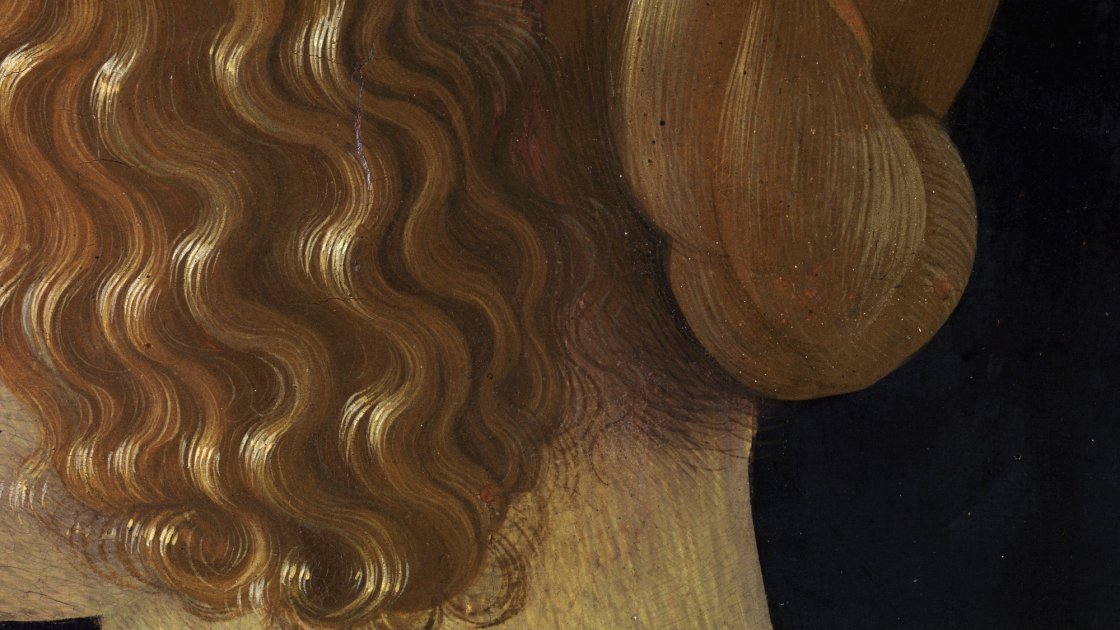
The work was painted using a “mixed technique”, a term which in this case refers to the combined use of tempera grassa and oil paint. Ghirlandaio applied this technique in different ways depending on the area being painted, distributing the same materials in a different order each time.
The figure of Giovanna Tornabuoni was built up from an underdrawing of perfectly defined outlines. The colour palette that Ghirlandaio used in this work is relatively limited; and yet, even with this austere range of colours, he achieved a rich chromatic variety thanks to his perfect mastery of the pictorial materials and brilliant execution.
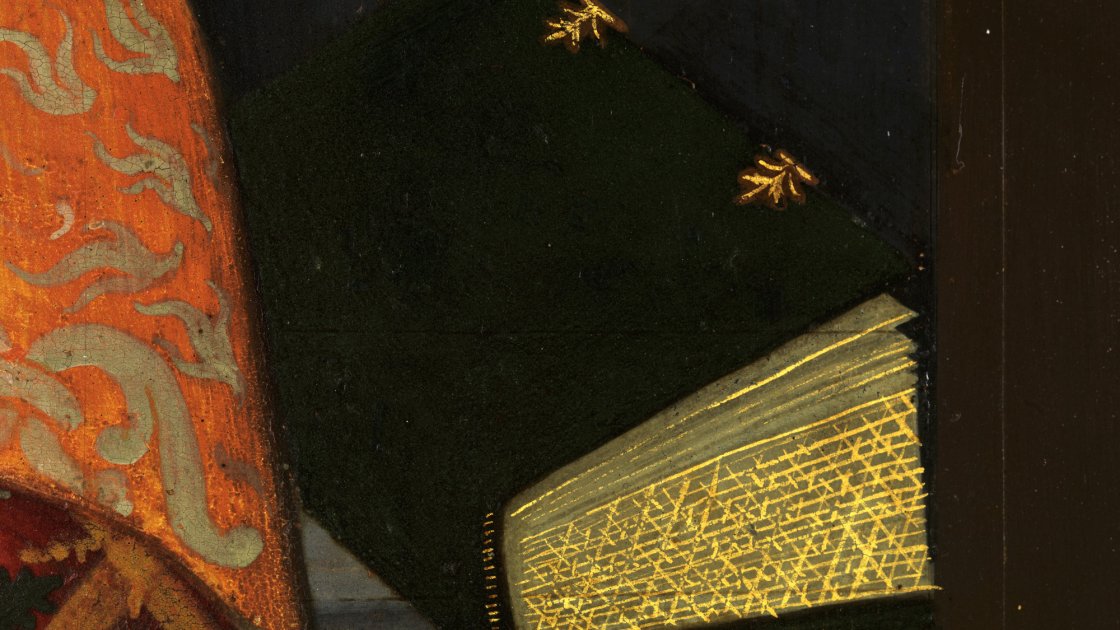
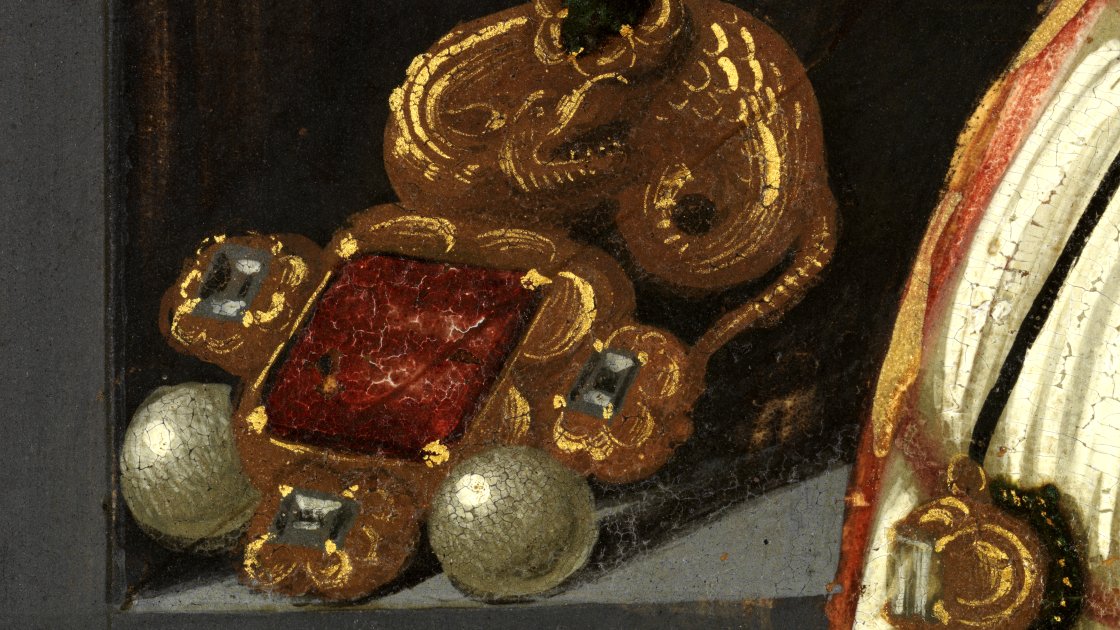
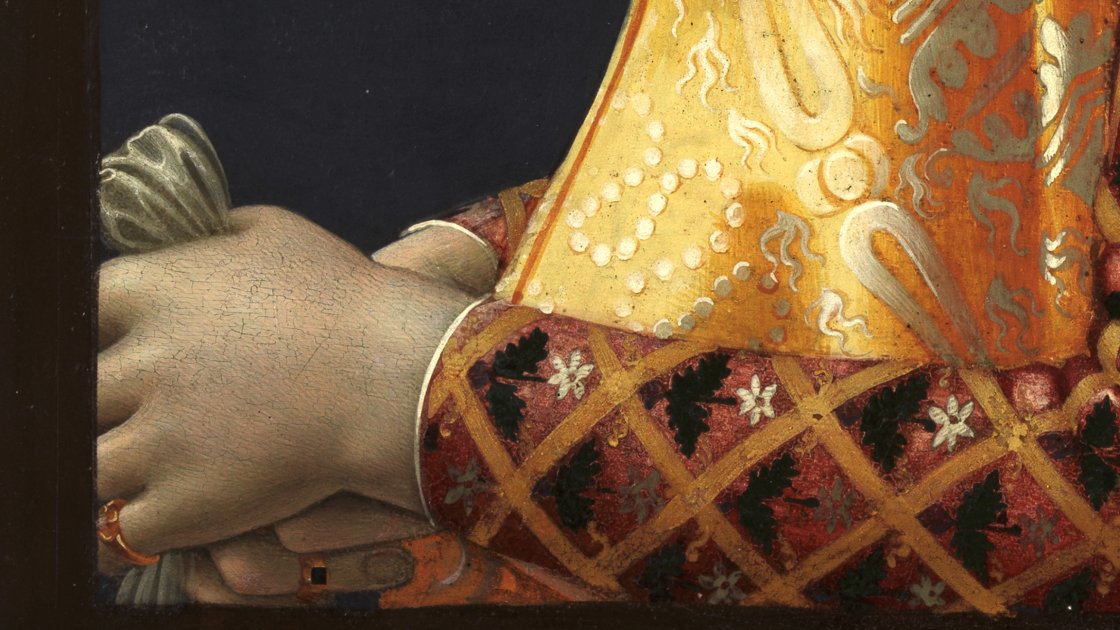
Analysis of materials
The materials analysis was carried out to determine the composition of the original materials used in the painting and how they are distributed in the various layers.
The information obtained from this analysis is useful for understanding the pictorial technique that the artist used and has helped to explain the different transformations that were effected during its execution.
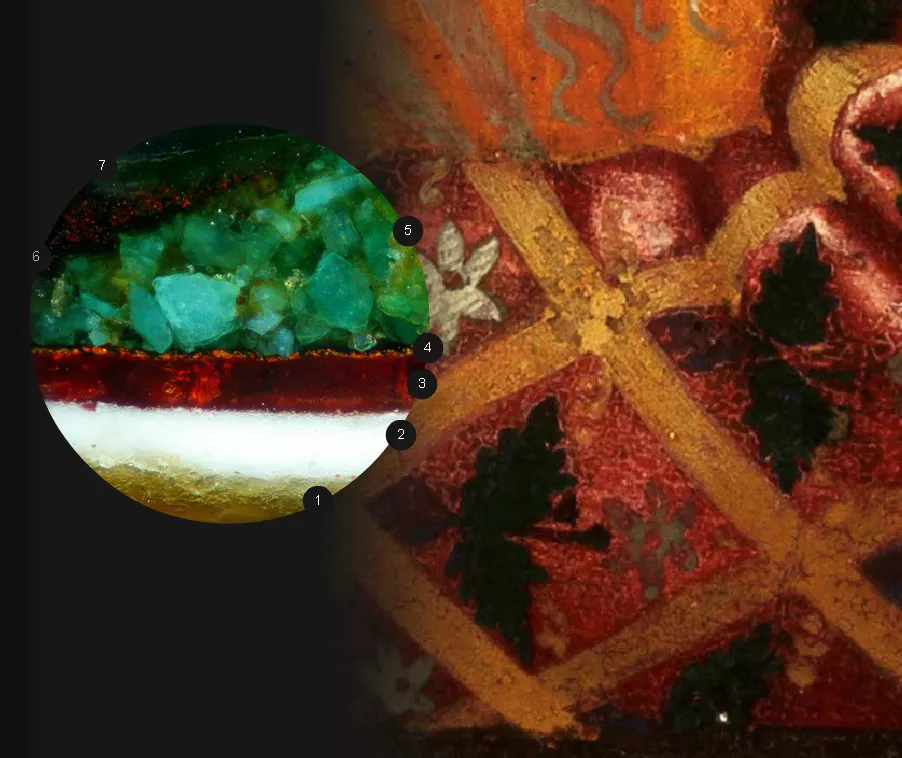
Green decorative elements over the red tones of the dress
The cross-sections of the micro-samples analysed reveal the components of the paints from a perspective that would be impossible outside a properly equipped analysis laboratory.
Each of the micro-samples contains true and reliable evidence of the materials Ghirlandaio used in this work.
Green decorative elements over the red tones of the dress: The superimposition of layers 1 to 4 is the same as the cross-section of the red decorative elements on the dress. A thick coat of obviously hand-ground malachite was applied over the red layer (5) followed by delicate.
X-Ray imaging
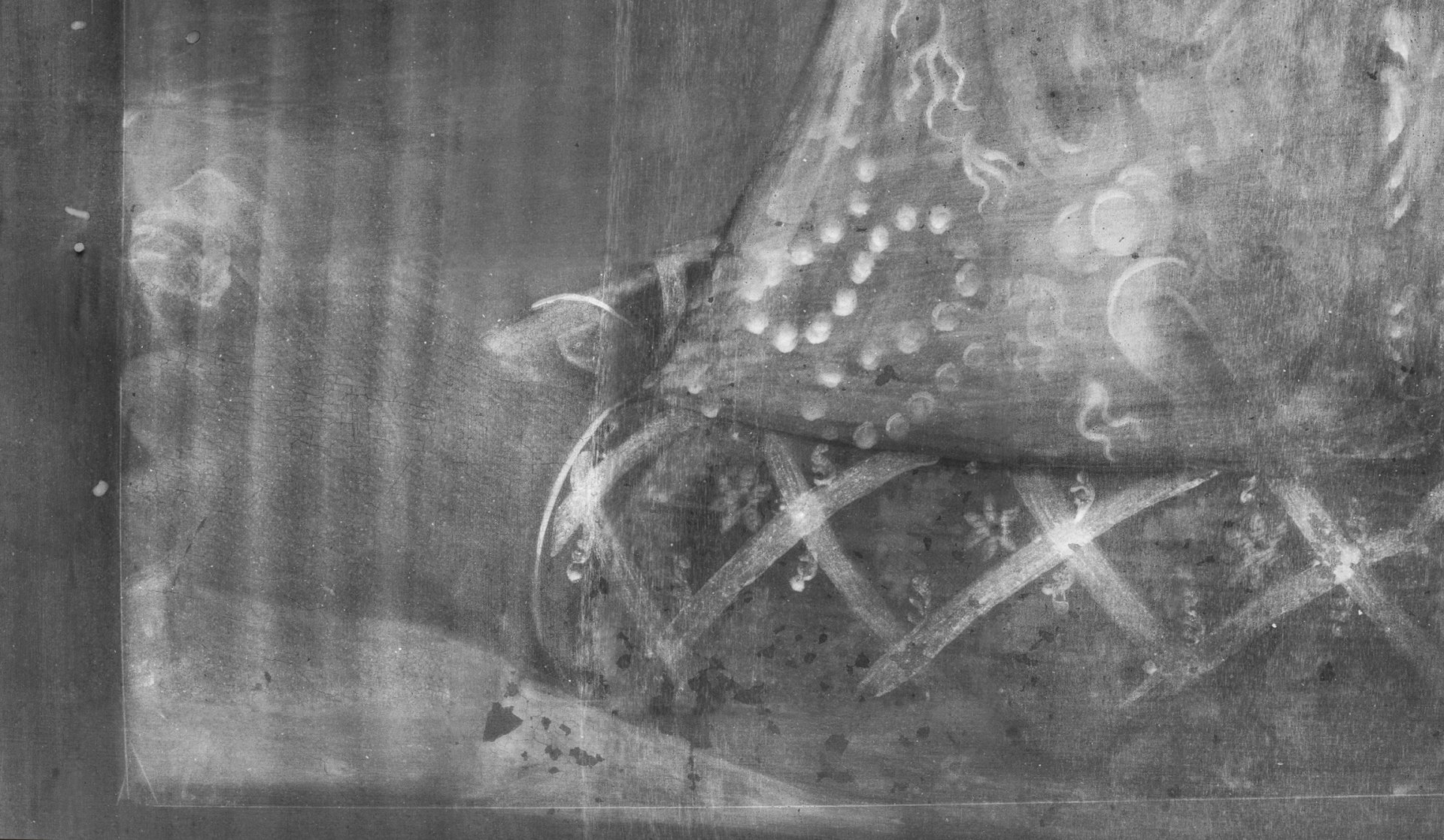
The X-ray shows us all of the layers that make up this work, from the support with its cradle to the last pictorial layer, and provides us with information about its conservation state and the artist’s creative process. A comparison of the X-ray image and the visible image also reveals the changes made to the composition while it was being painted.
The results shown in the X-ray depend on the density and structure of the paint layers. The densest areas with the most paint layers make it difficult for the radiation to penetrate to the photographic plate, which is why the X-ray image is shown in greyish or whitish tones.
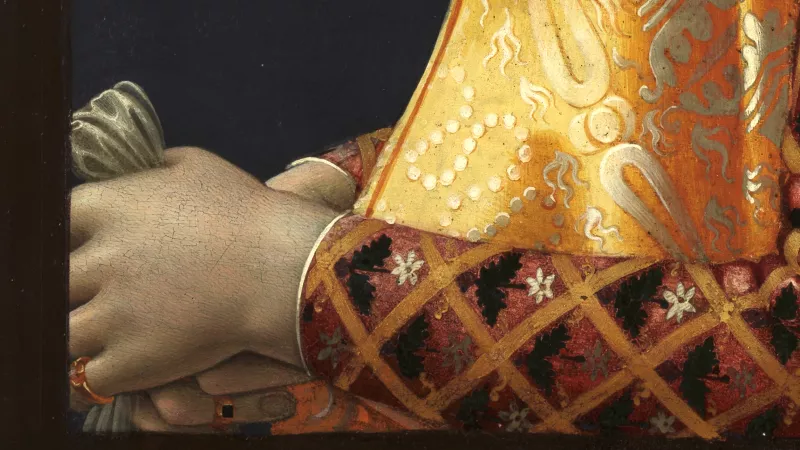
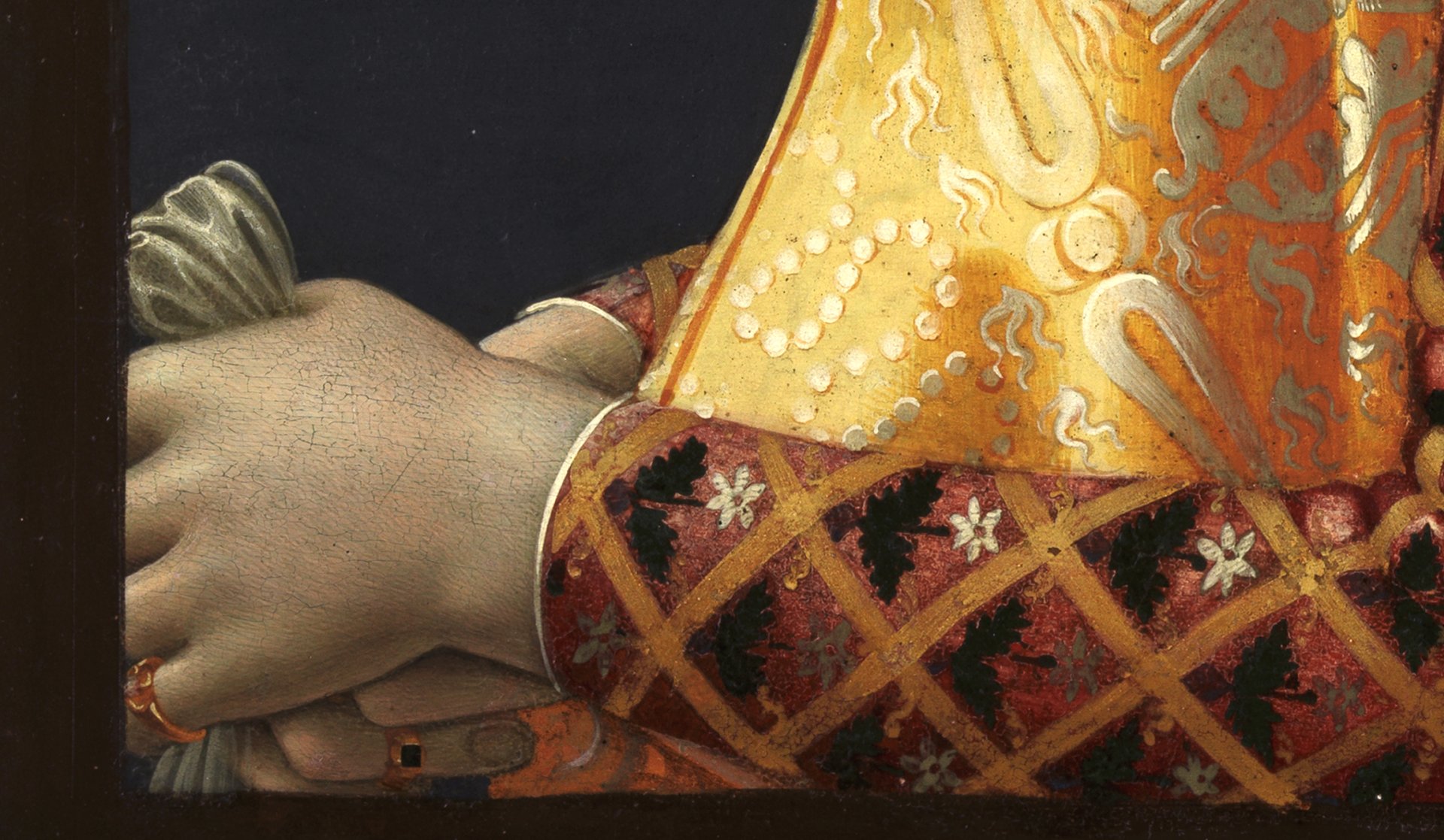
Hands: Ghirlandaio altered the position of the hands at some point during the creative process. The handkerchief clasped in Giovanna’s hands was once larger than it appears in the work today. The artist used white lead as a pigment, which is a very dense material with a high atomic weight that blocks radiation, and consequently this area is shown in whiter tones on the X-ray image.
He also modified the volume of the sleeves, which were widened to adjust them to the final design of the hands. The plant motifs decorating the sleeves were painted with thick brushstrokes, which contrasts with the more delicate strokes used in darker areas where the pictorial material has a lower atomic weight.
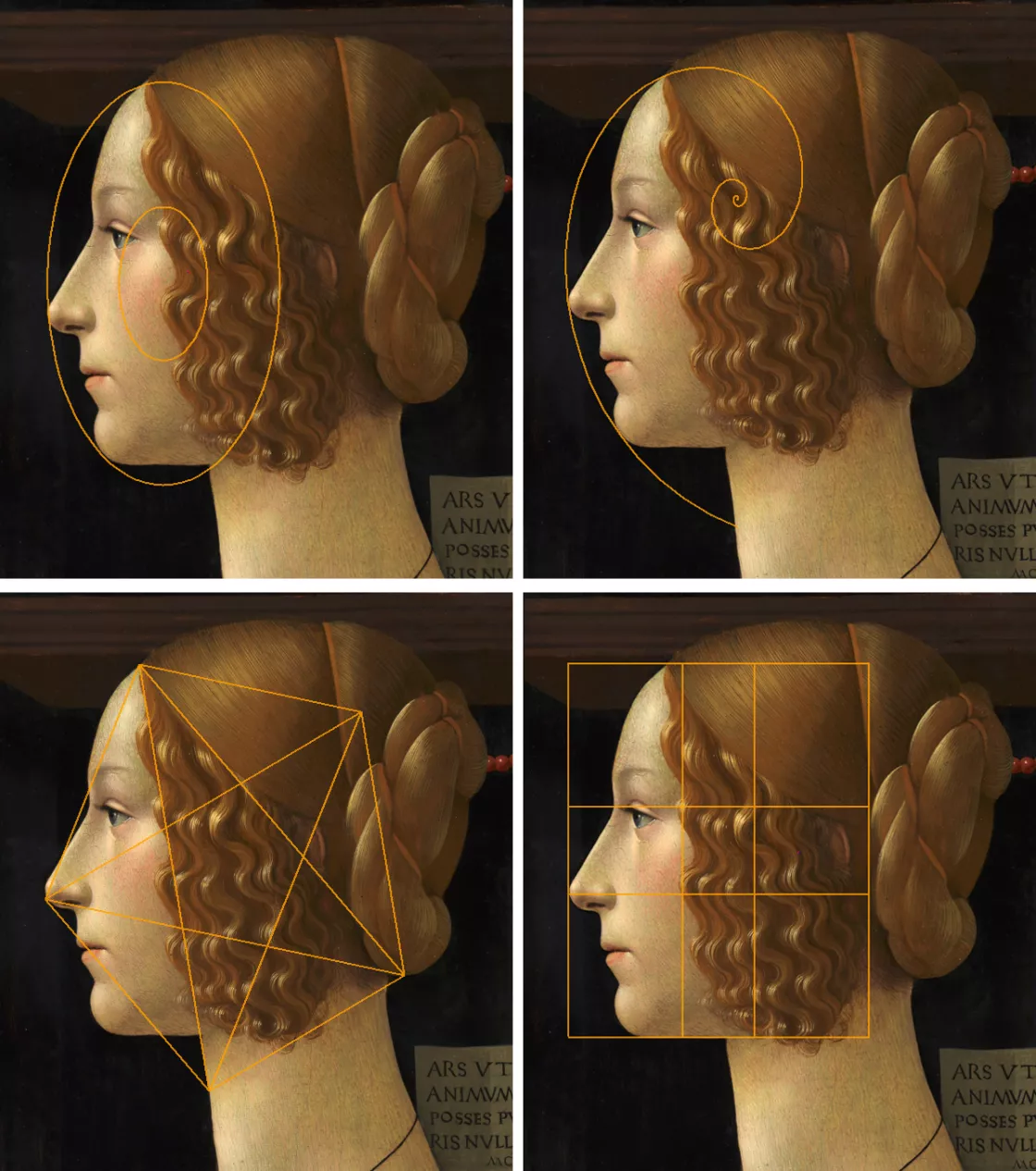
Application of the Golden Ratio
In Greek art, the perfection of forms was the result of numeric proportions. Renaissance artists rediscovered and revived the concept of mathematical precision in the proportions of the human figure used in Ancient Greece.
Mathematical equations were applied to the figure of Giovanna, with interesting results: behind beauty, one always finds a number.
The Golden Ratio was first discovered by the Pythagoreans and later used by artists, philosophers and scientists. During the Renaissance it was known as the Divine Proportion.
When we apply the golden mean to Giovanna’s face, we see how it corresponds perfectly to the pentagonal symmetry. The intersections of the segments are geometrically proportional. The Golden Ratio is present in every geometric object that has pentagonal symmetry.
Objects that follow the infinite succession of the Golden Ratio were defined as “golden” or “divine”.