
Digital exhibition guide
The works presented in this exhibition have one thing in common: none of them depict direct images of war. Although they originate in war, the refusal to depict it emerges as an ethical act, a deliberate withholding. This is a decision not to visualize war, as representation can itself become a way of reiterating its violence.
In 2007, Bernard Blistène and Yann Chateigné presented an exhibition entitled A Theater without Theater at MACBA in Barcelona that made a lasting impression on me. The premise was that theatricality survived after the disappearance of theater itself. Rather than presenting performances as live spectacles, the exhibition examined how modern and contemporary art absorbed and internalized theatrical structures—gesture, staging, presence, and duration—without relying on actors, scripts, or stages. But it is not only contemporary performance art that absorbs and digests the classical language of theater, regenerating its energy within exhibition spaces—the film practice of Roman Khimei and Yarema Malashchuk also requires theater being alive in order to depict events that cannot be recounted directly.
Pedagogies of War proposes that a conflict stripped of its own spectacle is one that insists on being known through a visual and theatrical language shaped by art. Indeed, art serves as a means of expression capable of rendering aspects of war that are fundamental to understanding its effect on every aspect of life. Visual practices and literature have created the largest collection of images and detailed descriptions of devastation, death, and sorrow. By reconfiguring the compositions of historical paintings and films, the work of art creates new ways of seeing.
Bertolt Brecht reflected a great deal about war during and after World War II, drawing an important distinction between Erlebnis and Erfahrung. Erlebnis is the immediate experience: intense, emotional, and unfiltered; Erfahrung is what comes later, when that encounter has been processed, reflected on, and transformed into something comprehensible. According to Brecht, art cannot truly reproduce what war feels like while it is happening. Instead, it creates distance and time for reflection, helping experience to become knowledge. The result is not a direct depiction of war, but an understanding of how it has been endured and repeated over time.
The works in this exhibition reflect on the ways in which artistic practice contributes to shaping a mode of inhabiting the world from within the protected space that art provides. The question of the function of images—at a moment when they can be generated artificially and endlessly, often without any specific documentary or artistic purpose—is therefore more than justified. One possible answer to this lies in affirming that certain images, produced in a context of war and in relation to situations of violence yet without illustrating or explicitly representing them, participate in a form of inner reconstruction. These images foster a necessary slowness, enabling a deeper and more reflective understanding of war; one that resists spectacle.
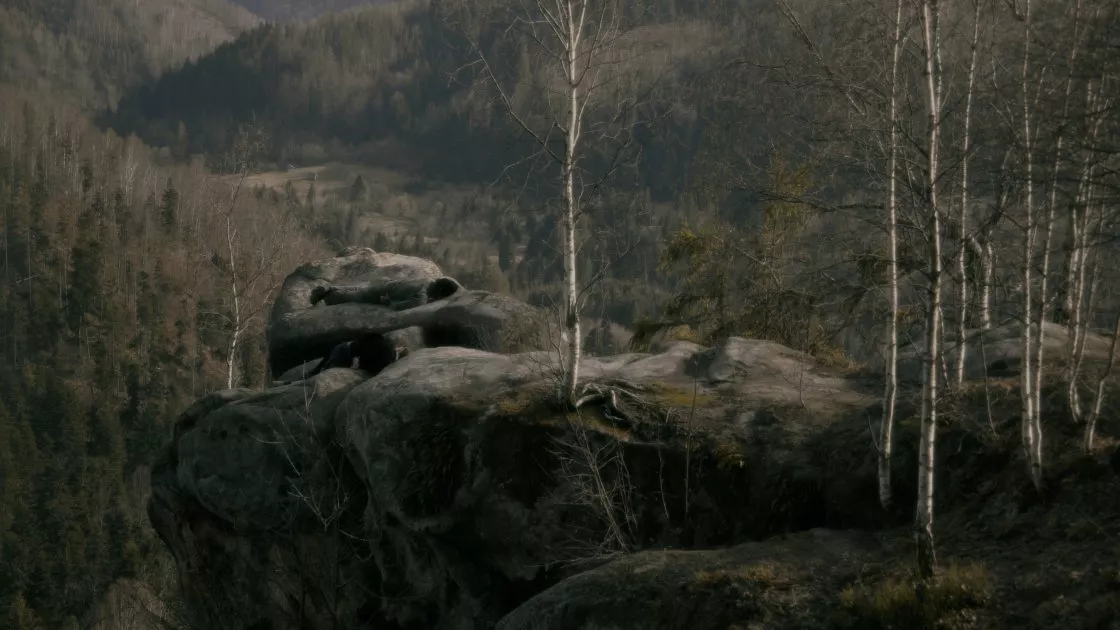
The exhibition opens with The Wanderer (2022), which is in the TBA21 Collection. Produced shortly after the beginning of Russia’s full-scale invasion of Ukraine, the work is set across five screens depicting scenes in the Carpathian Mountains. It depicts the bodies of deceased Russian soldiers within landscapes altered by occupation, using Malashchuk and Khimei’s bodies as stand-ins. Drawing inspiration from Caspar David Friedrich’s Wanderer above the Sea of Fog (ca. 1817) and the artwork If I Were a German (1994) by the Ukrainian collective Fast Reaction Group, the film challenges Western perspectives on war while deconstructing the romantic notion of death as sublime. By situating the fallen soldiers within this visual tradition, the artists reveal the landscape as a site of domination and identify the Russian army as a contemporary colonizing force. In doing so, the work confronts the rupture that war inflicts on both culture and territory.
Wanderer above the Sea of Fog emerges from a Europe that was deeply affected by the horrors of the Napoleonic Wars. Although the painting depicts neither soldiers nor weapons, it belongs to a world that has just experienced massive political upheaval, territorial reorganization, and collective trauma. Now that the war is over, the distance and uncertainty embodied by the fog remain, yet the elevated viewpoint assures visibility and possibility. In The Wanderer, the timeless and neutral landscape of the Romantic painting becomes a space where personal and collective interpretations of war, power, and memory collide.
The second artwork in the show, Open World (2025), is a film co-produced by TBA21 for the 36th Ljubljana Biennale of Graphic Arts. Centered on a young Ukrainian boy displaced by war, it traces his journey as he learns to operate a remote military-grade robotic dog to return to his old neighborhood and visit his family and friends. In video games, “open world” refers to a design in which players can freely explore a large virtual environment with fewer constraints than in linear games. Players can choose how and when to approach goals, often without strict mission order. In this case, the player is a boy who wants to return home. The robot, which resembles a dog, becomes one when it enters the boy’s mother’s house or greets children and neighbors on the boy’s behalf. Rather than theorizing video games, the film uses their logic as a lens through which to explore war, simulation, and power structures. Yet the artists have made a radical reversal: war can be mediated like a game, but in their creations bodies are fully present and able to convey their emotions and joy at seeing a loved one through a military robot. When they look at the robot, military infrastructure stops being war technology and becomes a mediator of feelings of exile and the deep sadness of family separation.
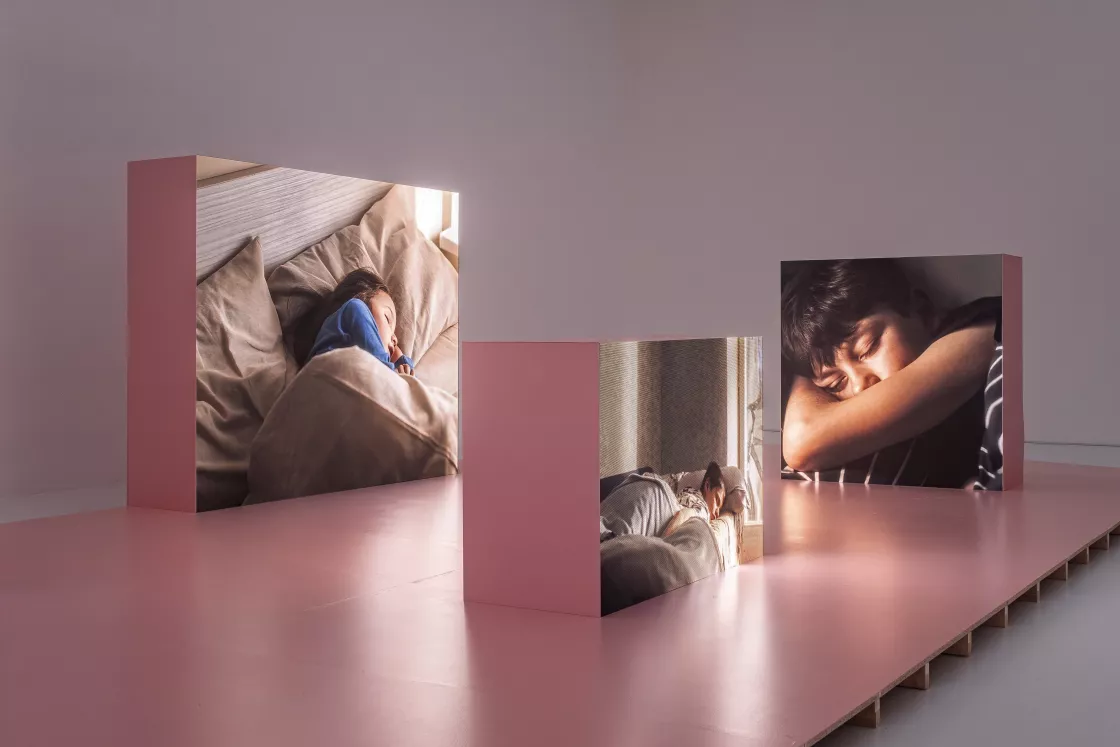
The last and largest room of the exhibition evokes a theatrical atmosphere. In this space, viewers encounter the film installations You Shouldn’t Have to See This (2024) and We Didn’t Start this War (2026). The first is a silent six-channel video installation where the artists confront the uneasy threshold between witnessing and voyeurism by depicting sleeping Ukrainian children who were forcibly taken to Russia and later returned. The work presents images that serve both as evidence of atrocity and as intimate, vulnerable scenes that resist spectacle. By withholding sound and dramatic cues, the installation prompts reflection on the meaning of looking at images of violence that do not announce themselves as such, and on how attention itself can become an ethical terrain.
Throughout the history of art, sleep has often been depicted as a liminal space between life and death, as well as an act of endurance—something that, at least consciously, escapes the present moment. Andy Warhol’s film Sleep (1963) shows the poet John Giorno sleeping for over five hours, turning the act of sleeping into an endurance test and an object of observation. Goya’s etching The Sleep of Reason Produces Monsters (1799) depicts the sleeping artist surrounded by a swarm of owls and bats erupting from the darkness, and a wide-eyed, alert feline in the foreground intensifies the sense of watchfulness. You Shouldn’t Have to See This, refers to the Ukrainian children who were forcibly taken from occupied territories and transferred to Russia since the full-scale invasion began in February 2022. Only a small number of those children have been returned to Ukraine thus far, while many remain in Russia or in Russian-controlled areas with little reliable information about their whereabouts or wellbeing.
The mesmerizing and peaceful image of sleeping children reveals violence not through visible pain or ruins, but through absence and uncertainty. The camera allows itself to move closer to the dormant figures in a manner reminiscent of the licenses taken by the media in the name of the historical documentation of war. We are brought so dangerously close to these children that it feels as though a single misstep, or even a slight movement made by us in the exhibition space, in the room we share with them, might wake them. All of us—the spectators, the witnesses—are confronted here with violence not as an event, but as a condition; one that speaks of aftermaths and lingering wounds that images themselves cannot fully reach or represent.
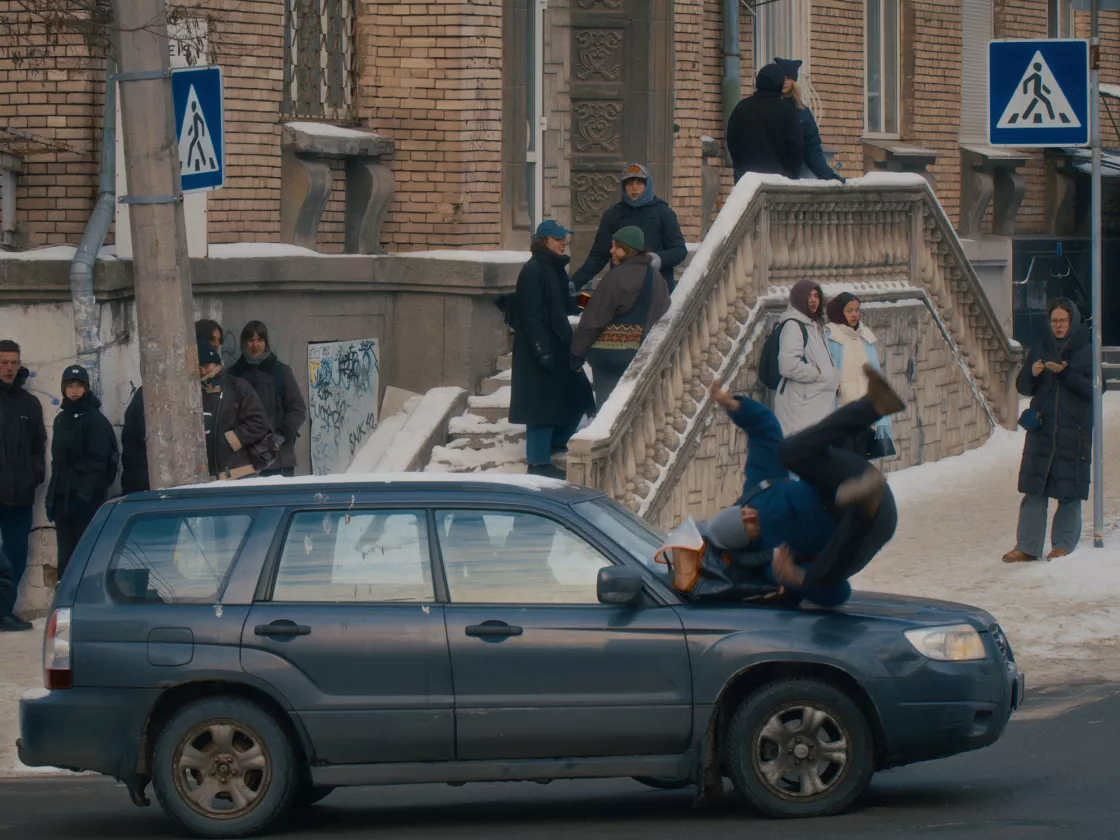
In the same room, the last work on view in the exhibition is We Didn’t Start this War (2026), a new commission produced for the Museo Nacional Thyssen-Bornemisza. Its title repeats a sentence that emerged after the beginning of the war like a mantra, expressing how ordinary Ukrainians—civilians, families, children—neither chose, provoked, nor consented to this war. The work takes the form of a triptych. In the center is a group of some dozen young people standing on the steps to and in the vicinity of a public building, a school or library. They are engaged in conversation, perhaps having just emerged from an event, or perhaps simply killing time before class. In front of them is a road with a pedestrian crossing clearly visible. To the right, a man sleeps on a folding chair during an outdoor nap as a bee hovers insistently around his face. Nearby, a man approaches a window and appears to strike up a conversation with someone inside the house. His gestures and words do not seem to disturb the old man. For a moment we hesitate, unsure whether the sleeper is truly asleep or absorbed in some other state of being. The ground is icy and snowy in all three videos, so we assume that the scenes are unfolding simultaneously in a neighborhood in Kyiv.
On the left-hand screen, the street is a place of constant comings and goings: a man slips and performs an improvised balancing act to avoid falling; another turns his mobile phone in different directions, searching for reception; a group of young people slide on the same ice. The scene repeats itself, this time with a collective character, as they help one another keep their balance and stay upright. Suddenly, someone seems to ignore something—a cyclist? a car?—and a collision takes place. At the same time, on the left screen, a man loses his footing. In a tenth of a second, two events unfold—two accidents—one individual in nature, the other on a small collective scale. Energy and attention concentrate for a moment on what just happened, on that which we witness yet can do little to affect. It does not seem serious. The situation resolves itself. Life resumes as normal, everything continues.
Paradoxical as it may seem, the presence of war within a society—the greatest disaster imaginable, generated by human action—does not preclude the existence of thousands of other disasters, accidents, and misfortunes that dramatically, and in many cases irreversibly, alter the course of individual lives lived in wartime. This paradox has long fascinated artists, who have observed how scenes in the grand genres—such as history painting, which depicts battles or treaties—so often forget the ongoing miseries that unfold in synchrony with those monumental moments. Look no further than the works of Hieronymus Bosch—The Garden of Earthly Delights (1490-1500), The Haywain Triptych (1512-1515), The Ship of Fools (ca. 1475-1500)—where something very particular, and strikingly similar to what occurs in this triptych, takes place: countless figures act oblivious or indifferent to the horrors, sins, and punishments around them. A bee in winter? One just landed in the mouth of the sleeping old man, in that glacial, frozen world.
Chus Martínez.
Roman Khimei and Yarema Malashchuk
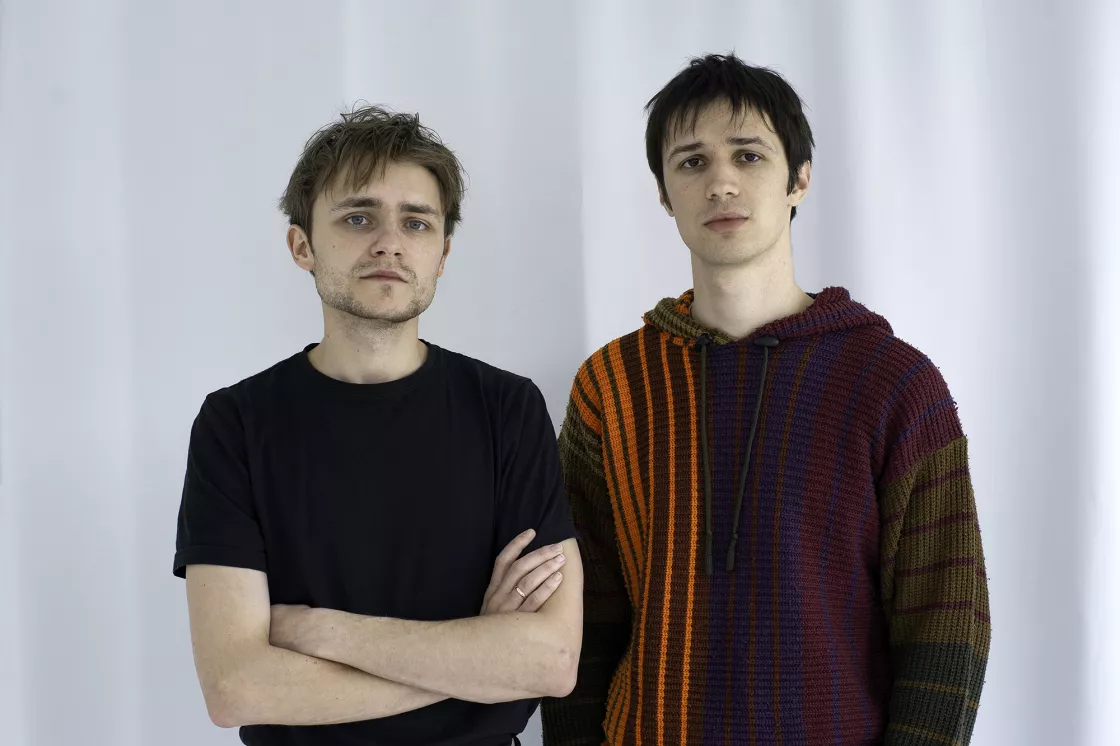
Yarema Malashchuk (Ukraine, 1993) and Roman Khimei (Ukraine, 1992) are an artistic duo who have been working as filmmakers and visual artists since 2016. Working at the intersection of documentary and fiction, their practice engages with Ukraine’s recent history as well as the present conditions of its society and ecosystems. Through multi-channel video installations that combine cinematic narratives with technological mediation, they examine the lingering frameworks of post-imperial power and their impact on a generation caught between historical trauma and an uncertain future. Rather than treating war as an exceptional event, Malashchuk and Khimei conceive it as a persistent force shaping bodies, territories, and regimes of knowledge. In this sense, their moving images do not simply illustrate war; building on a shift toward a more pedagogical and embodied aesthetic, they teach us to understand war as a structural condition.
Khimei and Malashchuk have received major recognition for their work, including the PinchukArtCentre Prize (2020), the VISIO Young Talent Acquisition Prize (2021), the Ukrainian Film Critics Award Kinokolo (2024), the Tallinn Black Nights Film Festival Award (2024), and the Curatorial Prize at OFFSCREEN Paris (2025). Their work has been featured in major international exhibitions, including the Future Generation Art Prize 2021, Baltic Triennial 14, Gothenburg Biennial, the 60th Venice Biennale, and Kyiv Biennial, as well as group shows at Haus der Kunst, Castello di Rivoli, and Albertinum. They have had solo exhibitions at Kunstverein Hannover and Galeria Arsenał, Białystok, among others.
Their video works are included in prominent collections, including Fondazione In Between Art Film, Kunstmuseum Liechtenstein, Kontakt, TBA21 Thyssen-Bornemisza Art Contemporary, Frac Bretagne, Museum of Contemporary Art Kiasma, M HKA Museum of Contemporary Art Antwerp, and Ukrainian Museum of Contemporary Art.
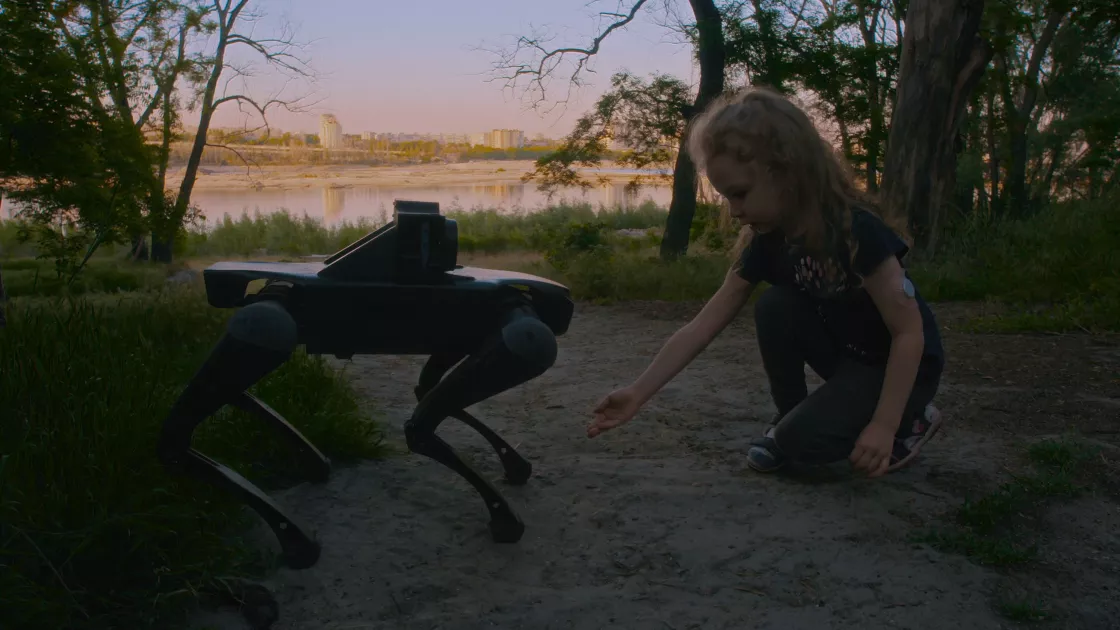
Open World, 2025
Three years after the full-scale Russian invasion of Ukraine, a young boy who fled the country returns to his old neighborhood using a military-grade robotic dog as a remote presence device. From abroad, and through the eyes and body of the animal-like machine, he navigates the streets he grew up in; reconnects with family, friends, and neighbors who remained in the city; and encounters the traces of a life left behind, bearing witness to the persistence of everyday life amid devastation. Straddling video-game streaming and documentary, the video installation engages with the realities of youth displacement and the consequences of war experienced remotely. By transforming a device originally designed for warfare and destruction into a tool for connection, the artists reflect on how technological mediation shapes exile, memory, and relationships. At the same time, they reveal the lasting effects of war on individuals and the precarious possibilities for building community in the diaspora.
Situated within a lineage of video-based works that examine the visual regimes of war, Open World questions what it means to return when return is no longer possible. The installation invites reflection on resilience and on the fragile acts of remembering and maintaining a sense of belonging across distance.
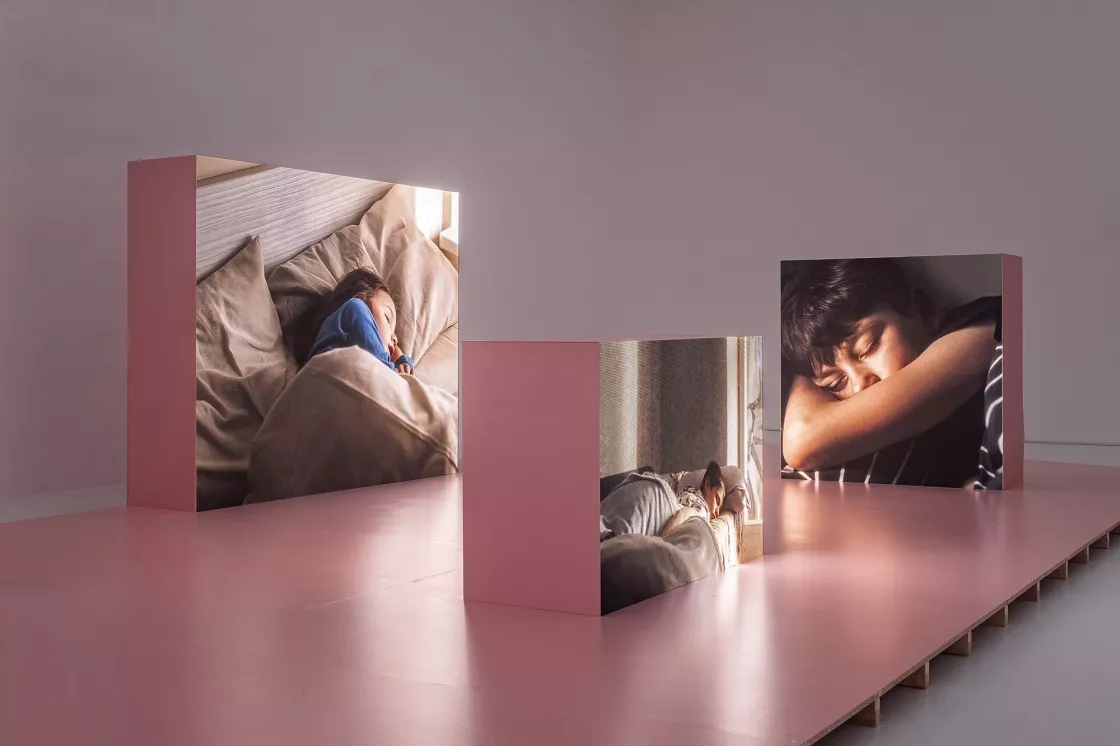
You Shouldn’t Have to See This, 2024
The silence of this video installation emphasizes a blissful yet fragile moment of empathy evoked by the sight of sleeping children, but the act of watching them can, at the same time, trigger a feeling of unease. For the production of this work, Roman Khimei and Yarema Malashchuk filmed Ukrainian children who were forcibly taken into Russian territory and later returned to Ukraine. The estimated numbers of children abducted like this span from 20,000 to over a million cases since the beginning of the Russo-Ukrainian war in 2014. While drawing attention to this heinous war crime, the artists offer a compelling account of childhood under the conditions of the ongoing war.
By deliberately transgressing the limits of privacy and crossing the delicate line between a loving gaze and voyeurism, Khimei and Malashchuk question how the architectures of media shape our sense of the real; how we perceive what is shown and what is withheld. These moving images are first and foremost evidence of a crime, and only potentially a work of art, one that should never have existed. Because of the elegance and aestheticized nature of these scenes, the viewer may experience a momentary sense of relief or involvement; however, their presence in the public sphere serves as vital testimony, carrying both political significance and moral imperative.
The installation situates the viewer within the complex terrain of witnessing, a space where empathy, responsibility, and reflection converge. It challenges us to confront the ethical and political dimensions of looking from a critical lens, revealing how images of conflict shape our understanding of war.
The Wanderer, 2022
Filmed shortly after the beginning of the Russian invasion and failed annexation of Ukraine, the artists work in this piece with staged cinematic images that place their own bodies in the rocky landscape of the Carpathians Mountains, recreating the postures of fallen Russian soldiers.
The project refers to a work by the Ukrainian artist group Fast Reaction Group (Sergiy Bratkov, Boris and Vita Mikhailov, as well as Sergiy Solonsky), whose photographic series If I Were a German (1994) re-enacted the actions of German soldiers during the occupation of Kharkiv in World War II. With this work, Khimei and Malashchuk question the German and Western view of the Russian war in Ukraine and, at the same time, allude to the contemporary practices of war photography.
The film’s title and the steady flow of its sequences of images refer to the celebrated Romantic painting The Wanderer above the Sea of Fog (ca. 1817) by Caspar David Friedrich and the colonial approach to the landscape. Faced with the genuine horrors of war, the artists criticize the romantic imagery of death as something sublime. In this context, the fallen Russian soldiers are cast as contemporary colonizers of Ukraine in an act of symbolic revenge which breaks the taboo associated with showing the bodies of the dead.
We Didn’t Start this War, 2026
We Didn’t Start this War explores the daily realities of life under a state of war and the complex entanglements it creates. The title echoes a mantra invoked by Ukrainians in the wake of the Russian invasion, asserting their refusal of the conflict. This belief clashes with the direct consequences of war endured by civilians haunted by the proximity of tension. The work dwells precisely in this tension, existing on the fine, almost imperceptible line between war and its absence.
Though conceived in the context of a war, the images in this triptych do not depict violent representations of the conflict. Instead, the screens show the result of a sustained attention to a routine that has nearly disappeared for Ukrainian society: everyday life unfolding without visible catastrophe. In the central scene, a group gathers on the steps of a public building, engaged in conversation. To the right, an elderly man sleeps on a folding chair outdoors, as a bee hovers insistently around his face, while another man speaks through a window. On the left-hand screen, the icy streets also present in the other two screens become a stage for small accidents, both individual and collective, as people slip, balance, and collide, capturing others’ attention momentarily before life resumes its ordinary flow. Within a social reality shaped by the constant threat of violence, the possibility of representing ordinary situations—where the greatest tension is a minor accident that is resolved without tragedy—signals a fragile and largely imaginary return to normality.
This video installation is shown as part of an exhibition about war, where viewers might expect images of suffering or explicit violence. Instead, it offers an ironic and provocative perspective on war’s impact and presence. It represents violence not as a monumental event but as a condition whose effects are measured not only in visible devastation, but also in the altered meaning of everyday life.