
LGTBIQ+


Two Adoring Angels
The ideals of the Christian West are all founded on the primacy of the intelligible, ethereal, Apollonian and spiritual over the sensible, material, Dionysian and corporeal. ‘Enlightenment’, ‘elevation’ and ‘spiritualisation’ are the main metaphors through which theoretical, moral and aesthetic ideals have been conceived.
Consequently, beauty required the erasure of anything lewd, viscous or carnal from bodies, as well as all signs of reproduction, gestation and fertility, and anything associated with procreation and sexuality. This did not just apply to manifestations of femininity: signs of virility also had to be suppressed in order to attain that almost fleshless and always sexless ideal.
As a result, a markedly androgynous, ambiguous and equivocal ideal of beauty emerged, giving rise to a problematic relationship with the normative: real bodies had to be gendered. All of them without exception. But not ideals – or not to the same extent, at least. Sexuality was always considered abject and had to be concealed: the good kind (genital and reproductive) almost as much as the bad kind. Love was a matter for souls, or so the story went (and so it was, at least in that respect) – souls without sex or gender (though, deep down they were masculine).
The scene depicts a pair of angels in adoration. Their beauty dazzles us – or that is the idea. They are the second most exalted object of love imaginable. The first is, of course, God, whom they worship together – a shared passion that intensely unites them, placing them no more than one step away from the purely spiritual; no more than one step but no less either, because there is a corporeal element in their union – at the very least a fraternal bond. The pair of angels have bodies; and thanks to this, they are not one: they do not have the same character, nor do they relate to the other figures in the same way. The difference is undoubtedly subtle, but it is discernible in the direction of their gazes – the least material of the senses.
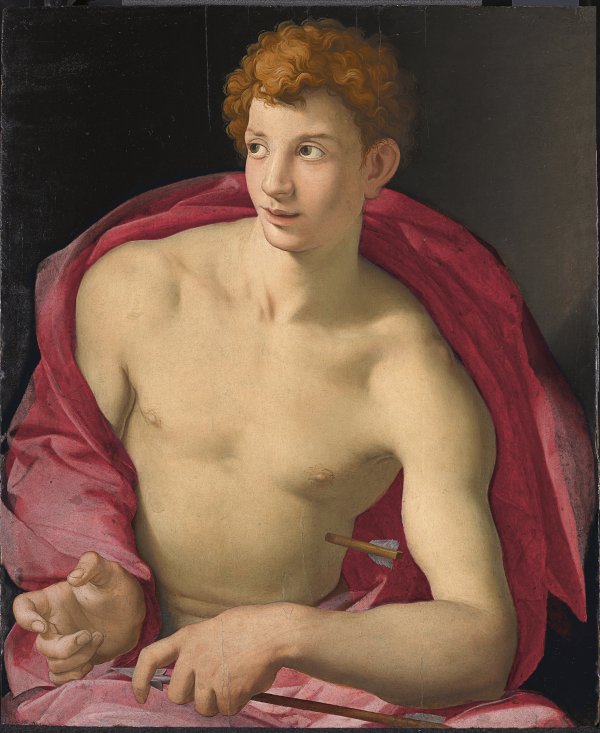
Portrait of a young Man as Saint Sebastian
Saint Sebastian has been venerated by the gay community ever since Oscar Wilde declared his admiration for his beauty. But that was merely a small step in a long history. For Wilde to be able to take it, the bearded, mature, fully clothed military tribune – always depicted with a halo – had to give way to a beautiful ephebe who was increasingly scantily dressed and often lacked a halo of sanctity.
The Saint Sebastians by Andrea Mantegna and Antonio and Piero del Pollaiuolo marked significant turning points in this lengthy process. Bronzino’s picture adds a further layer of complexity: rather than depicting the saint's martyrdom, it is a portrait of a young man who, in a sense, is searching and finds himself in the image of Saint Sebastian that was beginning to emerge in Florence.
To what extent is the image sacred and to what extent is it profane? To what extent is the young man motivated by religious devotion and to what extent by erotic identification? And what about Bronzino? And us, the viewers? What pleasures does the painting evoke? That of identifying with the saint’s selflessness? Or the closeness of the beauty of his body? How are these pleasures modulated by each viewer’s faith or their appreciation of male beauty? And what about the arrows? To what extent do they represent the plague from which the saint protects us, and to what extent the weapons with which Cupid pierces us? Why is it not enough for the play of identities to depict him caressing one with his hand? What would the painting lose if there were no arrow piercing his side?
Fortunately, none of these questions has a single, fixed answer: every interpretation leaves its own small mark on the history of meaning. But one thing is certain: our perspective today would be far more limited without the long history of underground cultures that needed points of reference and sought them out or invented, discovered and created them, or found them legitimised as religious themes and accordingly viewed or produced them as legitimate objects of love or identity. This is how the intense and pulsating historical depth which is ours today was built up layer by layer, with every gaze and every brushstroke. That which belongs to us all.
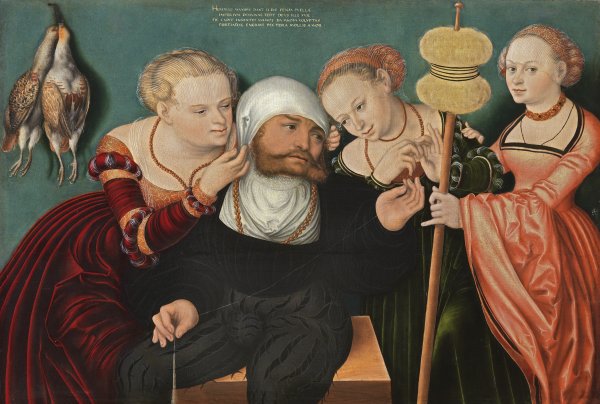
Hercules at the Court of Omphale
Hercules is no ordinary hero. His colossal strength, vigour and audacity make him a symbol of masculine values. No mere mortal could aspire to embody them so solidly. Yet is it not striking how little it takes to shatter that solidity?
In this scene, Hercules is not threatened by ferocious lions, hydras, bulls, wild boars, three-bodied giants or three-headed guardians of the underworld. He is undoubtedly threatened by something deeply unsettling, but it turns out to be nothing more than clothes, ornaments, light tasks and glances that are ultimately tender. Nothing in his body appears to be suffering physical harm or injury, yet the bravest of heroes is cowering.
What is this profound quality that has been defeated, and how is it possible that it has been vanquished by such gentle means? An identity, a rule, a sign, an idea… nothing more and nothing less. At Omphale’s court, the outward signs of his masculinity have been stripped away. His muscles, which are almost always visible, are covered by women’s clothing, and the tasks assigned to him on this occasion are of the most mundane kind; spinning may be fundamental to the reproduction of life, but it is a far cry from what we associate with a masculine epic.
With this alone, something vast has been so thoroughly subverted that the hero does not dare to return our gaze: we can look at him; the maidens look at him; the maidens can look at us and we at them… but Hercules – Hercules, no less – has been defeated to his very core by a simple shift in symbols, with no need for jaws, horns or weapons.
Masculinity, which seemed so solid and essential, proves to be so vulnerable that, even in its most steadfast form, it is destabilised by a simple change in attire, tasks, gestures and gazes.
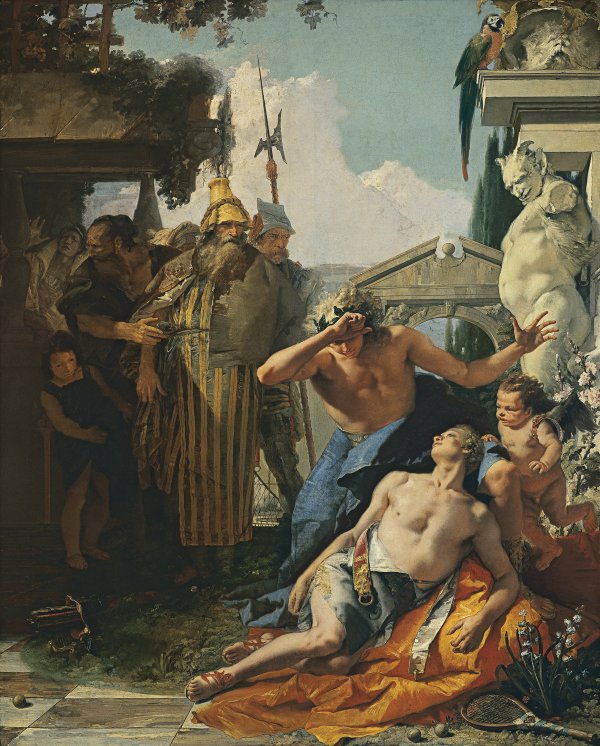
The Death of Hyacinthus
The homoerotic reference in the work could not be more explicit: along with the episode of Jupiter and Ganymede, the love affair between the god Apollo and the mortal Hyacinthus is the most celebrated love story between men on Olympus. Apollo, the sun god, fell madly in love with the young Spartan prince and, to cap it all, his feelings were reciprocated. However, following a fatal accident – or, depending on the account, a crime committed by Zephyr, consumed by jealousy – Hyacinth was mortally wounded. Despite all his attempts, Apollo was unable to bring him back to life. Being Jupiter’s favourite son is not enough to grant your lover the same immortality that your father bestowed on his own.
The work was commissioned by the young Count of Schaumburg-Lippe, whose lover – a Spanish musician with whom he had shared more than just a passionate affair while living in Venice – had recently died. And, to dispel any doubt that the myth only concerns ancient gods, Tiepolo has replaced the classical discs with the racket-and-ball game that was so popular in his day.
This took place at a time when homosexuality was strictly prohibited. Granted, by comparison Venice was more permissive than other Italian cities of the time, but, at least on paper, sodomy remained a capital offence – albeit ‘softened’, in that those found guilty were supposed to be beheaded before being burned. It is also true that the severity of the prescribed penalties contrasted with the rarity of prosecutions and that, in most cases, the death penalty was replaced by other types of punishment such as imprisonment, exile or galley slavery.
In any case, although criminal proceedings were rare, it is easy to imagine the stigma and social censure that would have been attached to anyone who might be accused. Such relationships were best kept hidden, out of sight and out of mind. To understand the importance of art’s ability to grant a glimmer of light and presence to what had no right to exist elsewhere, it is sufficient to imagine the suffocating sense of isolation people must have felt in such a situation.
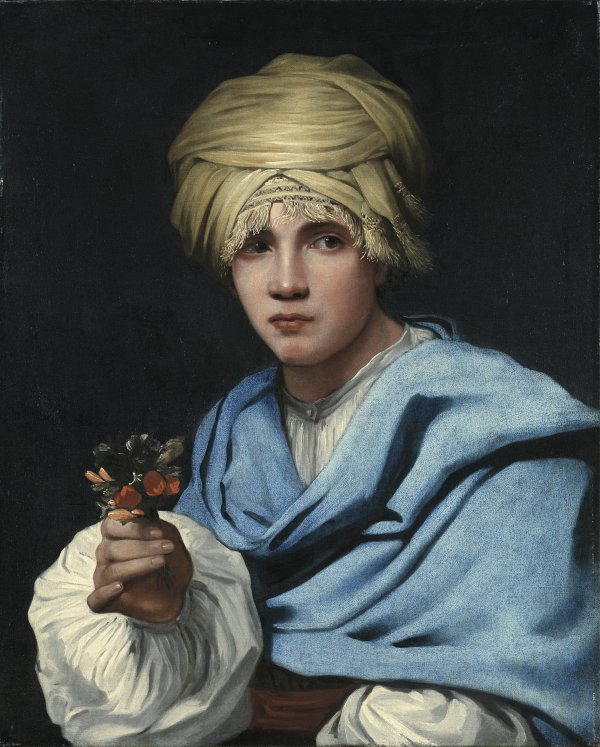
Boy in a Turban holding a Nosegay
Sweerts’s life story is as enigmatic and ambiguous as the boy’s gaze. We know only a few things for certain about his life: in Rome, he settled in the neighbourhood every city has to accommodate those who do not fit in anywhere else (beggars, prostitutes, foreigners…), but he was also made a cavaliere by Pope Innocent X, whose nephew he worked for. We know that he ended his life at a Jesuit mission in India, after Bishop François Pallu deemed his behaviour unsuitable for the mission he was leading to China.
Nor do we know much about the boy with the turban and the bouquet of flowers. He does not quite seem to come from this part of the world – where we do not wear turbans. If he did, it would not be easy to gaze at him in the way Sweerts does, and we do too. Nor is he quite a man: to begin with, because he is still almost a boy, although his senses are already beginning to awaken in a new way, starting with the most sensual and least civilised of the five – the sense of smell. Another reason he is not quite a man is that everything about him is feminine: his delicate hands, silky-smooth skin, fine features, gentle gestures and melancholic gaze. Despite all this, he is not a woman either, and he will never know – because his blush prevents him from finding out – whether men gaze at him in the same way they do at women.
Yet nothing is strictly sexual in Sweerts’s visual laboratory. In that liminal space from which he observes, things exist first and foremost to be contemplated and so that, as they are contemplated, new layers of beauty emerge. For example, in the way men look at male beauty: how men look at naked men to learn how to paint them; how they look at naked men bathing; how they look at naked men wrestling; how they look at other men dressing and undressing…
There has been much speculation about how much Sweerts’s work owes to his possible homosexuality, but perhaps it is more interesting to ask the opposite question: how much the contemporary homosexual way of looking owes to Sweerts’s work.

Portrait of Madame Bouret as Diana
Every civilisation has a place where the meaning police lower their guard, enabling people to be a little freer. In eighteenth-century Europe, that place was classical mythology. Its stories, allegories, symbols, devices and settings broadened the limits of what was possible. It boasted an almost infinite wardrobe, as if it were a grand theatre, allowing people to assume identities not tolerated outside it.
In this peculiar paradise, Diana and her attributes represented independent femininity, not subject to the power of men. Diana is the virgin goddess who rejects marriage and male desire. She and her nymphs live in the woods, hunting and sleeping together in self-sufficient female communities. What needs do we humans have? Food, shelter, safety, affection, care, sex, fun, play, understanding and conversation…? Whatever they may be, Diana and the nymphs demonstrate that these needs can be fulfilled in all-female groups, without relying on men for any of them.
In everyday life, possessing any one of these traits alone would have attracted heavy social stigma. It would have been scandalous for the wife of a financier like Étienne-Michel Bouret to appear in any other setting displaying the traits of an active personality and a desirable yet unavailable body. She is armed for hunting with a bow and arrows that grant her power (absolute power) over the bodies upon which she fixes her gaze – she or the community she forms together with her nymphs, whose absence is as visible as anything else present in the painting.
None of that is acceptable for a lady. But Diana is a goddess and, through her attributes, she conveys an astonishing power: the ability to render visible truths which reality denies. Such is the magic of the gods, and such is the magic of art.

Mary Magdalen conforted by Angels
In terms of concept, things tend to be quite clear-cut: it is one thing to be a man and quite another to be a woman; one thing is the flesh and another is the soul, the material and the spiritual; one thing is suffering and another is eroticism… But the body is not as straightforward as the concept. Much less so the Baroque body. And even less so the Baroque body painted by Sebastiano Ricci.
The suffering of Mary Magdalene, a figure strongly associated with the sins of the flesh, is spiritual, yet it is felt in every fibre of her body. The painting is pierced from end to end, as if struck by lightning, by a pain that originates in the soul but causes the whole body to hurt. And that solace for the soul, insofar as it is possible, can only be provided by an intensely sensitive, affectionate and loving community of angels whose love becomes tangible in the contact between bodies, whether through caresses or glances as physical as embraces.
The erotic community that comforts and supports the Magdalen is undoubtedly strange. It is an emotional community whose workings are not easy to fathom. A vast range of feelings permeates the composition: sympathy, compassion, hope, sorrow, pain, curiosity, tenderness, trust and unease. All these feelings are present in the painting, in each character as befits their nature. Yet at no single point does anything take shape with the simplicity of the concept: without mixtures, compositions or ambiguities.
This emotional community is also strange in terms of gender. To see this for yourself, simply carry out the following exercise: find the most masculine hand, the most masculine arm, the most masculine neck, the most masculine face and the most masculine foot in the whole composition. Then assign a gender to each figure and you will see the painting’s surprising twist.
The bodies and emotions depicted in the work are undoubtedly unusual. However irritating the ambiguity may be to the concept though, who, when suffering as the Magdalen does, would not wish to be comforted by such a loving community?

Misia Godebska
Contemporary homosexual figures would not be what they are today without Misia Godebska.
Above all, Misia has gone down in history for the number of male artists who created works for, about or inspired by her: the paintings by Toulouse-Lautrec, Renoir, Vuillard, Vallotton and Bonnard – such as this one – as well as Ravel’s musical compositions and Proust’s literary characters.
However, remembering her in this way does not do her justice. Misia was much more than just a muse in Belle Époque Paris. She was a queen, almost a goddess, who managed to create the world she wanted and needed around her. It was a world far bigger than the one she found, big enough to encompass at the very least the powerfully compelling persona she had created for herself and everything that she or her persona deemed beautiful.
Her salons were something of a laboratory for the era, for life itself and, in that regard, for art. Conversely, as is always the case with such places, they were hotbeds of artistic creation where, thanks to that, the most unexpected forms of life, friendship, pleasure and love flourished. In her love and sexual life, she embraced forms for which ‘polyamory’ or ‘pansexuality’ proved to be overly simplistic conceptual labels. She also enthusiastically supported artistic expressions of sexual non-conformity, such as Serge Diaghilev’s Ballets Russes.
Misia aspired to create a persona who was not just a ‘case’ but got to set the rules. She was not just a muse; she was the arbiter of her era’s tastes. Her actions and choices were not easy to challenge because they could not be measured by any standards other than her own.
With all the theatricality and self-awareness that Pierre Bonnard expresses here in her doll-like face, Misia knew that she embodied the spirit and essence of an entire era, which all artists needed to capture in order to transcend Paris and time.
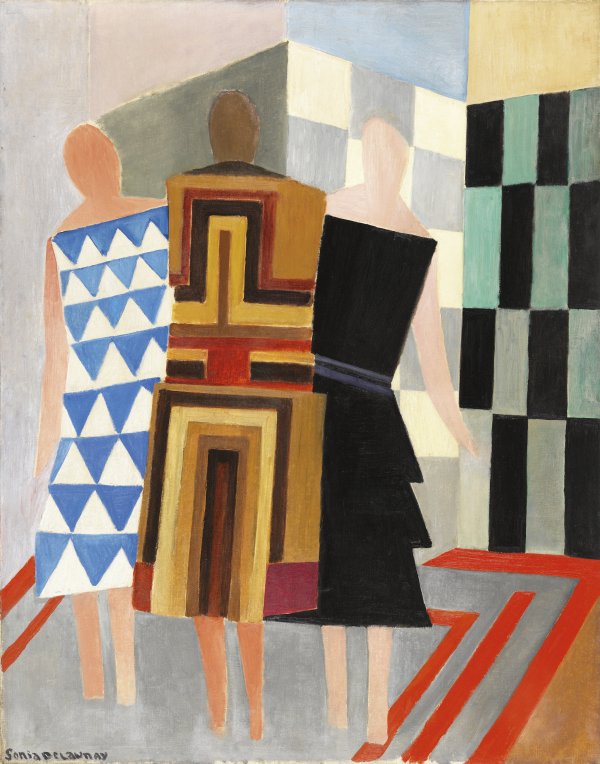
Simultaneous Dresses (Three Women, Forms, Colours)
Sonia Delaunay was one of the most important figures in the development of textiles in art during the early decades of the twentieth century. A proponent of the idea that applied arts should be considered on an equal footing with the fine arts, she championed the concept of the ‘total work of art’ and incorporated it into many of her designs.
A good example is her ‘simultaneous dresses’, works in which she sought to combine fashion, art and the avant-garde. Some of these dresses were created as fashion designs for performers, such as Gloria Swanson (in this work, for example, the pattern of the central figure is taken from a coat that Delaunay designed for the actress).
Linked to Simultanism, a movement she associated with modern life and urban development – particularly the city of Paris – Sonia Delaunay designed her simultaneous dresses for the modern Parisian woman. In many ways, this icon of the new woman transcended the traditional ideal of femininity and the established sexual and gender norms. The French term used to describe this new icon (garçonne) in itself alludes to a far more androgynous concept, breaking away from the strict gender ideals imposed on women.
Fashion played a key role in the emergence of these new ideals, through an aesthetic that constituted a cultural, social and political revolution. Sonia Delaunay’s Simultaneous Dresses can be considered part of this revolution. Accordingly, fashion and design can be viewed as spaces for a radical political imagination where new counter-hegemonic identities were shaped in opposition to the social consensus. The fact that many of these designs were subsequently produced in dresses worn by Parisian women makes the performative aspect of the body and identity much more explicit.

Formation.Tri-partition
Formation. Tri-partition is linked to the world of the Triadic Ballet, in which the artist sought to bring his research into the relationship between the body and space to the stage as part of his geometric analysis of the human form. Conceiving of ballet as a total work of art, and situating this entire body of work within the context of the Bauhaus – with which he was associated – Schlemmer idealises the human figure in this painting through these geometric forms and shows it divided into three figures, which together form a single whole.
This geometrisation enables us to interpret an idealised yet denaturalised body: the body is not presented as something organic or natural, but as a constructed structure. From a queer perspective, drawing on key figures such as J. Butler, the body has been understood as having this performative and staged dimension. However, Schlemmer’s figures remind us that this dimension operates within all human bodies. Furthermore, the division of the figure into three also recalls one of the main contributions of queer theory to the study of identities: subjects are not unitary, but multiple, partial and fragmentary.
When we further consider that these three bodies – which are one – are positioned as part of a choreographed performance, it becomes much clearer how identities are always articulated in relation to space. Here, dance is the performative ritual that we enact daily to establish our existence as individuals within society. From a queer perspective, it is also interesting to see how Schlemmer’s figurative idealisation of bodies ultimately results in human figures that, in their idealisation, barely resemble humans. This is similar to how the ideal gender categories imposed on us end up being unattainable for anyone.
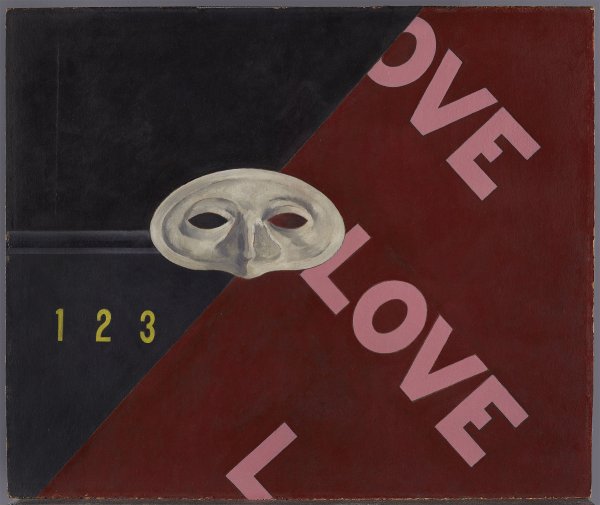
Love, Love, Love. Homage to Gertrude Stein
The work belongs to a series of nine portraits created by Charles Demuth as a tribute to other artists he was friends with (such as Georgia O’Keeffe and Wallace Stevens). All the portraits in the series are symbolic: in them, the artist portrays the person using words or objects that reflect something of their identity, thereby challenging the traditional canon of portraiture. In this piece, dedicated to the modernist writer Gertrude Stein, the word ‘LOVE’ appears three times, possibly alluding to her preference for the number three in her writings.
Gertrude Stein was a prominent figure in the intellectual and artistic circles of early-twentieth-century avant-garde Paris. She lived openly as a lesbian with Alice B. Toklas, her lover and lifelong partner. Their home hosted gatherings of artists of the time, and they collected and promoted avant-garde art of the period, many of whose practitioners were their friends. Both can be regarded as icons of lesbian Paris of the early 1900s.
The writer portrayed these romantic relationships between women in her autobiographical work Q.E.D. (Things as They Are). This is probably the origin of the word ‘LOVE’ that appears in the portrait. Like his friend Stein, the artist Charles Demuth was also gay and openly depicted homoerotic themes in many of his works, such as those featuring public baths (Turkish Bath with Self-Portrait, 1918) or sailors in erotic poses. Both artists moved in the same circles as Marsden Hartley, whose work influenced Demuth’s symbolic portraits. In these, themes such as identity and emotion were encoded through certain objects (an example of this can be seen in Hartley’s Portrait of a German Officer). Stein, Demuth and Hartley all lent visibility to the existence of lives on the margins of heteronormativity, offering narratives that had previously been absent from the dominant mindsets.
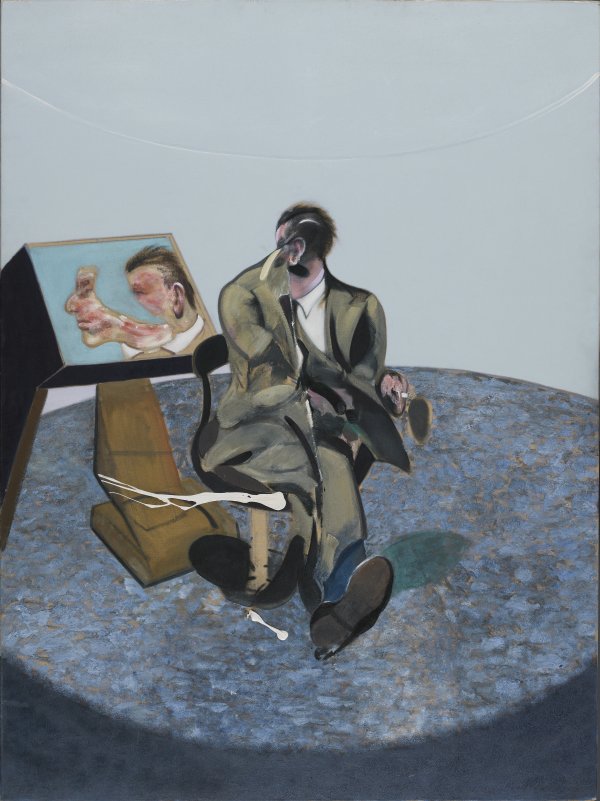
Portrait of George Dyer in a Mirror
Dorian Gray himself was astonished by the superficial psychology that conceives of the ‘self’ as a simple, permanent and reliable entity with a single essence. In reality, we are all composed of myriad lives and faces that interweave in sinuous ways through the eyes that perceive us. In lives that conform to the norm (where compatibility between gazes is more or less guaranteed), a curious mirage nevertheless arises: identity is not viewed as a complex combination of that kaleidoscope of images; instead, these images are often seen simply as a reflection of a single, unchanging and true ‘self’.
However, it is not that simple if you hate your father yet feel sexually attracted to him as a child. He has his stable lads whip you to correct your effeminacy, and with them the fragile boundary between pain and pleasure is blown to smithereens, as is the solid hierarchy of class and power. Gender boundaries dissolve as you try on your mother’s knickers in front of the mirror. For this, you are thrown out of the house so that you can become a ‘real man’. Instead, you end up in Sodom-like Berlin and enter into tortuous relationships with older men. Eventually, you become an admired painter and a member of the European intellectual elite. You fall in love with George Dyer, a young delinquent who has been in and out of prison for as long as anyone can remember and is a tough guy. He is illiterate, athletic, violent and an alcoholic. He is also financially dependent, vulnerable and insecure, yet elegant and resolute when smoking in a suit. He is held in very low regard in Bacon’s circles, which coexist, juxtaposed, with his own circles of London criminals and outcasts, about whom we know far less.
Francis Bacon painted more than 40 portraits of his lover and model. In this important portrait, George Dyer is gazing at a mirror which, as it is facing us, allows us to see him reflected in an almost naturalistic way, albeit split as if by a bolt of lightning. In any case, Bacon makes it clear that we are not simply looking at a mirror reflecting reality, but at an oil painting that he created. What he could not know is how we are looking at it – we who are standing in front of the painting right now (and perhaps, who knows, becoming an image within another network of meaning at this very moment).

Caffè Greco
In 1976, Renato Guttuso painted this interior of Rome’s legendary Caffè Greco, which has been open since 1760, as a bustling, almost snapshot-like scene bringing together people from different eras. He depicted historical figures who were regulars at the café – such as Buffalo Bill and Giorgio de Chirico, to whom the work is dedicated – alongside anonymous people, tourists, and couples, evoking both the café’s cultural past and a contemporary perspective. This work is a huge preparatory cartoon for a larger painting on canvas housed in Cologne.
Among the diverse characters portrayed, in the right-hand corner we see what appears to be a lesbian couple, judging by the openly affectionate way they interact. This depiction, which is natural and unremarkable within the café scene recreated by the work, is unusual in artistic tradition. Although they are just two women in the crowd filling the scene, their presence suggests a fracture in the dominant visual narrative present in the historical record of art.
As an audience, what do we look at when we observe a work of art? In whom do we seek ourselves or see ourselves reflected? Who do we look for in the works? When our identities do not align with what we see and we cannot find ourselves as a possibility of existence in the works of art that fill the museums, what other narratives do we imagine about what we are seeing? Guttuso’s intention may have been simply to recreate the relaxed atmosphere of a historic café in Rome, and to bring it into the present day. Yet this small act gives many of us who look at the works and have never found ourselves represented in them a sense of existence.
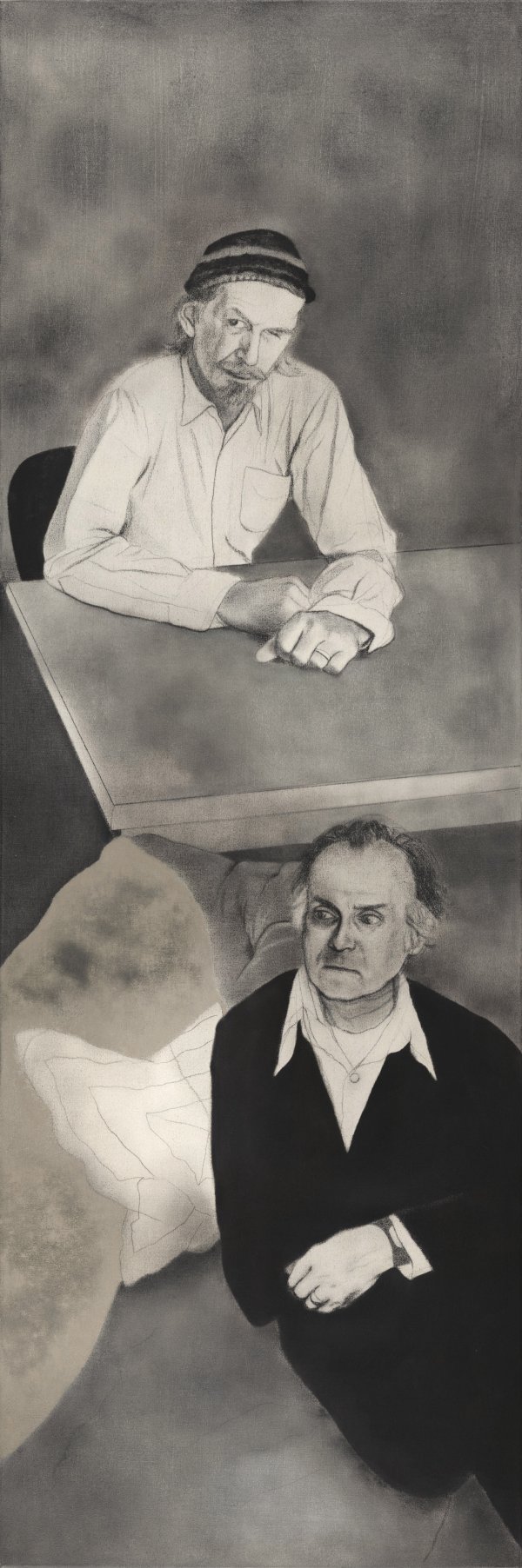
A Visit to London (Robert Creeley and Robert Duncan)
In this work, the artist Ronald B. Kitaj portrays two of his friends, the American poets Robert Creeley and Robert Duncan, who were associated with the Black Mountain College group. The portrait, painted from life when the pair visited his London home, forms part of a series of large-format, elongated works on canvas that the artist began creating in the 1970s. As in most of his portraits, he focused on artists, writers and intellectuals of the time.
Creeley and Duncan were close friends, a relationship reflected in their own poetic works, such as the poem Duncan dedicated to Creeley (‘Thank You for the Love’). Robert Duncan was openly gay and a champion of civil rights for homosexual people. Both were part of the San Francisco Renaissance scene. Their friendship with Kitaj introduced the artist to the intellectual circles in both San Francisco and New York.
Michel Foucault pointed out that one of the most transgressive aspects of gay life was friendships between men. For Foucault, these relationships made possible new ways of life that challenged heteronormativity, not only on an erotic or sexual level, but above all in terms of the emotional and loving bonds that men formed through friendship, which went beyond the affections permitted within the traditional family structure. The fact that Kitaj portrays his two friends – one of whom is, moreover, openly gay – allows us to understand friendship in its political dimension, as a way of being in the world alongside others, breaking with models of hegemonic masculinity based on denying affection, care and bonds.

Nude Turning Into a Dragonfly
In this work, Arthur Boyd depicts the transformation of a naked human body into a dragonfly. There is almost no trace of the humanity of the figure emerging from the leafy depths of the forest; we can just about make out a head, arms and hands, but the focus is on the translucent wings formed from the legs. The translucency of the new body contrasts with the darkness of the wooded background from which the figure emerges, lending the work a dreamlike and enigmatic quality.
This metamorphosis from human to animal can be interpreted as a means of understanding identities through the constant changes and transformations that break down any binary system seeking to fix and stagnate the formation of identities. This human body turning into a dragonfly – an insect associated with the ephemeral and ever-changing – reminds us of the performative nature of bodies which, far from being something fixed and set in stone, are in a state of constant transformation.
The experience of identity as a process and a constant progression towards otherness (which in turn constitutes us) is evident in all queer bodies that disrupt and destabilise the gender norms that underpin human identity. The metamorphosis presented by Boyd can therefore offer an escape from these oppressive structures. The transformation of the human into the non-human, set against the backdrop of a forest landscape, also enables us to envisage a nature that is not viewed through a conservative lens (where the natural is understood as a lost paradise) but rather as a queer potentiality, almost as a futurity – a ‘then’ and a ‘there’, in the words of José Esteban Muñoz – for radical diversity. This challenges binary gender categories and speciesist ones alike.
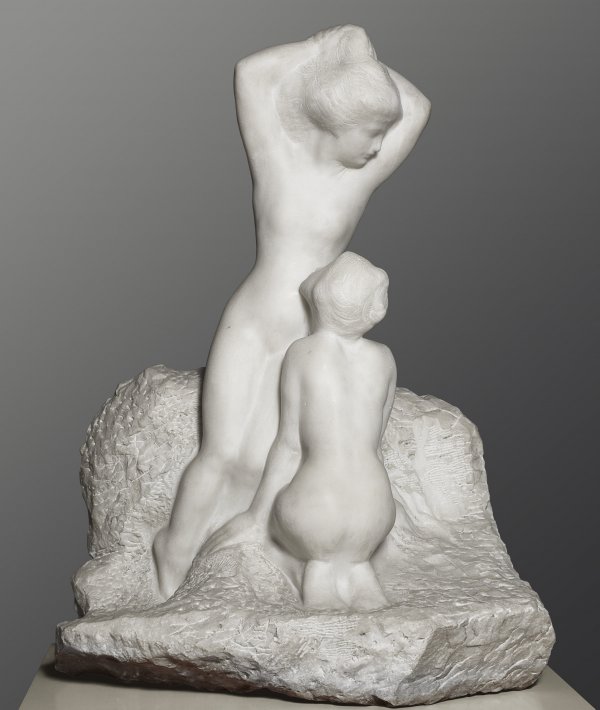
The Birth of Venus (The Aurore)
Venus is emerging from the stone. She is rising and issuing forth at this very moment. As the goddess of love, desire and beauty, we are accustomed to seeing her in her finished, harmonious, perfect and self-contained state. In contrast, Rodin presents us with unfinished bodies – twisted and fragmentary, immersed in the process of seeking the forms, postures, contours and intimate pleasures that suit them best. This process requires trial and error, experimentation, change and movement. After all, that is how the body works.
In depictions of Venus – and, more generally, of beauty – we have tended to celebrate only the finished product, not the process; the defined, not the ambiguous; the complete, not the journey. However, this Venus by Rodin allows us to recognise beauty in places we did not expect: in ambiguity, in exploration and in the process of creating identity and desire from a physicality that is open and rich in possibilities. This makes it possible to celebrate beyond the limitations imposed by an exclusive – and exclusionary – passion for the defined.
In this work, it so happens that the genesis of the piece coincides with the visible result. Venus, before becoming Venus, had been the plaster Headless Female Nude, to which Rodin added the arms and head of the Kneeling Man (Torso), finally transforming his head into a woman’s. And an ancient Sphinx could not help but love her, or at least kiss her. Only the imagination knows how many more lives that plaster piece would have wished to live, how many more identities it would have wished to inhabit and how many more pleasures it would have wished to enjoy, or at least to taste. The ending is open, but thanks to Rodin we know that there are as many as we can imagine.
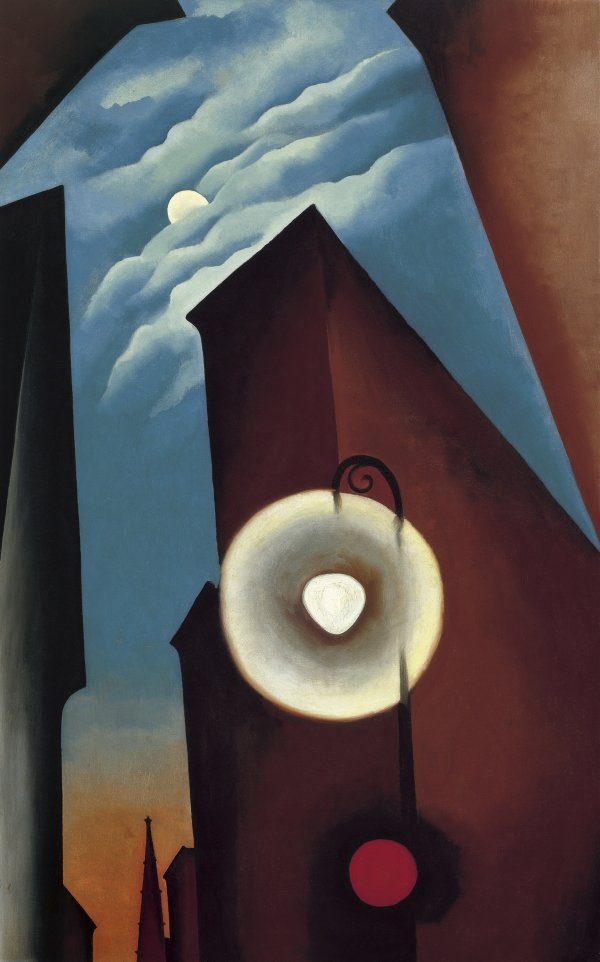
New York Street with Moon
This was Georgia O’Keeffe’s first painting of the urban landscape of New York, a city she admired and would portray in later works. Here, the artist depicts the city at night, illuminated by the moon and a streetlamp. The focus is on a skyscraper, a symbol of urban modernity that was a recurring theme explored by other artists and photographers of the time.
Although O’Keeffe is renowned for her large, extremely close-up depictions of flowers – traditionally associated with femininity – here she tries her hand at a cityscape, a genre that was considered transgressive for a female artist at the time. Indeed, Alfred Stieglitz refused to exhibit this work in 1925, deeming skyscrapers to be too complex a subject even for men.
So, what did the city represent for women, artists or otherwise? And what did the city at night offer them? If those vibrant cities of the 1920s and 1930s offered potential spaces of freedom, anonymity and community to sexual dissidents, who found a place of their own amid the urban noise and darkness, did they also offer freedom to non-heterosexual women? And even to heterosexual women? If O’Keeffe’s flowers readily evoke female eroticism and pleasure, might we offer a queer interpretation of the artist’s nocturnal urban paintings? She, as a bisexual woman, chose to look at the city by night and paint it – in an act of transgression in a male-dominated artistic (and vital) territory – and led us to also turn our gaze towards the nocturnal city and what it may (or may not) offer us. Is this not in itself an invitation to think about the city from a queer perspective and experience?

Smoko. The Human Volcano
Reginald Marsh captures the essence of 1920s and 1930s New York through his portrayal of street life and its many characters: from the unemployed victims of the Great Depression to the crowds flocking to popular venues such as Coney Island. He focuses on forms of entertainment accessible to the working classes, such as burlesque, vaudeville and the circus. In this piece, for instance, Marsh presents us with a crowd strolling along and watching various street performers (a fire-eater, a fortune-teller advertised on one of the stalls and a woman in the centre of the scene, whom we imagine to be part of the show).
These settings, far removed from high culture, provided a space for bodies and identities that deviated from the norm in terms of gender, appearance or ability and found a form of visible existence in the world of entertainment. Although their existence occupied an ambiguous space in which they were both admired and fetishised or categorised and labelled as ‘freaks’, their diverse deviations from the bodily and identity norm were permitted and enjoyed by a public that would probably shun (or even punish) any sign of strangeness or abnormality in their everyday environment.
Although ‘queer’ has always implied a deviation from the norm and an embrace of what society considers abject, Marsh’s scene reminds us that fear of the strange is often intertwined with fascination. These spectacles probably provided an opportunity to enjoy and gaze without fear upon that which was denied by society yet was visible and existed in the realm of popular culture.

The Dying Slave (by Michelangelo)
This piece belongs to a series that Yves Klein began in 1962. In this series he started to intervene on plaster models purchased from the Louvre using his signature shade of International Klein Blue, which he patented in 1957. By doing this, he reappropriated major icons of art history (among the works he altered were other classics such as the Aphrodite of Cnidus or the Winged Victory of Samothrace). By working with reproductions, he stripped them of their originality and exclusivity.
Klein’s Dying Slave by Michelangelo recalls the so-called ‘pathos formula’, which was described by Aby Warburg and analysed by Stephen F. Eisenman in countless works from Antiquity and the Renaissance. The formula refers to an artistic canon that apparently portrayed scenes of tremendous violence, but did so by aestheticising and eroticising that violence. Michelangelo mastered this formula perfectly in many of his works, combining ecstasy and torment and creating an aesthetic interplay of pleasure and violence. The Dying Slave is a prime example of this: in keeping with the idealisation of the body in classical sculpture, it depicts a vigorous, muscular and harmonious male body that appears to be suffering violence (after all, it is a dying body) yet it is portrayed as beautiful and even erotic.
Influenced by prototypical images of the martyrdom of Saint Sebastian, these iconic works by Michelangelo can be interpreted through a homoerotic lens. Here, this supposed hegemonic masculinity is depicted as an erotic and sensual object, despite the fact that the body is, in principle, being subjected to violence. Yves Klein’s reappropriation of this icon, taking it into the realm of copying and reproduction, entails a further step in the popularisation of this classical code of eroticising the male body.

Thank You
In this 1971 painting, Richard Lindner presents us with a hybrid female figure that is part human and part robot. Depicted in bold, monumental forms, she wears a circus tamer’s outfit, a look emphasised by the riding crop she holds.
Her exposed breast reminds us of the Amazons and what they symbolised (female warriors, skilled in the art of combat who lived in matriarchal societies outside patriarchal norms). Together, these elements create a female figure who is strong and empowered not only in her form but through all these elements: the circus tamer’s costume, her hybrid nature with the robotic, and her portrayal as a kind of contemporary Amazon. This breaks with the stereotyping of femininity that has tended to represent women as in need of protection, eroticising their weakness.
In contrast to these visual stereotypes of femininity, Lindner presents a female body whose erotic appeal lies in her strength and robust presence as a dominatrix. This robotic woman, conceived as an Amazon whose strength is celebrated, derives her eroticism from a power that is not concealed but admired. Through his characteristic aesthetic language, which features elements common to many of his works (the colour palette he uses, the pop visual style, geometric forms and typefaces reminiscent of his experience as an illustrator, or the advertising poster aesthetic), the women the artist creates embody everything that has been excluded from traditional femininity. Their appeal lies precisely in that transgression.